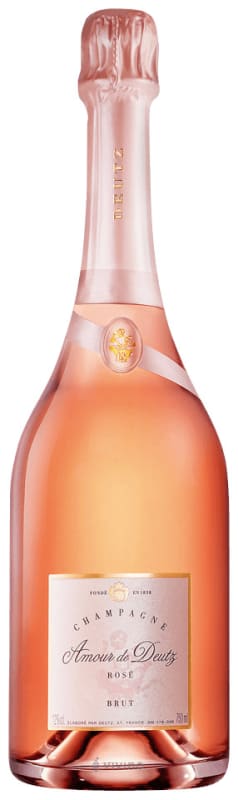


Winemaker Notes
Professional Ratings
-
James Suckling
Here's proof that prestige cuvee rosé Champagne doesn't need to be rich and opulent. What a complex nose of stone fruits with a slew of delicate spicy aromas. Super-elegant and precise on the sleek and incredibly focused palate. Steadily builds to a great finale where a touch of saltiness seems to ignite the staggering mineral freshness, creating a fireworks display on your palate. 50% chardonnay from the Cotes des Blancs and 50% from pinot noir from Ay, Mareuil, Bouzy and Ambonnay.
-
Wine Enthusiast
This is a fine, mature Champagne, its fruit and spice coming happily together. With an intense citrus edge and vivid fruitiness, the wine is at a fine point between maturity and freshness.
-
Jeb Dunnuck
Decadent perfume lifts from the glass of the 2013 Champagne Amour De Deutz Millesime Brut Rose, which displays a pale salmon color and offers luxurious aromas of almond croissant, rose petal, and preserved apricot. Rounded and medium-bodied, with a pillowy mousse, it takes on a pretty citrus-tinged profile through the palate with notes of tangerine and has a silky texture as well as good length. For those who enjoy the entry rose of Deutz, this is a great splurge to seek out, as it has a similarly approachable and elegant profile that casts a wide net for enjoyment. It also has a fair bit of longevity ahead of it.
-
Robert Parker's Wine Advocate
Alongside the superb Amour de Deutz Blanc de Blancs, the 2013 Amour de Deutz Rosé stands as the crown jewel of the cellar this year. It unfurls from the glass with a hauntingly complex bouquet of rose petals, cranberry and blood orange, entwined with accents of burnt buttered toast. On the palate, it is medium- to full-bodied yet tensile, defined by a taut musculature, a vibrant fruit core and racy acids that carry it toward a persistent, chalk-inflected close. While its Blanc de Blancs sibling may rival it in complexity, the Rosé distinguishes itself as the most ethereal of all the house’s vintage-dated releases this year. It is composed of 42% Chardonnay and 58% Pinot Noir, incorporating 6% red wine obtained through cold maceration of Pinot Noir, with only the free-run juice retained.
-
Wine Spectator
A mouthwatering rosé, with grace and vitality, this is beautifully textured as well, like a swathe of cashmere on the palate. A streak of minerally chalk and smoke underscores an enticing range of ripe melon, pink grapefruit sorbet, candied ginger and wild strawberry flavors that echo on the juicy finish. Pinot Noir and Chardonnay. Drink now
-
Wilfred Wong of Wine.com
COMMENTARY: The 2013 Champagne Deutz Amour de Deutz is complex and alluring. TASTING NOTES: This wine offers aromas and flavors of spice, dried earth, and ripe fruit. Pair it with game birds and saffron rice. (Tasted: April 27, 2022, San Francisco, CA)


What are the different types of sparkling rosé wine?
Rosé sparkling wines like Champagne, Prosecco, Cava, and others make a fun and festive alternative to regular bubbles—but don’t snub these as not as important as their clear counterparts. Rosé Champagnes (i.e., those coming from the Champagne region of France) are made in the same basic way as regular Champagne, from the same grapes and the same region. Most other regions where sparkling wine is produced, and where red grape varieties also grow, also make a rosé version.
How is sparkling rosé wine made?
There are two main methods to make rosé sparkling wine. Typically, either white wine is blended with red wine to make a rosé base wine, or only red grapes are used but spend a short period of time on their skins (maceration) to make rosé colored juice before pressing and fermentation. In either case the base wine goes through a second fermentation (the one that makes the bubbles) through any of the various sparkling wine making methods.
What gives rosé Champagne and sparkling wine their color and bubbles?
The bubbles in sparkling wine are formed when the base wine undergoes a secondary fermentation, which traps carbon dioxide inside the bottle or fermentation vessel. During this stage, the yeast cells can absorb some of the wine’s color but for the most part, the pink hue remains.
How do you serve rosé sparkling wine?
Treat rosé sparkling wine as you would treat any Champagne, Prosecco, Cava, and other sparkling wine of comparable quality. For storing in any long-term sense, these should be kept at cellar temperature, about 55F. For serving, cool to about 40F to 50F. As for drinking, the best glasses have a stem and a flute or tulip shape to allow the bead (bubbles) and beautiful rosé hue to show.
How long do rosé Champagne and sparkling wine last?
Most rosé versions of Prosecco, Champagne, Cava or others around the “$20 and under” price point are intended for early consumption. Those made using the traditional method with extended cellar time before release (e.g., Champagne or Crémant) can typically improve with age. If you are unsure, definitely consult our Customer Care team for guidance.

Associated with luxury, celebration, and romance, the region, Champagne, is home to the world’s most prized sparkling wine. In order to bear the label, ‘Champagne’, a sparkling wine must originate from this northeastern region of France—called Champagne—and adhere to strict quality standards. Made up of the three towns Reims, Épernay, and Aÿ, it was here that the traditional method of sparkling wine production was both invented and perfected, birthing a winemaking technique as well as a flavor profile that is now emulated worldwide.
Well-drained, limestone and chalky soil defines much of the region, which lend a mineral component to its wines. Champagne’s cold, continental climate promotes ample acidity in its grapes but weather differences from year to year can create significant variation between vintages. While vintage Champagnes are produced in exceptional years, non-vintage cuvées are produced annually from a blend of several years in order to produce Champagnes that maintain a consistent house style.
With nearly negligible exceptions, . These can be blended together or bottled as individual varietal Champagnes, depending on the final style of wine desired. Chardonnay, the only white variety, contributes freshness, elegance, lively acidity and notes of citrus, orchard fruit and white flowers. Pinot Noir and its relative Pinot Meunier, provide the backbone to many blends, adding structure, body and supple red fruit flavors. Wines with a large proportion of Pinot Meunier will be ready to drink earlier, while Pinot Noir contributes to longevity. Whether it is white or rosé, most Champagne is made from a blend of red and white grapes—and uniquely, rosé is often produce by blending together red and white wine. A Champagne made exclusively from Chardonnay will be labeled as ‘blanc de blancs,’ while ones comprised of only red grapes are called ‘blanc de noirs.’