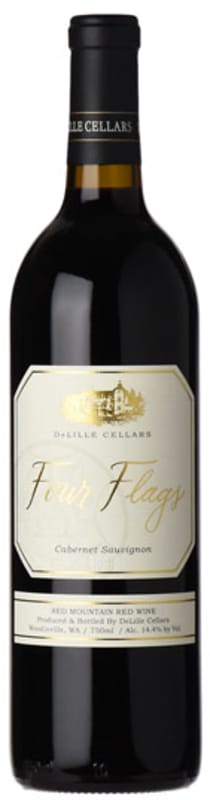


Winemaker Notes
Professional Ratings
-
Jeb Dunnuck
One of the gems in the lineup is the 2016 Cabernet Sauvignon Four Flags. This thrilling, sensational Cabernet Sauvignon has a beautiful perfume of red currants, spice box, new leather, and dried flowers. Medium to full-bodied, seamless, and thrillingly textured, it offers balance, remarkable purity, and a finish that won’t quit. While Red Mountain is known for producing powerful, structured wines, this is all about finesse and elegance. It will drink nicely for two decades.
-
Robert Parker's Wine Advocate
Named for the four famous vineyards on Red Mountain, the 2016 Cabernet Sauvignon Four Flags immediately shows power and elegance on the nose, with a fresh core of fruit and minerality, showcasing rich and velvety oak tones. The wine is rich and complex on the medium to full-bodied palate that's overflowing and expressive, with good depth and breadth, balanced tannins and the lifting support of oak spices and energetic acidity. It lingers long, with a tannic edge that will settle down with time, making it ready for food now. Only 1,500 bottles were produced. I recommend securing some for yourself before they are all gone!
-
Wine & Spirits
Four Flags is drawn from four prestigious vineyards on Red Mountain; this year, 40 percent of the fruit comes from Upchurch Vineyard, Chris Upchurch’s new development. It’s tense and tannic, smelling of soil and tobacco, the fruit dark and concentrated, laced with those ferrous tannins.
-
Wine Spectator
Tightly structured, with a precise core of lively acidity and tannins, framed by blackberry, stony mineral and black olive flavors. Best from 2021 through 2026.


A noble variety bestowed with both power and concentration, Cabernet Sauvignon enjoys success all over the globe, its best examples showing potential to age beautifully for decades. Cabernet Sauvignon flourishes in Bordeaux's Medoc where it is often blended with Merlot and smaller amounts of some combination of Cabernet Franc, Malbecand Petit Verdot. In the Napa Valley, ‘Cab’ is responsible for some of the world’s most prestigious, age-worthy and sought-after “cult” wines. Somm Secret—DNA profiling in 1997 revealed that Cabernet Sauvignon was born from a spontaneous crossing of Cabernet Franc and Sauvignon Blanc in 17th century southwest France.

A coveted source of top quality red grapes among premier Washington producers, the Red Mountain AVA is actually the smallest appellation in the state. As its name might suggest, it is actually neither a mountain nor is it composed of red earth. Instead the appellation is an anticline of the Yakima fold belt, a series of geologic folds that define a number of viticultural regions in the surrounding area. It is on the eastern edge of Yakima Valley with slopes facing southwest towards the Yakima River, ideal for the ripening of grapes. The area’s springtime proliferation of cheatgrass, which has a reddish color, actually gives the area the name, "Red" Mountain.
Red Mountain produces some of the most mineral-driven, tannic and age-worthy red wines of Washington and there are a few reasons for this. It is just about the hottest appellation with normal growing season temperatures commonly reaching above 90F. The soil is particularly poor in nutrients and has a high pH, which results in significantly smaller berry sizes compared to varietal norms. The low juice to skin ratio in smaller berries combined with the strong, dry summer winds, leads to higher tannin levels in Red Mountain grapes.
The most common red grape varieties here are Cabernet Sauvignon, Merlot, Cabernet Franc and Syrah, among others. Limited white varieties are grown, namely Sauvignon blanc.
The reds of the area tend to express dark black and blue fruit, deep concentration, complex textures, high levels of tannins and as previously noted, have good aging capabilities.