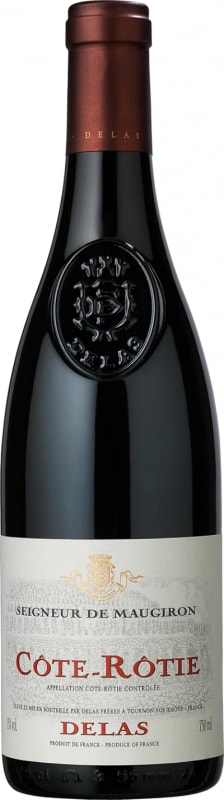


Winemaker Notes
The color is deep crimson. The powerful yet subtle nose of Côte-Rôtie "Seigneur de Maugiron" has blackcurrant, red currant, licorice and smoky aromas, underscored with light woody notes. The palate shows a tightly knit tannic framework. The wine is well-balanced with a silky texture. It unites fine concentration with great delicacy.
This wine pairs well with fine meats, roast beef, water games, truffles and spicy stews. It is recommended to open the bottle one to three hours before serving and decanted if the wine has been laid down for more than five years.
Professional Ratings
-
James Suckling
Complex nose of forest berries, spices and wild herbs with just a hint of pomegranate. A full-bodied, highly structured wine with the ripeness and concentration to carry this, the fine tannins building steadily on the finish to a very impressive finale. For this reason, it needs some time to reach its best form. Almost all from the Cote Brune side of this appellation.
-
Wine Spectator
Very fresh in feel, with racy cassis and bitter cherry notes flanked with flashes of alder, violet and white pepper. There's a piercing iron spine that drives the finish, leaving you wanting more thanks to a mouthwatering echo. Best from 2022.
-
Jeb Dunnuck
Starting off the Côte Rôties, the 2019 Côte Rôtie Seigneur De Maugiron comes from a mix of terroirs (both in the northern and southern parts) and is 100% Syrah brought up in a combination of new and used barrels. It's beautifully done and shows the sunny, ripe, sexy style of the vintage, offering lots of black raspberry fruits, notes of bacon fat, spring flowers, and scorched earth, medium to full body, a round, lush mouthfeel, and sweet tannins.
-
Robert Parker's Wine Advocate
Subtle floral and herb notes join blueberries and black cherries on the nose of the 2019 Cote Rotie Seigneur de Maugiron. It's a lush, fruit-filled effort, medium to full-bodied, with soft tannins and a long, silky-textured finish. It should drink well young but keep for a decade or more. Best After 2021
-
Wine Enthusiast
This wine presents an abundance of blackberries, black olives, thyme and mint on the nose. The palate comes alive with vibrancy from a wash of acidity, uplifting the concentrated fruit. Its finish frames the dark-fruited profile with a pleasing finish of clove.






Marked by an unmistakable deep purple hue and savory aromatics, Syrah makes an intense, powerful and often age-worthy red. Native to the Northern Rhône, Syrah achieves its maximum potential in the steep village of Hermitage and plays an important component in the Red Rhône Blends of the south, adding color and structure to Grenache and Mourvèdre. Syrah is the most widely planted grape of Australia and is important in California and Washington. Sommelier Secret—Such a synergy these three create together, the Grenache, Syrah, Mourvedre trio often takes on the shorthand term, “GSM.”

The cultivation of vines here began with Greek settlers who arrived in 600 BC. Its proximity to Vienne was important then and also when that city became a Roman settlement but its situation, far from the negociants of Tain, led to its decline in more modern history. However the 1990s brought with it a revival fueled by one producer, Marcel Guigal, who believed in the zone’s potential. He, along with the critic, Robert Parker, are said to be responsible for the zone’s later 20th century renaissance.
Where the Rhone River turns, there is a build up of schist rock and a remarkable angle that produces slopes to maximize the rays of the sun. Cote Rotie remains one of the steepest in viticultural France. Its varied slopes have two designations. Some are dedicated as Côte Blonde and others as Côte Brune. Syrahs coming from Côte Blonde are lighter, more floral, and ready for earlier consumption—they can also include up to 20% of the highly scented Viognier. Those from Côte Brune are more sturdy, age-worthy and are typically nearly 100% Syrah. Either way, a Cote Rotie is going to have a particularly haunting and savory perfume, expressing a more feminine side of the northern Rhone.