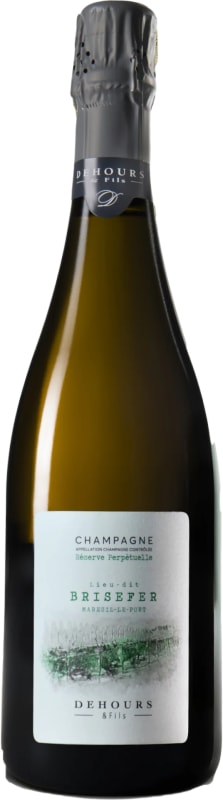


Winemaker Notes
Chardonnay vines from the bottom of a gentle slope (1:20), planted between 1966 and 1992. An east orientation with clay soil which has leeched out most of its limestone. Production methods respect biodiversity (Working the ground and allowing grass to grow between the vines). The wines are fully aged on the lees,in 200L, 300L and 500L barrels and clarified by natural settling, without filtration or fining.
Professional Ratings
-
Robert Parker's Wine Advocate
Disgorged in May 2020 with 0.9 grams per liter dosage, the NV Extra-Brut Lieu-Dit Brisefer derives from a perpetual reserve established in 2013—this release therefore incorporates wine from 2013, 2014 and 2015. This east-facing parcel of old vines has delivered fascinating results, unwinding in the glass with complex aromas of pear, orange oil, mint, tangerine, pastry cream and smoke. Medium to full-bodied, seamless and layered, it's deep and enveloping, displaying racy acids and a pillowy mousse, with an elegant profile that doesn't come at the expense of character or intensity.
-
Jeb Dunnuck
Aromatically, the NV Champagne Lieu-Dit Brisefer Perpetual Reserve Extra Brut is intense and forward with iodine, smoke, and lapsang souchong black tea. The palate is full and feels the oak influence, with toast, scotch-like salinity, hay, dried peach, and chamomile. This wine has a wild edge to it that commands food and a place alongside richer fare. It is a vinous blanc de blancs to drink over the next 10 years.


A term typically reserved for Champagne and Sparkling Wines, non-vintage or simply “NV” on a label indicates a blend of finished wines from different vintages (years of harvest). To make non-vintage Champagne, typically the current year’s harvest (in other words, the current vintage) forms the base of the blend. Finished wines from previous years, called “vins de reserve” are blended in at approximately 10-50% of the total volume in order to achieve the flavor, complexity, body and acidity for the desired house style. A tiny proportion of Champagnes are made from a single vintage.
There are also some very large production still wines that may not claim one particular vintage. This would be at the discretion of the winemaker’s goals for character of the final wine.

Associated with luxury, celebration, and romance, the region, Champagne, is home to the world’s most prized sparkling wine. In order to bear the label, ‘Champagne’, a sparkling wine must originate from this northeastern region of France—called Champagne—and adhere to strict quality standards. Made up of the three towns Reims, Épernay, and Aÿ, it was here that the traditional method of sparkling wine production was both invented and perfected, birthing a winemaking technique as well as a flavor profile that is now emulated worldwide.
Well-drained, limestone and chalky soil defines much of the region, which lend a mineral component to its wines. Champagne’s cold, continental climate promotes ample acidity in its grapes but weather differences from year to year can create significant variation between vintages. While vintage Champagnes are produced in exceptional years, non-vintage cuvées are produced annually from a blend of several years in order to produce Champagnes that maintain a consistent house style.
With nearly negligible exceptions, . These can be blended together or bottled as individual varietal Champagnes, depending on the final style of wine desired. Chardonnay, the only white variety, contributes freshness, elegance, lively acidity and notes of citrus, orchard fruit and white flowers. Pinot Noir and its relative Pinot Meunier, provide the backbone to many blends, adding structure, body and supple red fruit flavors. Wines with a large proportion of Pinot Meunier will be ready to drink earlier, while Pinot Noir contributes to longevity. Whether it is white or rosé, most Champagne is made from a blend of red and white grapes—and uniquely, rosé is often produce by blending together red and white wine. A Champagne made exclusively from Chardonnay will be labeled as ‘blanc de blancs,’ while ones comprised of only red grapes are called ‘blanc de noirs.’