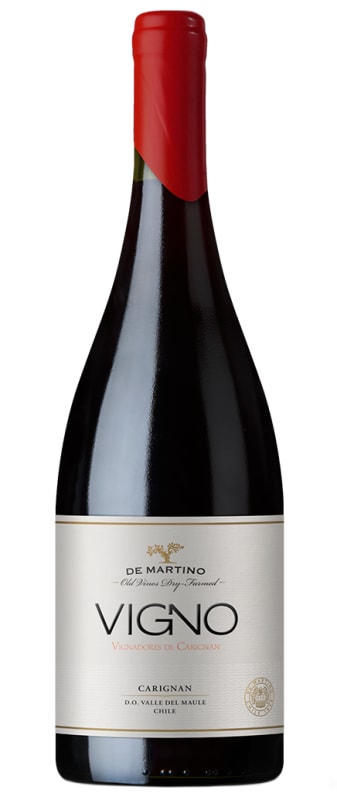


Winemaker Notes
Bright ruby color, with intense aromatics or ripe black cherries, blackberries and a mineral smoky note. Shows a fresh and juicy acidity backed with ripe fruit notes and firm fine grained tannins. Medium bodied with remarkable length, intensity and complexity.
Professional Ratings
-
Robert Parker's Wine Advocate
The 2018 Vigno is somewhat more austere and powerful, with more tannin and depth than the 2017 I tasted next to it. It's very complete and has all the ingredients for a long development in bottle. It's a wine with power and balance, but it's a little backward; the 2017 is more expressive and open, more drinkable now. But this will be a long-distance runner and more complete. 6,828 bottles were filled in October 2019. - Luis Gutierrez
-
James Suckling
A medium-bodied red with aromas of black raspberries, blueberries, violets and walnut husk. Firm, chewy tannins and some black-tea character on the palate. Rust and minerals on the finish.
-
Vinous
As in past years, Hermann’s #6 originates with old, ungrafted vines, relatively rare in the Treppchen, and, unsurprisingly, this year’s rendition reflects picking on the first day of Hermann’s harvest – namely, September 24. A penetrating, cooling nose offers site-typical mint and sassafras along with intimations of white peach and lime. Subtle smokiness and crushed stone suffusion add interest to a luscious, buoyant and glossy midpalate and an impressively persistent finish. (I wrote simply “#6” as part of this wine’s description because the label displays a prominent Arabic number six, although the wine in fact also carries the A.P. #6. There is once again a second Treppchen Kabinett from younger vines in a less privileged location, a wine of which, as usual, Hermann did not offer me a taste.)


Responsible for some of the most stunning old vine red wine on the planet, Carignan has an amazing capacity to survive dry, arid climates and still produce lovely, mouthwatering wine. In Spain it goes by the name of Mazuelo or Cariñena and while it may have originated there in the province of Aragón, its popularity lies elsewhere, particularly in Languedoc-Roussillon. Somm Secret—Historically Carignan did not enjoy the respect that it does today. In the mid 20th century, Carignan covered nearly 140,000 ha in Algeria, where it was made into low quality bulk and blending wine to supply mass-market demand.

Maule is the Central Valley’s most southern and coolest zone, reaching a southern latitude of 35°S, yet it is still warmer and drier than Bío-Bío to its south. The Maule Valley enjoys success with a unique set of grapes.
It lays claim to the local variety, Pais (synonymous with Tinta Pais, which is actually Tempranillo), which has dominated much of the region’s area under vine until the recent past. Now many growers, not confined by the tradition and regulations of the Old World, also successfully grow Cabernet Sauvignon.
While Maule’s total area under vine remains relatively static, its old Carignan vineyards are undergoing a great revival. The VIGNO (Vignadores del Carignan Vintners) group, an association in charge of promoting this long-forgotten variety, is getting fantastic results from the old vines in its dry-farmed coastal zones.
The Maule includes the subregions of Talca, San Clemente, San Javier, Parral, Linares and Cauquenes.