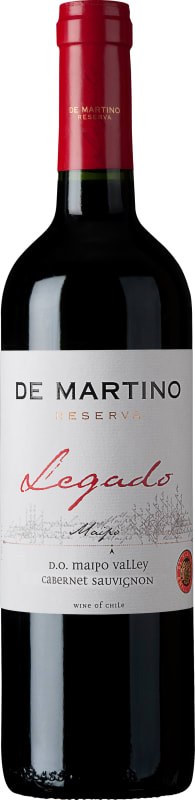


Winemaker Notes
This Cabernet Sauvignon presents classic aromas of blackcurrants, blueberries and violets combined with tobacco leaves and cedar notes. Shows great fruit intensity, with mid palate weight backed by fresh acidity and ripe, fine grained tannins and a lingering finish.
Professional Ratings
-
James Suckling
Another wine from this producer that’s so clear in its delivery of fruit; freshly picked blackcurrants, citrus, nutmeg, tea leaves and herbs all spring from the glass. Medium-bodied with tons of tangy fruit, wrapped in a layer of fine tannins and coated in bright acidity.
-
Robert Parker's Wine Advocate
Sourced from vines planted in Isla de Maipo between 1992 and 1998, the 2017 Legado Cabernet Sauvignon is from a warm vintage when they harvested early to keep the wine at 13.1% alcohol. It fermented in stainless steel with indigenous yeasts after a cold soak and matured in used barriques for 13 months. It has balsamic aromas of camphor, blackberries and cassis, quite classical and old-style, with the textbook tannins from the variety. This is quite in line with the 2015, both dry and warm years.
Rating: 90+


A noble variety bestowed with both power and concentration, Cabernet Sauvignon enjoys success all over the globe, its best examples showing potential to age beautifully for decades. Cabernet Sauvignon flourishes in Bordeaux's Medoc where it is often blended with Merlot and smaller amounts of some combination of Cabernet Franc, Malbecand Petit Verdot. In the Napa Valley, ‘Cab’ is responsible for some of the world’s most prestigious, age-worthy and sought-after “cult” wines. Somm Secret—DNA profiling in 1997 revealed that Cabernet Sauvignon was born from a spontaneous crossing of Cabernet Franc and Sauvignon Blanc in 17th century southwest France.

The Maipo Valley is Chile’s most famous wine region. Set in the country’s Central Valley, it is warm and quite dry, often necessitating the use of irrigation. Alluvial soils predominate but are supplemented with loam and clay.
The climate in Maipo is best-suited for ripe, full-bodied reds like Cabernet Sauvignon (the region’s most widely planted grape), Merlot, Syrah and Carmenère, a Bordeaux variety that has found a successful home in Chile.
White wines are also produced with great prosperity, especially near the cooler coast, include Chardonnay and Sauvignon Blanc.