
Winemaker Notes
Professional Ratings
-
Robert Parker's Wine Advocate
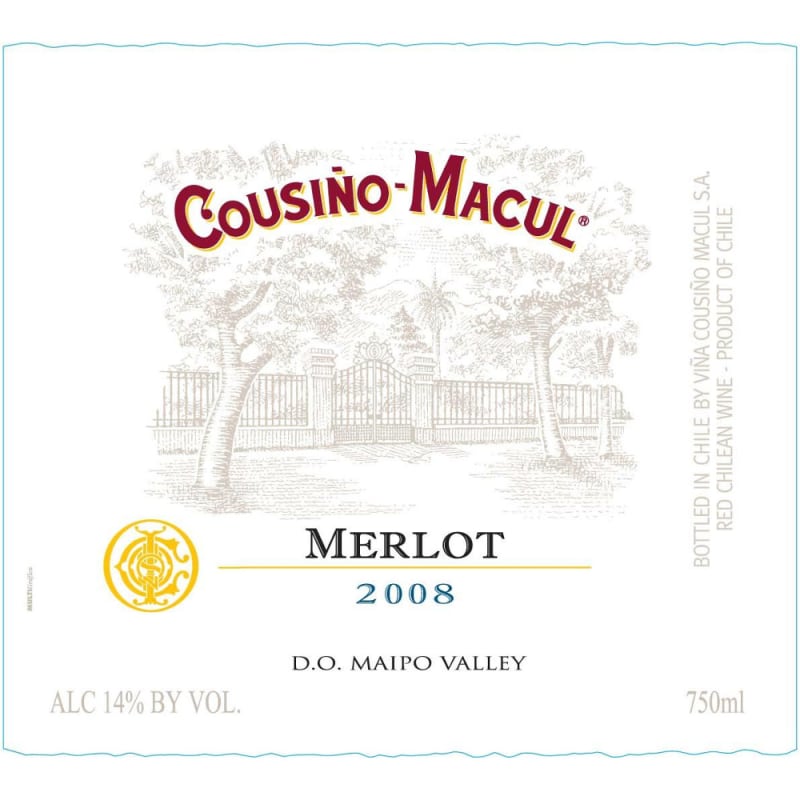
The red wines begin with the 2008 Merlot, a silky, elegant wine with lovely cherry flavors and aromas, excellent balance and a pure finish. If all value-priced Merlots were this satisfying, its prestige never would have diminished.
If there is anyone delivering more bang-for-the buck than Arturo Cousino and his namesake winery Cousino-Macul, I’d like to know about it. One of the first wineries from Chile to make a break-through in the USA market, over the years Cousino has continued to fine-tune his portfolio and the wines are better today than they have ever been. On


Tied to the history of the so-called “lost grape of Bordeaux,” Carmenѐre, the story of Chilean Merlot is a fascinating one. For decades in Chile the former was actually thought to be Merlot, so the two were typically planted together and harvested at the same time. Since Merlot is an early-ripening variety and Carmenѐre much later-ripening, the resulting wines often tasted unripe and vegetal. Not until 1994 was Chilean Carmenѐre identified correctly. As awareness grew, growers and winemakers began handling both grapes more optimally, leading to significant improvement in the wines.
Today Merlot ranks as the third most planted variety in Chile, behind Cabernet Sauvignon and Sauvignon Blanc. It is mostly found in the following valley DO’s, from north to south: Maipo, Cachapoal, Colchagua, Curicó and Maule. It can appear both in blends or on its own. Either way, Chilean Merlot tends to show characteristic aromas and flavors of ripe plums, dark berries and herbs, often accented by oak, with a mouthfeel that is round and full.