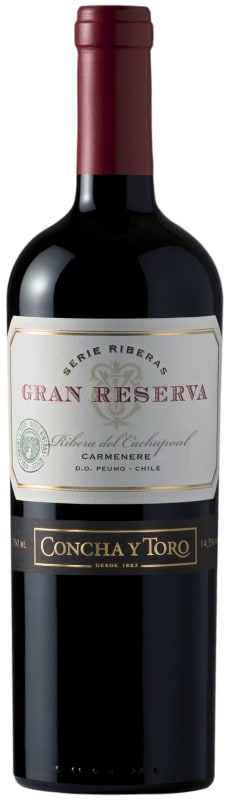


Winemaker Notes
Deep, dark red in color with lush aromas of cherries, blackcurrant, and blackberry with a touch of black and white pepper. Tight and focused with deeply concentrated flavors and an almost silky texture with soft, smooth tannins that come to the fore at the beginning of the long finish.
Blend: 86.6% Carmenere, 13.4% Cabernet Sauvignon
Professional Ratings
-
Wine Spectator
Svelte and focused, with fine-grained tannins supporting the fresh-crushed plum, cardamom and dark cherry flavors. Taut mid palate, offering a finish that lengthens out nicely with green herbal and mineral accents. Drink now through 2024.
-
Decanter
Sleek and plush dark fruit with plum and damson. Fine textured tannin with a smooth and juicy fruit profile.





Founded in 1883, Vina Concha y Toro is Latin America's leading producer and occupies an outstanding position among the world’s most important wine companies, currently exporting to 135 countries worldwide. Uniquely, it owns around 9,500 hectares of prime vineyards, which allows the company to secure the highest quality grapes for its wine production. Concha y Toro's portfolio includes a wide range of successful brands at every price point, from the top of the range Don Melchor and Almaviva to the flagship brand Casillero del Diablo and innovative stand-alone brands such as Palo Alto and Maycas del Limarí. The company has 3,162 employees and is headquartered in Santiago, Chile.

Dark, full-bodied and herbaceous with a spicy kick, Carménère found great success with its move to Chile in the mid-19th century. However, the variety went a bit undercover until 1994 when many plantings previously thought to be Merlot, were profiled as Carménère. Somm Secret— Carménère is both a progeny and a great-grandchild of the similarly flavored Cabernet Franc.

Well-regarded for intense and exceptionally high quality red wines, the Colchagua Valley is situated in the southern part of Chile’s Rapel Valley, with many of the best vineyards lying in the foothills of the Coastal Range.
Heavy French investment and cutting-edge technology in both the vineyard and the winery has been a boon to the local viticultural industry, which already laid claim to ancient vines and a textbook Mediterranean climate.
The warm, dry growing season in the Colchagua Valley favors robust reds made from Cabernet Sauvignon, Carmenère, Malbec and Syrah—in fact, some of Chile’s very best are made here. A small amount of good white wine is produced from Chardonnay and Sauvignon Blanc.