
Winemaker Notes
Professional Ratings
-
Robert Parker's Wine Advocate
A glass-coating opaque purple color, it surrenders a brooding personality marked by notions of sandalwood, smoke, earthy minerals, dried herbs, black plum, and blackberry. Sweetly-fruit, dense, and opulent, this full-bodied, pleasure-bent offering deftly conceals enough fine grained tannin to evolve for 5-6 years and should easily see its 20th birthday in fine form. This wine is a benchmark for what can be achieved with the Carmenere grape.
-
Wine & Spirits
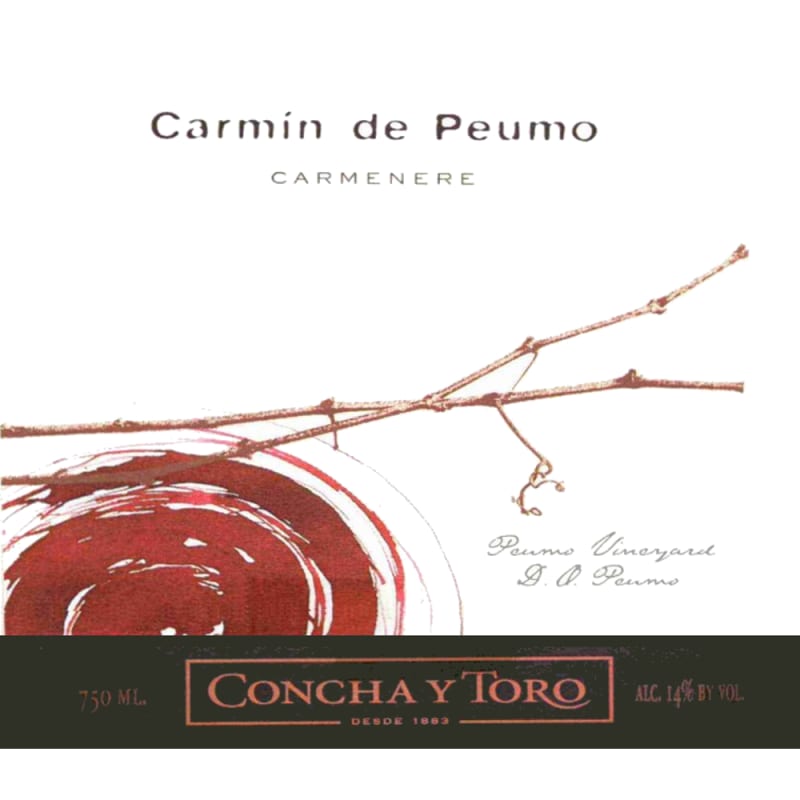
Ignacio Recabarren selects the fruit for this wine from a 20-acre plot in Concha y Toro’s 250-acre carmenère vineyard in Peumo, on the northern bank of the Cachapoal River. His 2007 Carmín is a tremendous carmenère, showing the voluptuous ripeness of the vintage: It fills every corner of the palate with concentrated, ripe blackberry and black cherry flavors, herbal notes and scents of toasted oak. Surprisingly smooth, the sweet flavors glide over the tongue with amplitude and depth, accompanied by acidity that might seem extreme in another context. But in this wine—in the middle of this orgy—that acidity brings the necessary quota of common sense and freshness. If you open this now, decant it for roast wild boar; you’d be better off following its evolution over the next decade.
-
Wine Spectator
This ripe red boasts juicy but focused crushed blackberry, plum and black currant fruit, woven with alluring toasty vanilla, espresso and black licorice notes. The lengthy, pure finish has a nice underlying minerality. Drink now through 2012.
-
Wine Enthusiast
About as dense, lush and ripe as you can get without teetering over the edge. Along the way there's mint, tobacco, cedar and heavy raisin/plum fruit aromas. Big and broad across the tongue, with sweet boysenberry, cassis and chocolate flavors. This is to wine what Guinness Stout is to beer.





Founded in 1883, Vina Concha y Toro is Latin America's leading producer and occupies an outstanding position among the world’s most important wine companies, currently exporting to 135 countries worldwide. Uniquely, it owns around 9,500 hectares of prime vineyards, which allows the company to secure the highest quality grapes for its wine production. Concha y Toro's portfolio includes a wide range of successful brands at every price point, from the top of the range Don Melchor and Almaviva to the flagship brand Casillero del Diablo and innovative stand-alone brands such as Palo Alto and Maycas del Limarí. The company has 3,162 employees and is headquartered in Santiago, Chile.

Dark, full-bodied and herbaceous with a spicy kick, Carménère found great success with its move to Chile in the mid-19th century. However, the variety went a bit undercover until 1994 when many plantings previously thought to be Merlot, were profiled as Carménère. Somm Secret— Carménère is both a progeny and a great-grandchild of the similarly flavored Cabernet Franc.

Dramatic geographic and climatic changes from west to east make Chile an exciting frontier for wines of all styles. Chile’s entire western border is Pacific coastline, its center is composed of warm valleys and on its eastern border, are the soaring Andes Mountains.
Chile’s central valleys, sheltered by the costal ranges, and in some parts climbing the eastern slopes of the Andes, remain relatively warm and dry. The conditions are ideal for producing concentrated, full-bodied, aromatic reds rich in black and red fruits. The eponymous Aconcagua Valley—hot and dry—is home to intense red wines made from Cabernet Sauvignon, Syrah and Merlot.
The Maipo, Rapel, Curicó and Maule Valleys specialize in Cabernet and Bordeaux Blends as well as Carmenère, Chile’s unofficial signature grape.
Chilly breezes from the Antarctic Humboldt Current allow the coastal regions of Casablanca Valley and San Antonio Valley to focus on the cool climate loving varieties, Pinot Noir, Chardonnay and Sauvignon Blanc.
Chile’s Coquimbo region in the far north, containing the Elqui and Limari Valleys, historically focused solely on Pisco production. But here the minimal rainfall, intense sunlight and chilly ocean breezes allow success with Chardonnay and Pinot Noir. The up-and-coming southern regions of Bio Bio and Itata in the south make excellent Riesling, Chardonnay and Pinot Noir.
Spanish settlers, Juan Jufre and Diego Garcia de Cáceres, most likely brought Vitis vinifera (Europe’s wine producing vine species) to the Central Valley of Chile sometime in the 1550s. One fun fact about Chile is that its natural geographical borders have allowed it to avoid phylloxera and as a result, vines are often planted on their own rootstock rather than grafted.