

Winemaker Notes
Professional Ratings
-
Robert Parker's Wine Advocate
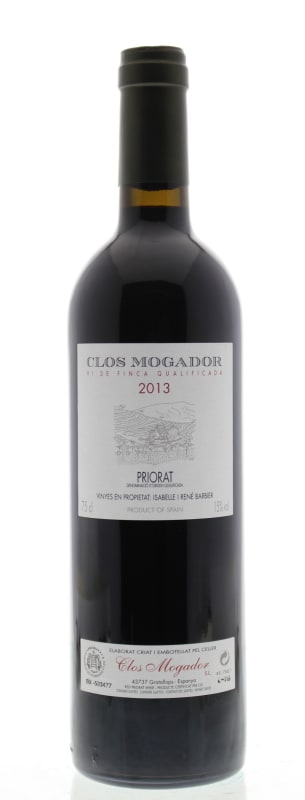
One of only two Vins de Finca Qualificada from Priorat, the 2013 Clos Mogador is a complex blend of Garnacha and Cariñena with a touch of Syrah and Cabernet Sauvignon. It felt serious and a little backward, terribly balanced with shy notes of peat and graphite emerging with some time in the glass, subtle and complex, slowly revealing nuances of dark cherries, violets, black olives and later some red fruit. The palate is surprising: when I expected it to show its power, it just whispered and danced on my tongue with lively acidity that made it feel a lot lighter than it is. There is depth, elegance and incipient complexity. Here everything is in perfect harmony, with lots of everything, dry extract, acidity, alcohol and tannin, but somehow you don't notice any of it. A remarkable vintage of Mogador. Given the quality, the price seems like a bargain, and availability shouldn't be too bad either, as some 28,000 bottles were filled in June 2015. Put it aside in your cellar, because this is a 20-year bottle of Priorat.
-
Wine Spectator
Plush yet focused, this red delivers alluring flavors of cherry, kirsch, licorice, espresso and mineral, with well-integrated tannins and vibrant orange peel acidity. Ripe yet balanced, this is both rich and fresh. Drink now through 2025.
-
Wilfred Wong of Wine.com
A red wine for Old World junkies that love delicious wines. The 2013 Clos Morgador, a serious wine, makes no pretentions of wanting to please the crowd. These guys make real wine that so classically defines Priorat. I'd like this one with a well-marbled ribeye of beef. Dark ruby color; ripe red and black fruit, with some dust in the nose; medium bodied, fine bite in the flavors; red and black fruit with sweet earth notes; rich and persistent in the aftertaste. (Drinking nicely now, will improve significantly with time. (Tasted: April 5, 2016, San Francisco, CA)


Beyond the usual suspects, there are hundreds of red grape varieties grown throughout the world. Some are indigenous specialties capable of producing excellent single varietal wines, while others are better suited for use as blending grapes. Each has its own distinct viticultural characteristics, as well as aroma and flavor profiles, offering much to be discovered by the curious wine lover. In particular, Portugal and Italy are known for having a multitude of unique varieties but they can really be found in any region.

Tiny and entirely composed of craggy, jagged and deeply terraced vineyards, Priorat is a Catalan wine-producing region that was virtually abandoned until the early 1990s. This Spanish wine's renaissance came with the arrival of one man, René Barbier, who recognized the region’s forgotten potential. He banded with five friends to create five “Clos” in the village of Gratallops. Their aim was to revive some of Priorat’s ancient Carignan vines, as well as plant new—mainly French—varieties. These winemakers were technically skilled, well-trained and locally inspired; not surprisingly their results were a far cry from the few rustic and overly fermented wines already produced.
This movement escalated Priorat’s popularity for a few reasons. Its new wines were modern and made with well-recognized varieties, namely old Carignan and Grenache blended with Syrah, Cabernet Sauvignon and Merlot. When the demand arrived, scarcity commanded higher prices and as the region discovered its new acclaim, investors came running from near and far. Within ten years, the area under vine practically doubled.
Priorat’s steep slopes of licorella (brown and black slate) and quartzite soils, protection from the cold winds of the Siera de Monstant and a lack of water, leading to incredibly low vine yields, all work together to make the region’s wines unique. While similar blends could and are produced elsewhere, the mineral essence and unprecedented concentration of a Priorat wine is unmistakable.