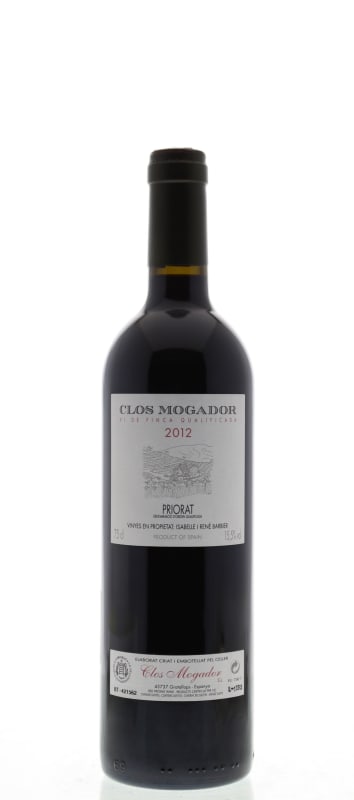


Winemaker Notes
Professional Ratings
-
Robert Parker's Wine Advocate
The 2012 Clos Mogador is nothing short of spectacular. They started in 1999 with some Cariñena, and they gradually increased the Garnacha and reduced the Cabernet. 2012 is possibly the vintage of Mogador with less Cabernet, as it didn't behave well in such warm year. René Barbier senior tells me it reminds him of the freshness of the 2000 that he generously uncorked for me to compare; they only have a handful of bottles for the old vintages! The nose of this 2012 is still little reticent but not reduced like many vintages in the past, slowly showing a great Mediterranean-Atlantic balance with notes of herbs, wet slate and graphite. The super-elegant palate offers great acidity and freshness with incredibly layered and delineated flavors that have an electric, mineral sensation with tension and really fine tannins. There are no traces of oak and no edges... rugged silk? This is a Mogador for decades. If this is always a bargain for the quality it delivers, it is even more so in 2012!
-
Wine Enthusiast
With its patented blend of ripe plum and berry aromas matched against notes of wood smoke, herbs and leather, this is ripped and focused in the mouth, with strong but manageable tannins. Flavors of buttery oak, schist, blackberry and cassis culminate with mocha, vanilla and an overall sense of greatness. Drink from 2017 through 2025.
-
James Suckling
Blueberry, blackberry and mineral character. Full body. Soft and silky tannins. Afterburners come on at the finish with alcohol. I expected a little more, but impressive nonetheless.


Beyond the usual suspects, there are hundreds of red grape varieties grown throughout the world. Some are indigenous specialties capable of producing excellent single varietal wines, while others are better suited for use as blending grapes. Each has its own distinct viticultural characteristics, as well as aroma and flavor profiles, offering much to be discovered by the curious wine lover. In particular, Portugal and Italy are known for having a multitude of unique varieties but they can really be found in any region.

Tiny and entirely composed of craggy, jagged and deeply terraced vineyards, Priorat is a Catalan wine-producing region that was virtually abandoned until the early 1990s. This Spanish wine's renaissance came with the arrival of one man, René Barbier, who recognized the region’s forgotten potential. He banded with five friends to create five “Clos” in the village of Gratallops. Their aim was to revive some of Priorat’s ancient Carignan vines, as well as plant new—mainly French—varieties. These winemakers were technically skilled, well-trained and locally inspired; not surprisingly their results were a far cry from the few rustic and overly fermented wines already produced.
This movement escalated Priorat’s popularity for a few reasons. Its new wines were modern and made with well-recognized varieties, namely old Carignan and Grenache blended with Syrah, Cabernet Sauvignon and Merlot. When the demand arrived, scarcity commanded higher prices and as the region discovered its new acclaim, investors came running from near and far. Within ten years, the area under vine practically doubled.
Priorat’s steep slopes of licorella (brown and black slate) and quartzite soils, protection from the cold winds of the Siera de Monstant and a lack of water, leading to incredibly low vine yields, all work together to make the region’s wines unique. While similar blends could and are produced elsewhere, the mineral essence and unprecedented concentration of a Priorat wine is unmistakable.