


Winemaker Notes
Blend: 70% Grenache, 20% Syrah, 10% Mourvèdre
Professional Ratings
-
Robert Parker's Wine Advocate
A blend of 70% Grenache, 20% Syrah and 10% Mourvèdre, with half of the Grenache coming from Domaine de Panisse's young vines and the rest from Clos du Caillou, the 2021 Chateauneuf du Pape Le Tradition features delicate herbal notes entwined around gentle raspberry and strawberry fruit. It's pretty charming stuff, medium to full-bodied, silky and elegant.
Range: 91-93 -
Vinous
The 2021 Châteauneuf-du-Pape Le Tradition is showing nicely, mingling vivid aromas of rose water, raspberry, strawberry, dried herbs and mint. Medium to full-bodied, layered and refined, this is a delicious entry-level red Châteauneuf-du-Pape with a bright finish. It has the potential to improve with bottle aging.
-
Jeb Dunnuck
Leading off the 2021 Châteauneuf Du Pape, the 2021 Châteauneuf Du Pape Tradition reveals a healthy semi-opaque color as well as a spicy, perfumed bouquet of wild strawberries, framboise, savory flowers, and hints of garrigue. It's elegant, medium-bodied, has a supple, layered mouthfeel, and outstanding length. It's another finesse-driven, seamless, beautifully layered 2021 that readers will love to drink any time over the coming decade.

—Robert Parker, The Wine Advocate
From robust Côtes-du-Rhône to memorable Chateauneuf-du-Pape, Clos du Caillou wines arguably represent some of the finest values in all of France. Proprietor Sylvie Vacheron and winemaker Bruno Gaspard are keeping the great work of the late Jean-Denis Vacheron alive with wines that are heady, robust and mouth-wateringly lush.
Caillou tends wonderfully old Grenache vines, some of which are 70 to 100 years old. With older Syrah and Mourvèdre added to the mix, it’s no wonder that Caillou wines are across the board impressive for their power, extract and deep minerality. The estate’s Chateauneuf terroir borders the impressive domaines of Chateau Rayas and Beaucastel.
Yet many of the Vacheron-Pouizin family's old vines are classified, by a quirk of 1923 politics, Côtes-du-Rhône and Côtes-du-Rhône-Villages. It’s why our Côtes-du-Rhône barrel selections show surprisingly like its kin in Chateauneuf-du-Pape.
In 1996 Jean-Denis Vacheron took full control of the viticulture and élévage at this estate. Under his stewardship, the wines of Caillou steadily gained stature, and today are benchmarks for the appellation. He understood that temperature-controlled fermentation and a cool, clean cellar are necessary to craft wines with refinement and true complexity.

With bold fruit flavors and accents of sweet spice, Grenache, Syrah and Mourvèdre form the base of the classic Rhône Red Blend, while Carignan, Cinsault and Counoise often come in to play. Though they originated from France’s southern Rhône Valley, with some creative interpretation, Rhône blends have also become popular in other countries. Somm Secret—Putting their own local spin on the Rhône Red Blend, those from Priorat often include Merlot and Cabernet Sauvignon. In California, it is not uncommon to see Petite Sirah make an appearance.

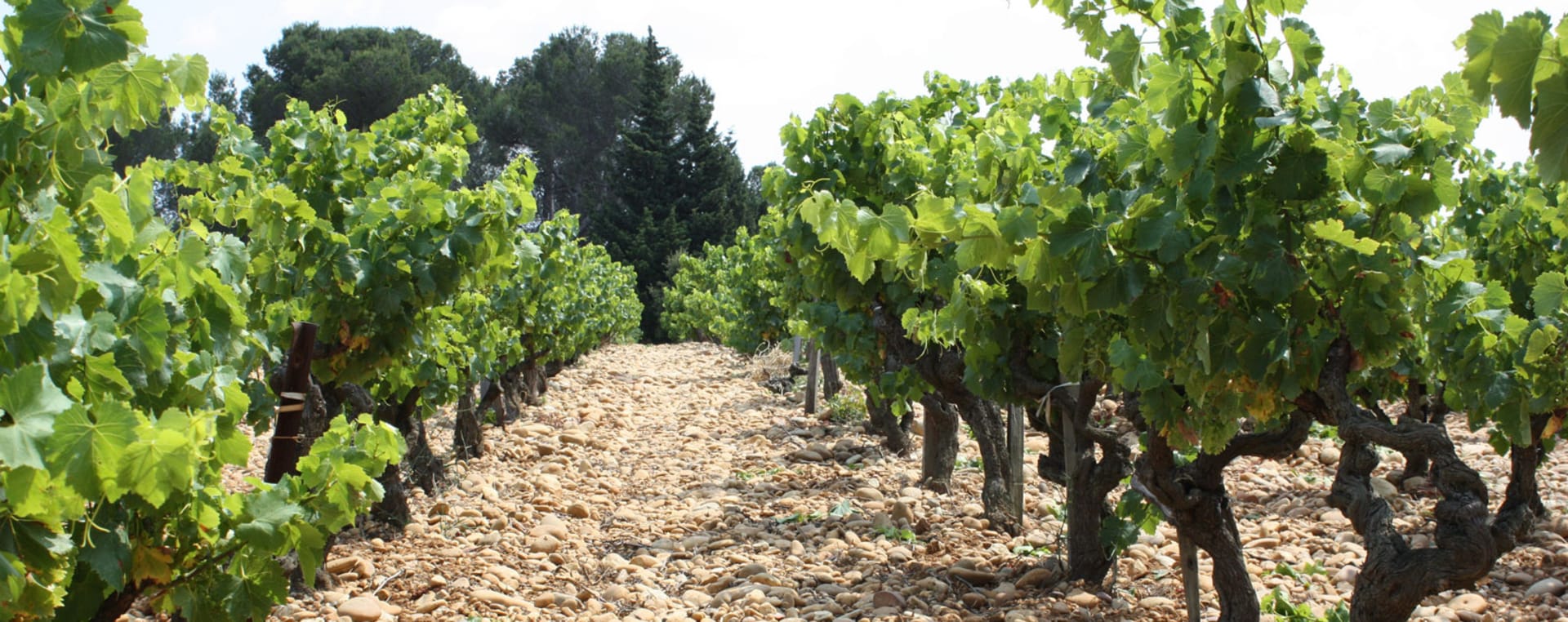
Famous for its full-bodied, seductive and spicy reds with flavor and aroma characteristics reminiscent of black cherry, baked raspberry, garrigue, olive tapenade, lavender and baking spice, Châteauneuf-du-Pape is the leading sub-appellation of the southern Rhône River Valley. Large pebbles resembling river rocks, called "galets" in French, dominate most of the terrain. The stones hold heat and reflect it back up to the low-lying gobelet-trained vines. Though the galets are typical, they are not prominent in every vineyard. Chateau Rayas is the most obvious deviation with very sandy soil.
According to law, eighteen grape varieties are allowed in Châteauneuf-du-Pape and most wines are blends of some mix of these. For reds, Grenache is the star player with Mourvedre and Syrah coming typically second. Others used include Cinsault, Counoise and occasionally Muscardin, Vaccarèse, Picquepoul Noir and Terret Noir.
Only about 6-7% of wine from Châteauneuf-du-Pape is white wine. Blends and single-varietal bottlings are typically based on the soft and floral Grenache Blanc but Clairette, Bourboulenc and Roussanne are grown with some significance.
The wine of Chateauneuf-du-Pape takes its name from the relocation of the papal court to Avignon. The lore says that after moving in 1309, Pope Clément V (after whom Chateau Pape-Clément in Pessac-Léognan is named) ordered that vines were planted. But it was actually his successor, John XXII, who established the vineyards. The name however, Chateauneuf-du-Pape, translated as "the pope's new castle," didn’t really stick until the 19th century.