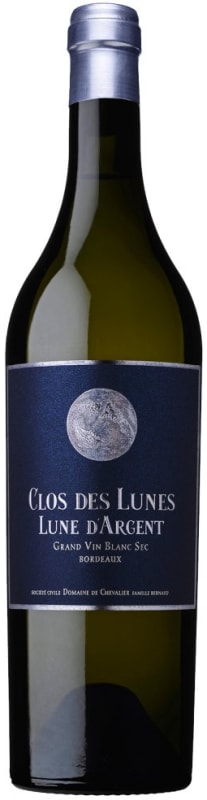


Winemaker Notes
Lune d’Argent is the heart of Clos des Lunes’ production. We firmly believe in the future of this legendary terroir and its truly original style. With a touch of French oak, the Sémillon is dense and rich, the Sauvignon Blanc refined and precise. This cuvée of dry white wine promises to convey all the magic of Sauternes.
Professional Ratings
-
James Suckling
Perfumed and very pretty white peaches and mangoes on the nose. Medium-to full-bodied, layered and rich with lots of beautiful fruit and a long, flavorful finish. Vibrant acidity holds the finish fresh. Love drinking it now.
-
Wine Spectator
Delicious, featuring a mix of pear, tangerine, yellow and green apple flavors, lined with light honeysuckle and fennel hints. Creamy along the edges, and pure and vibrant through the middle. This combines racy and exotic notes in a distinctive package.
-
Jeb Dunnuck
The 2017 Clos Des Lunes Lune D'Argent Blanc offers a touch more richness and depth as well as beautiful notes of ripe peach, white flowers, Meyer lemons, and sappy herbs. It’s a pretty, elegant white that has deceptive richness and depth as well as a great finish. This cuvee comes from the Cap Lanne Lieu-dit, largely gravelly soils, and is 70% Semillon and 30% Sauvignon Blanc brought up in 15% new French oak. It hit 13% alcohol and is a gorgeous wine.
-
Robert Parker's Wine Advocate
After fermentation in 500-liter cement tanks, stainless steel vats and barrels, a portion of the 2017 Lune d'Argent was aged in 15% new French oak barrels. The wine was aged on its lees with regular bâtonnages during the six-month aging regimen. The blend is 70% Sémillon and 30% Sauvignon Blanc. It opens with lemonade, spiced apples, lime cordial, fresh grass and grapefruit scents plus wafts of wet pebbles and honeysuckle. Medium-bodied, clean and refreshing, it finishes on a lingering citrusy note.


Sometimes light and crisp, other times rich and creamy, Bordeaux White Blends typically consist of Sauvignon Blanc and Semillon. Often, a small amount of Muscadelle or Sauvignon Gris is included for added intrigue. Popularized in Bordeaux, the blend is often mimicked throughout the New World. Somm Secret—Sauternes and Barsac are usually reserved for dessert, but they can be served before, during or after a meal. Try these sweet wines as an aperitif with jamón ibérico, oysters with a spicy mignonette or during dinner alongside hearty Alsatian sausage.

One of the most important wine regions of the world, Bordeaux is a powerhouse producer of wines of all colors, sweetness levels, and price points. Separated from the Atlantic Ocean by a coastal pine forest, this relatively flat region has a mild maritime climate, marked by cool wet winters and warm summers. Annual weather differences create significant vintage variations, making Bordeaux an exciting French wine region to follow.
The Gironde estuary, a defining feature of Bordeaux, separates most of the region into the Left Bank and the Right Bank. Farther inland, where the Gironde splits into the Garonne and Dordogne Rivers, the bucolic, rolling hills of the area in between, called Entre-Deux-Mers, is a source of great quality, approachable reds and whites.
The Left Bank, dominated by Cabernet Sauvignon, contains the Médoc, Graves, and Sauternes, as well as the region’s most famous chateaux. Merlot is important here as the perfect blending grape for Cabernet Sauvignon adding plush fruit and softening Cabernet's sometimes hefty tannins. Cabernet Franc, Petit Verdot and Malbec may also be used in the Left Bank Bordeaux wine blends.
Merlot is the principal Bordeaux wine variety of the Right Bank; Cabernet Franc adds structure and complexity to Merlot, creating wines that are concentrated, supple, and more imminently ready for drinking, compared with their Left Bank counterparts. Key appellations of the Right Bank include St. Emilion and Pomerol.
Dry and sweet Bordeaux white wines are produced throughout the region from Sauvignon Blanc, Sémillon, and sometimes Muscadelle or Sauvignon Gris. Some of the finest dry whites can be found in the Graves sub-appellation of Pessac-Léognan, while Sauternes is undisputedly the gold standard for sweet wines. Small amounts of rosé and sparkling Bordeaux wines are made in the region as well.