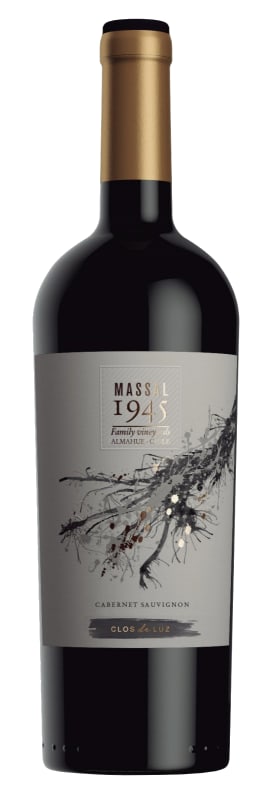


Winemaker Notes
Intense ruby red color. On the nose, fresh red fruit aromas such as plums and cherries and delicate notes of sweet spices. Very elegant. Concentrated body with balance and length. Good tannin structure and a round mid palate, persistent finish.
Professional Ratings
-
Robert Parker's Wine Advocate
I was able to taste the 2017 Massal 1945 Cabernet Sauvignon next to the 2018 and compare these two vintages that had very different climate conditions. 2017 was warm and dry and saw one of the hottest summers ever, which resulted in a very early harvest and lower yields. The wine fermented in stainless steel with indigenous yeasts and matured in well-seasoned 300-liter oak barrels and one 7,000-liter oak foudre for 12 months. It is quite fresh, balanced and varietal, quite surprising for the conditions of the year. In fact, it feels a bit leaner than the 2018 I tasted next to it. It has the fine tannins of the variety, serious and tasty. 12,000 bottles produced. It was bottled in August 2018. Rating: 91+


A noble variety bestowed with both power and concentration, Cabernet Sauvignon enjoys success all over the globe, its best examples showing potential to age beautifully for decades. Cabernet Sauvignon flourishes in Bordeaux's Medoc where it is often blended with Merlot and smaller amounts of some combination of Cabernet Franc, Malbecand Petit Verdot. In the Napa Valley, ‘Cab’ is responsible for some of the world’s most prestigious, age-worthy and sought-after “cult” wines. Somm Secret—DNA profiling in 1997 revealed that Cabernet Sauvignon was born from a spontaneous crossing of Cabernet Franc and Sauvignon Blanc in 17th century southwest France.

Touching the Pacific in the west and stretching up into the Andes on its eastern side, the Rapel Valley is one of the more substantial fine red wine producing regions of Chile and contains both the Colchagua Valley in its south and west and the Cachapoal in its north and east. While it is recognized for its exceptional warm-climate reds, the region does produce some fine Pinot noir and Sauvignon blanc on its coastal side.
Some of the country’s finest Cabernet Sauvignon comes from the Rapel’s Andean foothills—with significant individualized smaller zones already identified. Soils here are mixtures of loam, clay, and sand; Cabernet Sauvignon, Carmenère, and Merlot are the most prolific varieties throughout the region.