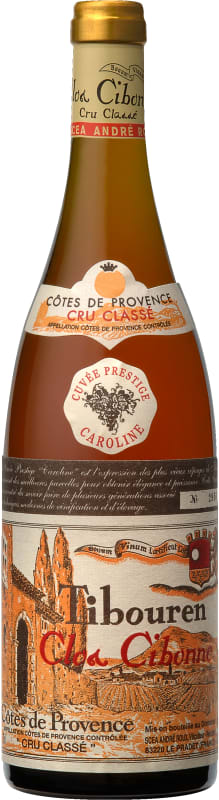


Winemaker Notes
Clos Cibonne’s Cuvée Prestige Caroline stands uniquely apart from other rosés as a classic, one-of-a-kind Côtes de Provence rosé featuring the Tibouren grape in the lead role, with Grenache. Like the other Cibonne Cuvées, Caroline has the structure to improve in bottle for up to a decade or more.
Blend: 90% Tibouren, 10% Grenache
Professional Ratings
-
Robert Parker's Wine Advocate
A blend of 90% Tibouren and 10% Grenache matured in 300-liter barrels over 10 months, the 2021 Cotes de Provence Rose Cuvee Prestige Caroline from Clos Cibonne has a lively, aromatic bouquet with aromas of spring flowers, garrigue, red berries, spices, iodine, sweet spices and perfectly integrated oaky notes. Medium to full-bodied, it’s enveloping and full-bodied, fruity and fresh, its gastronomic mid-palate segueing into a sappy finish. It's approachable now but also built to evolve gracefully over the next 3-5 years.
-
Wine Spectator
A formidable rose, with suppleness belying a deep well of complexity, offering salted almond notes atop a bed of candied orange peel, cassis and quince. Reveals distinctive green tea and smoked tobacco leaf details, with the richness and creamy texture expertly offset by crushed wet stone and dried thyme elements. Tibouren and Grenache. Drink now through 2030. 1,200 cases made, 60 cases imported.


Whether it’s playful and fun or savory and serious, most rosé today is not your grandmother’s White Zinfandel, though that category remains strong. Pink wine has recently become quite trendy, and this time around it’s commonly quite dry. Since the pigment in red wines comes from keeping fermenting juice in contact with the grape skins for an extended period, it follows that a pink wine can be made using just a brief period of skin contact—usually just a couple of days. The resulting color depends on grape variety and winemaking style, ranging from pale salmon to deep magenta.

Cotes de Provence is an extensive but valuable appellation that includes vineyards bordering the main Provencal appellations. Its sites vary from subalpine hills, which receive the cooling effects of the mountains to the north, to the coastal St-Tropez, a region mainly influenced by the warm Mediterranean sunshine.
Here the focus is on quality rosé, as it defines four fifths of the region’s wines. Following in the rosé footsteps, a lot of new effort is going into the region’s red production as well. A new generation has turned its focus on high quality Grenache, Syrah, Cinsault and Carignan. Cotes de Provence white wines, which represent a miniscule part of the region as far as volume, are nonetheless worthy of consideration and can include any combination of Clairette, Semillon, Ugni Blanc and Vermentino.