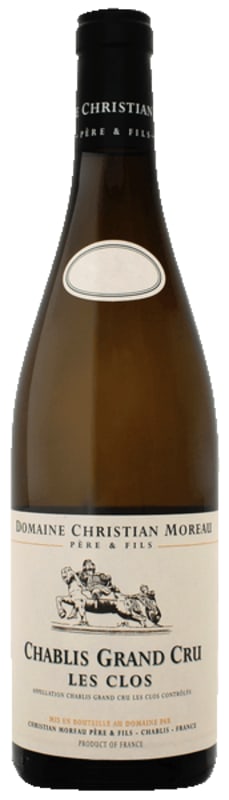


Winemaker Notes
This is the most famous Grand Cru of Chablis, complex, massive, very mineral with a remarkablefiness and a beautiful structure.
Pairs perfectly with scallops, lobster, fine fish, white meat, cheeses.
Professional Ratings
-
Jasper Morris
Blended last week. A glowing lemon and lime colour. A complex and classy nose, with a little touch of coconut on top of the crushed oyster shells. Floral too but not honeyed. Good grip to this, with the requisite tension, the oak not fully blended in yet, making for a butterier finish. Drink from 2027-2036. Tasted Jun 2024.
Barrel Sample: 92-95 -
Wine Spectator
This is a ripe style, revealing a flash of pineapple, along with peach, mirabelle plum and melon, plus a hint of seashore. Unfolds effortlessly on the palate. Fresh finish. Drink now through 2033.
-
Vinous
The 2023 Chablis Les Clos Grand Cru has a neutral, stony nose that is outperformed by the Valmur this year. The palate is well balanced with a fine bead of acidity. Fresh clementines intermix with gooseberry and red apple notes. It is quite peppery and admirably persistent toward the finish. Give this a couple of years in bottle.
Rating: 91+


One of the most popular and versatile white wine grapes, Chardonnay offers a wide range of flavors and styles depending on where it is grown and how it is made. While it tends to flourish in most environments, Chardonnay from its Burgundian homeland produces some of the most remarkable and longest lived examples. California produces both oaky, buttery styles and leaner, European-inspired wines. Somm Secret—The Burgundian subregion of Chablis, while typically using older oak barrels, produces a bright style similar to the unoaked style. Anyone who doesn't like oaky Chardonnay would likely enjoy Chablis.

The source of the most racy, light and tactile, yet uniquely complex Chardonnay, Chablis, while considered part of Burgundy, actually reaches far past the most northern stretch of the Côte d’Or proper. Its vineyards cover hillsides surrounding the small village of Chablis about 100 miles north of Dijon, making it actually closer to Champagne than to Burgundy. Champagne and Chablis have a unique soil type in common called Kimmeridgian, which isn’t found anywhere else in the world except southern England. A 180 million year-old geologic formation of decomposed clay and limestone, containing tiny fossilized oyster shells, spans from the Dorset village of Kimmeridge in southern England all the way down through Champagne, and to the soils of Chablis. This soil type produces wines full of structure, austerity, minerality, salinity and finesse.
Chablis Grands Crus vineyards are all located at ideal elevations and exposition on the acclaimed Kimmeridgian soil, an ancient clay-limestone soil that lends intensity and finesse to its wines. The vineyards outside of Grands Crus are Premiers Crus, and outlying from those is Petit Chablis. Chablis Grand Cru, as well as most Premier Cru Chablis, can age for many years.