


Winemaker Notes
Chimeres is made from vines of Grenache, Syrah and Carignan planted on black schist and schistous clay soils near the village of Maury (both inside and just outside the village boundaries so Chimeres carries the Cotes du Roussillon Villages appellation). These sites are located at the base of the mountain-top fortress of Queribus – one of the last sanctuaries of the Cathars. Made through a strict selection of fruit, first at the vineyard and then a berry by berry selection after destemming, Chimeres captures the dark fruit flavors and spicy minerality of the black schist soils of greater Agly valley.
Professional Ratings
-
Jeb Dunnuck
Coming from Maury and a blend of 40% Grenache and 30% each of Carignan and Syrah, the deep purple colored 2017 Chimeres is a sensational wine in every sense. Kirsch, blueberries, blackberries, crushed rocks, and violet notes all flow to a full-bodied, pure, layered 2017 that’s packed with character, yet stays pure, focused, and perfectly balanced. This cuvée is brought up in equal parts concrete tank and demi-muid, and comes all from black slate soils.
-
Robert Parker's Wine Advocate
The 2017 Chimeres is a ripe, dark-fruited wine loaded with cola, spice and black cherry notes. It's rich and earthy on the palate, with ample weight, supple tannins and just enough freshness to make the finish sing. It should have enough extract to last several years in the cellar, but I'd drink it on the young side, while it still hangs on to the fruit.


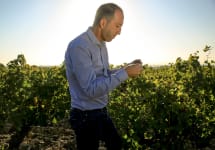
For over two centuries, the La-Fage family has been rooted in the rugged, beautiful lands of Roussillon. It is a legacy of worldly and generational knowledge, rooted in Roussillon, which forms the very soul of Château Saint-Roch. After traveling the globe as an acclaimed international winemaker, Jean-Marc Lafage felt the powerful pull of his family's origins, returning in 2005 to acquire the estate in the ancient village of Maury. His return was not just a business decision; it was a homecoming.
Here, in the majestic Agly Valley, every wine tells a story forged by wind and stone. The vineyards, some over 50 years old, cling to their unique clay-shale soils with a limestone base, a difficult terroir that forces the vines to struggle, concentrating the grapes with an incredible depth of character. Above all, the powerful, dry "Tramontana" winds, a constant presence from the sea, act as a natural sculptor, protecting the vines from disease and imbuing the grapes with a singular freshness. It is a place of raw beauty, watched over by the dramatic silhouette of the ancient Cathar castle of Quéribus.
Jean-Marc's winemaking philosophy perfectly marries this rich tradition with modern innovation with sustainable commitments. He is renowned for pioneering regenerative viticulture practices, preserving old vines and planting new varietals, cultivating and using biochar for water retention, etc.
Jean-Marc has meticulously restored and updated the cellars, knowing that the most advanced technology is simply a tool to honor the land's ancient wisdom. He allows the soul of the terroir to be fully expressed, blending the rugged power of old vines with the precision of modern stainless steel to create wines of exceptional purity and character.
This is especially true of his Rosé, a wine that truly captures the essence of the place. With every sip, you experience the taste of the Mediterranean breeze, captured in a Rosé bottle—a vibrant, fresh, and compelling expression of the Roussillon sun, the wind, and the stone. It is a wine that is both a reflection of a family's deep history and a toast to the living, breathing landscape they call home.

With bold fruit flavors and accents of sweet spice, Grenache, Syrah and Mourvèdre form the base of the classic Rhône Red Blend, while Carignan, Cinsault and Counoise often come in to play. Though they originated from France’s southern Rhône Valley, with some creative interpretation, Rhône blends have also become popular in other countries. Somm Secret—Putting their own local spin on the Rhône Red Blend, those from Priorat often include Merlot and Cabernet Sauvignon. In California, it is not uncommon to see Petite Sirah make an appearance.

A northern point in France’s far southern Roussillon region, Maury is dominated by steep limestone cliffs and the castle of Queribus, which the French used as a defense outpost against the Spanish until 1659. Today it remains an important symbol of the presence of both cultures in the region.
Though Maury is famous for vins doux naturels (a style of fortified wine), Maury dry red wines are quickly becoming more in vogue and received their own appellation designation in 2011, called Maury Sec. As is the case in most of Roussillon, Grenache plays a key role here. The region’s schist-dominant vineyards, which climb up to 1,300 feet, are excellent for the production of Grenache of all styles.
For Maury dry red wines, Carignan, Mourvèdre and Syrah act as blending partners with Granche Noir. In the production of vins doux naturels, Grenache Gris and Blanc play a subsidiary role. The latter are characterized using the same terminology as that in Riveslates with those named as grenat or tuilé based on Grenache Noir and those described as ambré or blanc containing more Grenache Blanc and Grenache Gris.