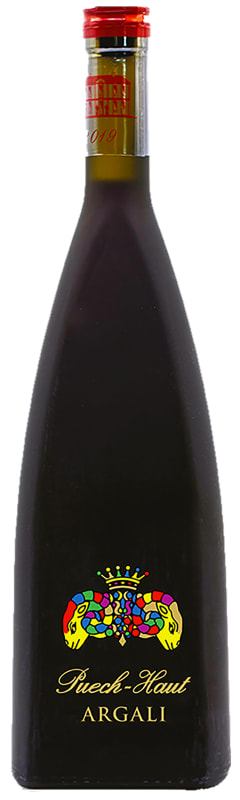


Winemaker Notes
Blend: 50% Syrah, 40% Grenache, 10% Merlot
Professional Ratings
-
Wilfred Wong of Wine.com
Over the years, I have participated in many Vin de France Wine Competitions and found that the quality ranges from average to very good, a few excellent. The Château Peuch-Haut Argali Rouge is a cut above most of them. With its richness of berries, this wine would be amazing with a savory lamb stew. (Tasted: June 19, 2024, San Francisco, CA)
-
James Suckling
Lovely nose of cherries, blackberries, cassis and sweet spices. Medium-bodied with soft tannins. Juicy, silky and fruit-driven.




Nestled on the shores of the Mediterranean and the foothills of the Cevennes region of southern France, Chateau Puech-Haut’s vineyards span 625 acres in Côteaux du Languedoc AOC, including 230 acres in Saint Drézéry and 55 acres in Pic Saint Loup. The estate’s vineyards are mainly planted to Syrah, Grenache, Carignan (50-60-year-old vines), Viognier, Marsanne and Roussanne.
The history of Château Puech-Haut is above all the story of Gérard Bru, a visionary man who built his vineyard just as he built his own life: starting from nothing and creating and achieving a dream without question. In 1980, Bru bought a parcel that was planted to olive trees and wasn’t part of the Languedoc A.O.C. classification. Bru was impressed with the area’s unique terroir and believed it was ideal for growing premium grapes, with its clay and limestone soils topped with a layer of rounded pebbles. The property was converted from olives to grapes and the property’s farmhouse evolved to Château Puech-Haut, producing its first wines a few years later.
The wines of Château Puech-Haut are all full of history and endowed with a singular identity with strong character. In summarizing the Estate’s philosophy, Gérard Bru states, “Our objective is clear: produce the greatest wines by respecting and captivating various terroirs is the philosophy of Puech Haut.”

With hundreds of red grape varieties to choose from, winemakers have the freedom to create a virtually endless assortment of blended red wines. In many European regions, strict laws are in place determining the set of varieties that may be used, but in the New World, experimentation is permitted and encouraged resulting in a wide variety of red wine styles. Blending can be utilized to enhance balance or create complexity, lending different layers of flavors and aromas. For example, a red wine blend variety that creates a fruity and full-bodied wine would do well combined with one that is naturally high in acidity and tannins. Sometimes small amounts of a particular variety are added to boost color or aromatics. Blending can take place before or after fermentation, with the latter, more popular option giving more control to the winemaker over the final qualities of the wine.
How to Serve Red Wine
A common piece of advice is to serve red wine at “room temperature,” but this suggestion is imprecise. After all, room temperature in January is likely to be quite different than in August, even considering the possible effect of central heating and air conditioning systems. The proper temperature to aim for is 55° F to 60° F for lighter-bodied reds and 60° F to 65° F for fuller-bodied wines.
How Long Does Red Wine Last?
Once opened and re-corked, a bottle stored in a cool, dark environment (like your fridge) will stay fresh and nicely drinkable for a day or two. There are products available that can extend that period by a couple of days. As for unopened bottles, optimal storage means keeping them on their sides in a moderately humid environment at about 57° F. Red wines stored in this manner will stay good – and possibly improve – for anywhere from one year to multiple decades. Assessing how long to hold on to a bottle is a complicated science. If you are planning long-term storage of your reds, seek the advice of a wine professional.

An extensive appellation producing a diverse selection of good quality and great values, Languedoc spans the Mediterranean coast from the Pyrenees mountains of Roussillon all the way to the Rhône Valley. Languedoc’s terrain is generally flat coastal plains, with a warm Mediterranean climate and frequent risk of drought.
Virtually every style of wine is made in this expansive region. Most dry wines are blends with varietal choice strongly influenced by the neighboring Rhône Valley. For reds and rosés, the primary grapes include Grenache, Syrah, Carignan, Cinsault and Mourvèdre. White varieties include Grenache Blanc, Muscat, Ugni Blanc, Vermentino, Macabéo, Clairette, Piquepoul and Bourbelenc.
International varieties are also planted in large numbers here, in particular Chardonnay, Sauvignon Blanc and Cabernet Sauvignon.
The key region for sparkling wines here is Limoux, where Blanquette de Limoux is believed to have been the first sparkling wine made in France, even before Champagne. Crémant de Limoux is produced in a more modern style.