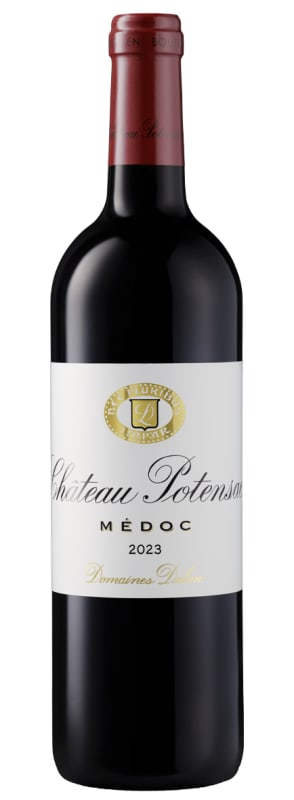


Winemaker Notes
The estate's Grand Vin's vineyards are located west of Ordonnac village. Its rows of vines grow on a double thalweg of gravelly-clay. They produce a very fine wine with tight texture, great richness and wonderful freshness. On the palate, the wine is pure and powerful, the tannins dense and spicy, and the finish of great depth with glorious aromas. Because of these qualities, Château Potensac is often considered to represent the "pure Medoc style". It should be noted that Potensac was the only "Cru Bourgeois Exceptionnel" of its appellation.
Blend: 48% Cabernet Sauvignon, 35% Merlot, 17% Cabernet Franc
Professional Ratings
-
James Suckling
Aromas of mulberries, blackberries, tobacco, cedar and herbs. Gentle yet expressive, with dark fruit throughout. Precise, fine grained tannins that will need some time to soften, but overall it’s cohesive and structured. 48% cabernet, 35% marlot and 17% cabernet franc.
-
Vinous
The 2023 Potensac is a seriously beautiful wine that shows just how complex and nuanced wines from this property can be. Crushed flowers, spice, red/purplish fruit, rose petal and mint are some of the notes that lift from the glass. Bright saline tones underpin the mid-palate and finish. This is one of the most complete young Potensacs I can recall tasting. –Antonio Galloni
Barrel Sample: 91-93 -
Jeb Dunnuck
With roughly 13,500 cases produced, the 2023 Château Potensac is a Cabernet Sauvignon-heavy blend of 48% Cabernet Sauvignon, 35% Merlot, and 17% Cabernet Franc that spent 12 months in 20% new French oak. This is the first vintage where they used an optical and water bath sorting method, and it shows in its overall purity and elegance. Cassis, black cherries, leafy tobacco, and some mineral nuances all shine here, and it's medium-bodied, with a pure, layered, focused mouthfeel, ripe tannins, and integrated acidity.
-
Decanter
Dark aromatics, violet, blackcurrant. Clean and clear, crystalline and pure, doesn’t have so much flesh, relatively lean, but actually is more crisp than harsh. Good structure, needs to fill out a little and is missing some sweetness, but then the menthol and herbal accents are lovely. Chalky and powdery tannins fill the mouth. Nice length and lift on the finish.
Barrel Sample: 91 -
Robert Parker's Wine Advocate
The 2023 Potensac offers up notes of minty cassis, sweet red berries and pencil shavings, followed by a medium- to full-bodied, taut and layered palate framed by chalky tannins. This classic Médoc will require a bit of patience.
-
Wine Spectator
Juicy and engaging, with red and black cherry compote notes scored with savory, chalky minerality and chestnut leaf on the finish. Shows character. Cab- ernet Sauvignon, Merlot and Cabernet Franc.


One of the world’s most classic and popular styles of red wine, Bordeaux-inspired blends have spread from their homeland in France to nearly every corner of the New World. Typically based on either Cabernet Sauvignon or Merlot and supported by Cabernet Franc, Malbec and Petit Verdot, the best of these are densely hued, fragrant, full of fruit and boast a structure that begs for cellar time. Somm Secret—Blends from Bordeaux are generally earthier compared to those from the New World, which tend to be fruit-dominant.

One of the most—if not the most—famous red wine regions of the world, the Medoc reaches from the city of Bordeaux northwest along the left bank of the Gironde River almost all the way to the Atlantic. Its vineyards climb along a band of flatlands, sandwiched between the coastal river marshes and the pine forests in the west. The entire region can only claim to be three to eight miles wide (at its widest), but it is about 50 miles long.
While the Medoc encompasses the Haut Medoc, and thus most of the classed-growth villages (Margaux, Moulis, Listrac, St-Julien, Pauillac and St. Estephe) it is really only those wines produced in the Bas-Medoc that use the Medoc appellation name. The ones farther down the river, and on marginally higher ground, are eligible to claim the Haut Medoc appellation, or their village or cru status.
While the region can’t boast a particularly dramatic landscape, impressive chateaux disperse themselves among the magically well-drained gravel soils that define the area. This optimal soil draining capacity is completely necessary and ideal in the Medoc's damp, maritime climate. These gravels also serve well to store heat in cooler years.