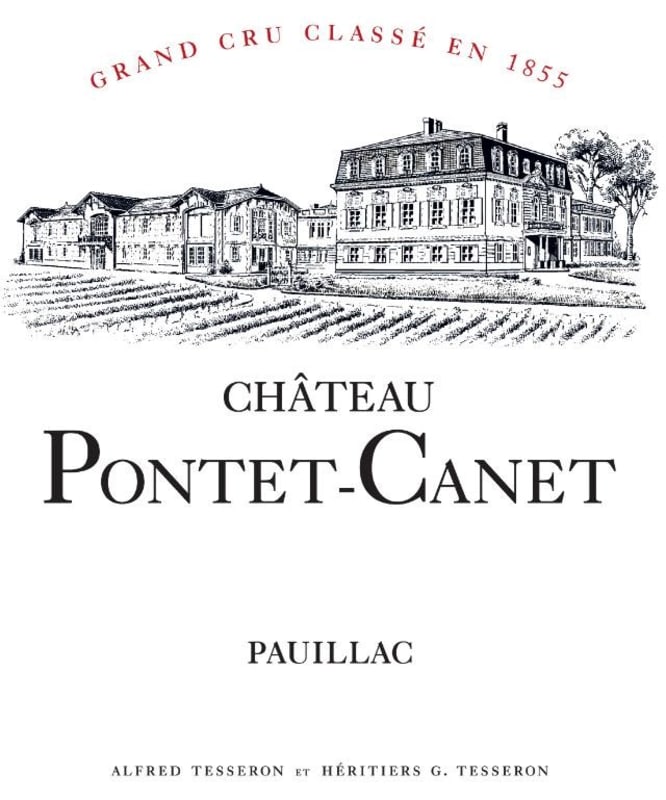

Winemaker Notes
Professional Ratings
-
James Suckling
Aromas of blackcurrants and black cherries with hints of crushed walnuts, grilled thyme, cocoa powder and graphite. It’s full-bodied with layers of ultra-fine, silky tannins that elegantly coat your palate, allowing the juicy and vibrant fruit to shine. Delicate and pristine, yet compact with lots of energy and power to uncover in the coming years. It lasts for minutes and is delicious now. The purity of fruit is really impressive. 60% cabernet sauvignon, 32% merlot, 4% cabernet franc and 4% petit verdot. 50% new oak 15% old oak and 35% concrete amphorae. Try after 2027.
-
Decanter
Highly successful Pontet, one of the few Pauillacs that, for me, overperforms on its 2019. Inky purple with ruby reflections in colour. Lots of firm but upright tannins, a good dollop of graphite, pencil lead and cassis bud, there is depth through the mid palate shot through with wild blackberry, hawthorn, sage, rosemary and wild mint. It has personality, and is a little old school in the best possible way. Recommended. They have avoided the over-concentrated feel of some Pauillacs in the vintage, while remaining true to the appellation. 4% Petit Verdot completes the blend, 50% new oak 35% amphoras, 15% one-year barrels. First full vintage for Mathieu Bessonnet who replaced the previous long-term director Jean-Michel Comme in 2020. 100% first wine, as it has been for the past four years. 45% will be aged in new oak barrels, 15% one year, 40% in amphoras. The mildew pressure was stressful in the early part of the year, but they had learnt from 2018, and brought in the manpower to get around the whole vineyard in a (very long) day, so their yields ended up being close to normal.
Barrel Sample -
Jeb Dunnuck
The flagship from this estate, the 2020 Château Pontet-Canet is a beauty based on 60% Cabernet Sauvignon, 32% Merlot, and 4% each of Cabernet Franc and Petit Verdot, brought up in 50% new oak, with 35% in amphora. Deep purple-hued with a great nose of dark currants, plums, tobacco leaf, and truffly earth, it hits the palate with full-bodied richness, a layered, seamless mouthfeel and a great finish. The higher Merlot content here really shows in its overall sexy, supple, seamless style, and while this already offers pleasure, it's going to be one for the ages as well. Rating: 97+
-
Wine Enthusiast
The magnificent structure and balance of this wine are powerful. It shows poise between the black fruits and the freshness of the vintage, while the texture is almost velvet. The wine is juicy and seriously structured at the same time. Drink from 2027. Organic and biodynamic.
-
Vinous
The 2020 Pontet-Canet is a potent, brooding wine that really seems to reflect the richness of the year in its flavor profile and overall feel. Today, the 2020 is quite dark and somber, although aeration gradually brings out floral top notes that convey freshness. The 2020 is an exotic Pontet-Canet that that will require time. The 2020 spent 14-16 months in the cellar, in the combination of 50% new oak, 35% amphora and 15% once-used barrel. - Antonio Galloni Rating: 95+


One of the world’s most classic and popular styles of red wine, Bordeaux-inspired blends have spread from their homeland in France to nearly every corner of the New World. Typically based on either Cabernet Sauvignon or Merlot and supported by Cabernet Franc, Malbec and Petit Verdot, the best of these are densely hued, fragrant, full of fruit and boast a structure that begs for cellar time. Somm Secret—Blends from Bordeaux are generally earthier compared to those from the New World, which tend to be fruit-dominant.

The leader on the Left Bank in number of first growth classified producers within its boundaries, Pauillac has more than any of the other appellations, at three of the five. Chateau Lafite Rothschild and Mouton Rothschild border St. Estephe on its northern end and Chateau Latour is at Pauillac’s southern end, bordering St. Julien.
While the first growths are certainly some of the better producers of the Left Bank, today they often compete with some of the “lower ranked” producers (second, third, fourth, fifth growth) in quality and value. The Left Bank of Bordeaux subscribes to an arguably outdated method of classification that goes back to 1855. The finest chateaux in that year were judged on the basis of reputation and trading price; changes in rank since then have been miniscule at best. Today producers such as Chateau Pontet-Canet, Chateau Grand Puy-Lacoste, Chateau Lynch-Bages, among others (all fifth growth) offer some of the most outstanding wines in all of Bordeaux.
Defining characteristics of fine wines from Pauillac (i.e. Cabernet-based Bordeaux Blends) include inky and juicy blackcurrant, cedar or cigar box and plush or chalky tannins.
Layers of gravel in the Pauillac region are key to its wines’ character and quality. The layers offer excellent drainage in the relatively flat topography of the region allowing water to run off into “jalles” or streams, which subsequently flow off into the Gironde.