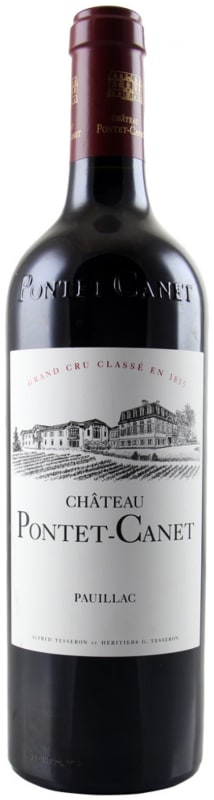


Winemaker Notes
#7 Wine Spectator Top 100 of 2008
Very intense color and nose, marked by notes of cherry, blackberry and redcurrant with traces of vanilla, liquorice and cedar. The attack is full to the palate. The tannins of great smoothness reveal a fine elegance. The finish, with no trace of aggressiveness, is marked by a good length.
Professional Ratings
-
Jeb Dunnuck
The 2005 Pontet Canet is a bruiser that’s still not anywhere near primetime. Blackcurrants, scorched earth, graphite, and saddle leather all emerge from this concentrated, powerful, structured 2005 that has an incredible amount of fruit, yet no shortage of ripe tannin, extract, and length. It needs another 4-5 years (or more) to hit maturity, but it’s an incredible wine that’s going to reward patience.
Rating: 97+ -
Robert Parker's Wine Advocate
Tasted at the Pontet-Canet vertical in London, the 2005 Château Pontet-Canet has long been one of the stars of the vintage and this might well be the best of over a dozen showings of this wine. However, do not expect ostentation on the nose. This is 2005 and like many wines of this vintage, even with considerable decanting, it remained broody and introspective on the nose, as if it is checking you out and seeing if you are worthy. Once you have been accepted, then it swings the doors open to reveal gorgeous scents of blackberry, briary and cassis fruit, perhaps a little more sous-bois than I have noticed compared to previous bottles. The palate is medium-bodied, but dense and structured—certainly a more masculine Pontet-Canet built for long-term ageing. Yet it retains marvelous freshness and vitality all the way through to the pencil-lead, quite saline finish. I suspect that the 2009 Pontet-Canet is more approachable than the 2005, so heeding Robert Parker's sage advice, afford this up to ten years in your cellar and then reap the rewards of patience.
-
Wine Spectator
Black in color, with aromas of blackberry, black licorice, tar, mineral and fresh flowers. Full-bodied and powerful, with ultrafine tannins that last for minutes on the palate. A polished, thought-provoking wine. Shows wonderful purity of Cabernet Sauvignon.
-
Connoisseurs' Guide
Here is a rich and powerful wine that shows off the ripeness of the vintage without losing its varietal and territorial ways. Deep, keenly defined curranty Cabernet Sauvignon fruit sits at its heart while hints of cigar box, briar and forest-floor keep it very much in the Pauillac fold. Its rounded entry is soon followed plenty of gripping tannins, and, while structured for keeping, it conveys a wonderful impression of fruity volume even now.
-
Wine Enthusiast
Despite its core of strength and power and obvious aging ability, this is already a delicious wine, with mint aromas, ripe fruit masking the solid tannins. This estate has been on a roll for several years, and this 2005 shows why.
-
Wine & Spirits
Drawn into a tannic trance, this wine's fresh black raspberry flavor moves through blueberry skin into a graphite, mineral blackout. Before the tannin, it shows a deep reservoir of fruit and the rich espresso-roast scent of fine oak. The texture is meaty, the structure set for long evolution in the cellar.


One of the world’s most classic and popular styles of red wine, Bordeaux-inspired blends have spread from their homeland in France to nearly every corner of the New World. Typically based on either Cabernet Sauvignon or Merlot and supported by Cabernet Franc, Malbec and Petit Verdot, the best of these are densely hued, fragrant, full of fruit and boast a structure that begs for cellar time. Somm Secret—Blends from Bordeaux are generally earthier compared to those from the New World, which tend to be fruit-dominant.

The leader on the Left Bank in number of first growth classified producers within its boundaries, Pauillac has more than any of the other appellations, at three of the five. Chateau Lafite Rothschild and Mouton Rothschild border St. Estephe on its northern end and Chateau Latour is at Pauillac’s southern end, bordering St. Julien.
While the first growths are certainly some of the better producers of the Left Bank, today they often compete with some of the “lower ranked” producers (second, third, fourth, fifth growth) in quality and value. The Left Bank of Bordeaux subscribes to an arguably outdated method of classification that goes back to 1855. The finest chateaux in that year were judged on the basis of reputation and trading price; changes in rank since then have been miniscule at best. Today producers such as Chateau Pontet-Canet, Chateau Grand Puy-Lacoste, Chateau Lynch-Bages, among others (all fifth growth) offer some of the most outstanding wines in all of Bordeaux.
Defining characteristics of fine wines from Pauillac (i.e. Cabernet-based Bordeaux Blends) include inky and juicy blackcurrant, cedar or cigar box and plush or chalky tannins.
Layers of gravel in the Pauillac region are key to its wines’ character and quality. The layers offer excellent drainage in the relatively flat topography of the region allowing water to run off into “jalles” or streams, which subsequently flow off into the Gironde.