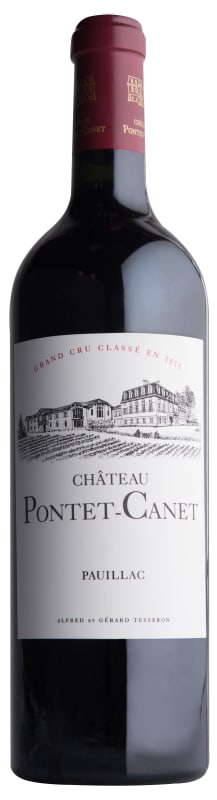


Winemaker Notes
These cooler, richer soils are better suited to Merlot and produce wines that are more structured and fleshy in texture. To establish a link with the viticultural past, four plots located on the edge of the outcrop have been planted with the Petit Verdot variety, which brings spicy aromas to the Pontet-Canet “grand vin”.
Professional Ratings
-
James Suckling
Aromas of blackcurrants and black cherries with hints of crushed walnuts, grilled thyme, cocoa powder and graphite. It’s full-bodied with layers of ultra-fine, silky tannins that elegantly coat your palate, allowing the juicy and vibrant fruit to shine. Delicate and pristine, yet compact with lots of energy and power to uncover in the coming years. It lasts for minutes and is delicious now. The purity of fruit is really impressive. 60% cabernet sauvignon, 32% merlot, 4% cabernet franc and 4% petit verdot. 50% new oak 15% old oak and 35% concrete amphorae. Try after 2027.
-
Wine Enthusiast
Pure berry fruit and cedar aromas, the wine has great purity. It is a straight line of freshness as well as black-currant fruits and ripe acidity. The wine is beautifully textured and firm at its core.
-
Decanter
Gorgeous fragrance on the nose, so perfumed and floral - really vibrant - you can smell the Cabernet and the Petit Verdot on the nose. Juiciness straight away from a burst of high acidity focussed on blackcurrant and black cherry with both a fragrance, spice and minerality following. This really hits you square on - it's not opulent but it’s so fully flavoured, forward and upfront. Tannins are fine-grained but plentiful, they hold the structure and give the frame while the creaminess and freshness gives an expansive aspect to the palate. There's refinement and an aerial quality here despite the clear Pauillac power. The Cabernet fruit is in full shine mode, giving a eucalyptus, perfumed berry and black pepper touch. Structured and supple with grape and terroir characteristics. If you love Pontet, and classic Pauillac claret, this is an impressive reference point. Skilled winemaking from technical director Mathieu Bessonet. 4% Cabernet Franc completes the blend.
Barrel Sample: 95 -
Jeb Dunnuck
Ripe blue fruits, spring flowers, violets, tobacco, and some graphite notes all emerge from the 2021 Château Pontet-Canet, a richer, medium to full-bodied Pauillac that has polished, building tannins, terrific overall balance, and outstanding length. It picks up more classic Pauillac lead pencil notes with time in the glass (I was able to taste this on multiple occasions) and is a fleshy, beautifully textured 2021 that will benefit from 4-5 years of bottle age and evolve for two decades. The 2021 is based on 58% Cabernet Sauvignon, 32% Merlot, 4% Cabernet Franc, and 6% Petit Verdot that was raised 50% in new oak barrels, 35% amphora, and the balance in once-used oak.
-
Robert Parker's Wine Advocate
Offering up wild, exotic aromas of blackberries, cloves and Indian spices mingled with notions of rose petal, bruised orchard fruit and cherry pit that evolve rapidly in the glass, the 2021 Pontet-Canet is medium to full-bodied, ample and fleshy, with a layered mid-palate and refined tannins that assert themselves on the firm, saline finish. Always one of the Médoc's most singular, idiosyncratic wines, it will be interesting to see how it performs in bottle.
Barrel Sample: 91-93 -
Wine Spectator
A nice, dark, winey offering, with steeped black cherry and black currant fruit melding nicely with warm earth, alder and cast iron accents through the focused finish. Shows grip and range, with barely any indication of the vintage's skinny side. Cabernet Sauvignon, Merlot, Petit Verdot and Cabernet Franc. Best from 2026 through 2038.


One of the world’s most classic and popular styles of red wine, Bordeaux-inspired blends have spread from their homeland in France to nearly every corner of the New World. Typically based on either Cabernet Sauvignon or Merlot and supported by Cabernet Franc, Malbec and Petit Verdot, the best of these are densely hued, fragrant, full of fruit and boast a structure that begs for cellar time. Somm Secret—Blends from Bordeaux are generally earthier compared to those from the New World, which tend to be fruit-dominant.

The leader on the Left Bank in number of first growth classified producers within its boundaries, Pauillac has more than any of the other appellations, at three of the five. Chateau Lafite Rothschild and Mouton Rothschild border St. Estephe on its northern end and Chateau Latour is at Pauillac’s southern end, bordering St. Julien.
While the first growths are certainly some of the better producers of the Left Bank, today they often compete with some of the “lower ranked” producers (second, third, fourth, fifth growth) in quality and value. The Left Bank of Bordeaux subscribes to an arguably outdated method of classification that goes back to 1855. The finest chateaux in that year were judged on the basis of reputation and trading price; changes in rank since then have been miniscule at best. Today producers such as Chateau Pontet-Canet, Chateau Grand Puy-Lacoste, Chateau Lynch-Bages, among others (all fifth growth) offer some of the most outstanding wines in all of Bordeaux.
Defining characteristics of fine wines from Pauillac (i.e. Cabernet-based Bordeaux Blends) include inky and juicy blackcurrant, cedar or cigar box and plush or chalky tannins.
Layers of gravel in the Pauillac region are key to its wines’ character and quality. The layers offer excellent drainage in the relatively flat topography of the region allowing water to run off into “jalles” or streams, which subsequently flow off into the Gironde.