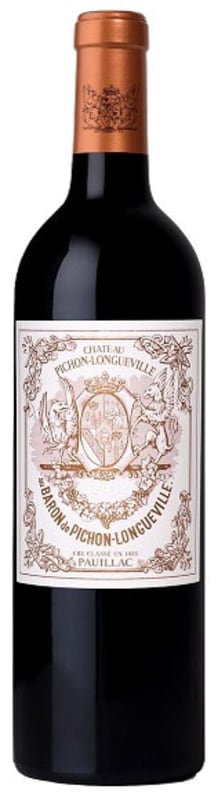


Winemaker Notes
Professional Ratings
-
Decanter
Yet another nose with standout freshness, even delicacy, but still quite youthful, mingling black fruit, spices, and spring flowers. A bit massive and still tightly wound on the palate, the wine has impressive tannic density and power but also finesse, apparent in the airborne, minty finish. Its terroir expression will need some time to come fully to the fore, but this is a superb wine.
-
Jeb Dunnuck
Reminding me of the 1990, the 2015 Château Pichon Baron is a sensational bottle of wine made from 80% Cabernet Sauvignon and 20% Merlot that spent 18 months in 80% new French oak. Boasting a deep purple color as well as awesome notes of black raspberries, toasted spices, cassis, lead pencil shavings, tobacco leaf and building minerality, this full-bodied, concentrated 2015 has sweet tannin, a great texture, and a big, big finish. Pauillac all the way, with both opulence and finesse, forget bottles of 4-5 years and enjoy anytime over the following two to three decades. This is a match for the 2009, 2000, and 1990.
-
Wine Enthusiast
This is one of the great successes of this vintage. It is generous and rich while also solid and structured. The combination of the essence of black currant and the elegant tannic structure are superb. This is a wine for serious aging and the wine should not be broached before 2026.
Cellar Selection -
Robert Parker's Wine Advocate
Medium to deep garnet-purple in color, the 2015 Pichon-Longueville Baron is enticingly scented of chocolate-covered cherries, crushed red currants and mulberries with touches of baking spices, potpourri and bay leaves plus a hint of fallen leaves. Sumptuously elegant, refreshing and medium-bodied with gorgeous, expressive, perfumed red fruits and very fine, very firm tannins, it has a persistent, perfumed finish. Its remarkable intensity, freshness and very firm frame suggest a long-lived Pichon Baron, which should cellar gracefully for 30+ years.
-
Wilfred Wong of Wine.com
A masterful wine, the 2015 Château Pichon Baron navigates nicely through elegance and power. The wine's fresh red currants deftly lead into nuances of black fruits and bright minerality. On the palate, there is a firmness that makes it superbly satisfying. This wine will go down as one of the château's best wines ever. (Tasted: January 25, 2018, San Francisco, CA)
-
Connoisseurs' Guide
Sensationally rich though it may be, this spellbinding wine earns its third star by way of its impeccable crafting and polish. It is full and wonderfully fleshy in feel, but its potency comes with a sense of unexpected grace and it conveys confidence without need of swagger. Evocative of cassis, berries and optimally ripe plums, but not stopping with fruit and showing a penetrating streak of stony, graphite-like minerality along with touches of black tea and a smattering of exotic spice, it is at once fairly accessible yet has the structure to warn against overly hasty drinking. It will likely test the resolve of claret collectors who are short on patience, but six to ten years of patience is very much in order if the wine is to reach its considerable best.
-
James Suckling
Blackberries, sweet tobacco, incense and currants. Aromatic. Medium to full body and firm, sleek tannins. Racy and refined. Shows lovely balance and finesse. Pretty now, but needs another three or four years of bottle age. Try from 2023. Reviewed in Hong Kong Chinese Wine Tasting July 2020.
-
Wine Spectator
A fresh and focused style, with a terrific beam of black cherry and black currant compote flavors. Strong graphite and black tea notes harness the finish, ending with alder and tobacco echoes. This has serious length without losing any drive along the way. Best from 2022 through 2038.


One of the world’s most classic and popular styles of red wine, Bordeaux-inspired blends have spread from their homeland in France to nearly every corner of the New World. Typically based on either Cabernet Sauvignon or Merlot and supported by Cabernet Franc, Malbec and Petit Verdot, the best of these are densely hued, fragrant, full of fruit and boast a structure that begs for cellar time. Somm Secret—Blends from Bordeaux are generally earthier compared to those from the New World, which tend to be fruit-dominant.

The leader on the Left Bank in number of first growth classified producers within its boundaries, Pauillac has more than any of the other appellations, at three of the five. Chateau Lafite Rothschild and Mouton Rothschild border St. Estephe on its northern end and Chateau Latour is at Pauillac’s southern end, bordering St. Julien.
While the first growths are certainly some of the better producers of the Left Bank, today they often compete with some of the “lower ranked” producers (second, third, fourth, fifth growth) in quality and value. The Left Bank of Bordeaux subscribes to an arguably outdated method of classification that goes back to 1855. The finest chateaux in that year were judged on the basis of reputation and trading price; changes in rank since then have been miniscule at best. Today producers such as Chateau Pontet-Canet, Chateau Grand Puy-Lacoste, Chateau Lynch-Bages, among others (all fifth growth) offer some of the most outstanding wines in all of Bordeaux.
Defining characteristics of fine wines from Pauillac (i.e. Cabernet-based Bordeaux Blends) include inky and juicy blackcurrant, cedar or cigar box and plush or chalky tannins.
Layers of gravel in the Pauillac region are key to its wines’ character and quality. The layers offer excellent drainage in the relatively flat topography of the region allowing water to run off into “jalles” or streams, which subsequently flow off into the Gironde.