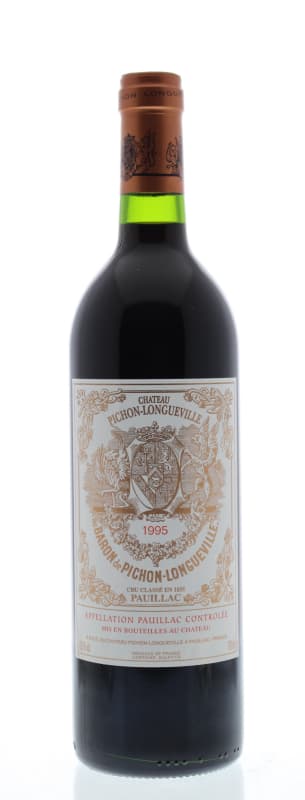


Winemaker Notes
Professional Ratings
-
Vinous
The 1995 Pichon Baron was an ex-château bottle that had been reconditioned at the estate. This has a beautiful bouquet, a mixture of red and black fruit, cedar and mint, the latter becoming prominent with aeration. A friend mentioned rooibos tea and I immediately clock that scent. The palate is medium-bodied with fine tannins, very pure and slightly ferrous in style. I have to say that this bottle is superior to previous ones, more vigorous with greater weight and less evolution towards the finish. Quite sweet on the aftertaste, it is simply, banally, just delicious.
-
Robert Parker's Wine Advocate
A stylish, elegant, more restrained style of Pichon Baron, with less obvious new oak than usual, this deep ruby/purple-colored wine offers a pure black currant-scented nose with subtle aromas of coffee and smoky toasty oak. In the mouth, the wine displays less weight and muscle than the 1996, but it offers suave, elegant, rich fruit presented in a medium to full-bodied, surprisingly lush style.
-
Wine Spectator
Blackberry, with violet and currant undertones. Full-bodied, with silky tannins and a long finish. A little tight still. Give it some time. This is layered and rich. Classy.


One of the world’s most classic and popular styles of red wine, Bordeaux-inspired blends have spread from their homeland in France to nearly every corner of the New World. Typically based on either Cabernet Sauvignon or Merlot and supported by Cabernet Franc, Malbec and Petit Verdot, the best of these are densely hued, fragrant, full of fruit and boast a structure that begs for cellar time. Somm Secret—Blends from Bordeaux are generally earthier compared to those from the New World, which tend to be fruit-dominant.

The leader on the Left Bank in number of first growth classified producers within its boundaries, Pauillac has more than any of the other appellations, at three of the five. Chateau Lafite Rothschild and Mouton Rothschild border St. Estephe on its northern end and Chateau Latour is at Pauillac’s southern end, bordering St. Julien.
While the first growths are certainly some of the better producers of the Left Bank, today they often compete with some of the “lower ranked” producers (second, third, fourth, fifth growth) in quality and value. The Left Bank of Bordeaux subscribes to an arguably outdated method of classification that goes back to 1855. The finest chateaux in that year were judged on the basis of reputation and trading price; changes in rank since then have been miniscule at best. Today producers such as Chateau Pontet-Canet, Chateau Grand Puy-Lacoste, Chateau Lynch-Bages, among others (all fifth growth) offer some of the most outstanding wines in all of Bordeaux.
Defining characteristics of fine wines from Pauillac (i.e. Cabernet-based Bordeaux Blends) include inky and juicy blackcurrant, cedar or cigar box and plush or chalky tannins.
Layers of gravel in the Pauillac region are key to its wines’ character and quality. The layers offer excellent drainage in the relatively flat topography of the region allowing water to run off into “jalles” or streams, which subsequently flow off into the Gironde.