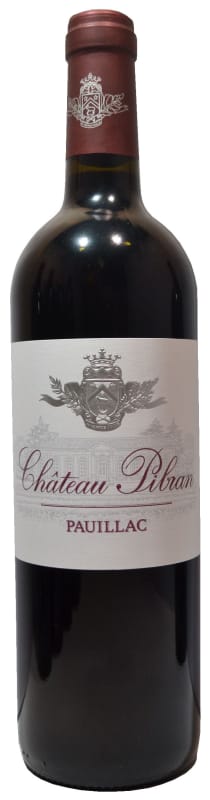


Winemaker Notes
Château Pibran estate benefits from a prestigious, 17-hectare terroir on one of Pauillac’s most beautiful hilltops.The wines benefit from exceptional support, with the vinification process and technical monitoring both carried out by the Château Pichon Baron team.
Blend: 54% Cabernet Sauvignon, 46% Merlot
Professional Ratings
-
Wine Spectator
Very solid from the start, with dark currant and blackberry compote notes, a graphite grip and a long tobacco- and iron-fueled finish. Very well-defined.
Barrel Sample:92-95 -
Jeb Dunnuck
The 2018 Château Pibran emerges from a cooler, gravelly terroir in Pauillac and is close to an even split of Cabernet Sauvignon and Merlot, all raised in 50% new oak. Lots of red, black, and blue fruits as well as lead pencil, violets, camphor, and smoked tobacco emerge from the glass, and it's medium to full-bodied, with a terrific sense of freshness, ripe yet firm, polished tannins, and a great finish. This is another classic Pauillac that's going to benefit from 3-6 years of bottle age (it's far from unapproachable today) and keep for 20-25 years in cold cellars. Rating : 93+
-
James Suckling
Blackcurrant, blueberry, pencil-lead, clove and walnut-husk aromas. It’s medium-to full-bodied with firm, tight-grained tannins. Nice minerality. Try from 2024 and onwards.
-
Robert Parker's Wine Advocate
The 2018 Pibran is a blend of 54% Cabernet Sauvignon and 46% Merlot, matured for 18 months in barriques, 50% new and 50% one year old. Deep garnet-purple in color, it comes skipping out of the glass with bright, cheerful scents of Morello cherries, mulberries and wild blueberries, giving way to a core of cassis, dark chocolate and violets, with a waft of wood smoke. Medium-bodied, the palate is delicately styled with fantastic freshness and fine-grained tannin's supporting the crunchy black fruit layers, finishing long and lifted.
-
Wine Enthusiast
Rich in both structure and fruit, this wine has ripe tannins and a full, generous texture that is given shape by full-bodied, black-fruit flavors. From the northern part of Pauillac, the wine is good for medium-term aging. Drink from 2023.
-
Decanter
A very tasty, enjoyable Pibran that comes from a cooler site than the main Pichon Baron wine, from gravel soils over a bed of limestone, and always the last for the team to harvest as was the case again in 2018. You can certainly feel the freshness and juice through the dark fruits – a wine that will be limbered up after just four or five years in bottle. 50% new oak. A yield of 37hl/ha. Drinking Window 2024 - 2038. Barrel Sample: 90


One of the world’s most classic and popular styles of red wine, Bordeaux-inspired blends have spread from their homeland in France to nearly every corner of the New World. Typically based on either Cabernet Sauvignon or Merlot and supported by Cabernet Franc, Malbec and Petit Verdot, the best of these are densely hued, fragrant, full of fruit and boast a structure that begs for cellar time. Somm Secret—Blends from Bordeaux are generally earthier compared to those from the New World, which tend to be fruit-dominant.

The leader on the Left Bank in number of first growth classified producers within its boundaries, Pauillac has more than any of the other appellations, at three of the five. Chateau Lafite Rothschild and Mouton Rothschild border St. Estephe on its northern end and Chateau Latour is at Pauillac’s southern end, bordering St. Julien.
While the first growths are certainly some of the better producers of the Left Bank, today they often compete with some of the “lower ranked” producers (second, third, fourth, fifth growth) in quality and value. The Left Bank of Bordeaux subscribes to an arguably outdated method of classification that goes back to 1855. The finest chateaux in that year were judged on the basis of reputation and trading price; changes in rank since then have been miniscule at best. Today producers such as Chateau Pontet-Canet, Chateau Grand Puy-Lacoste, Chateau Lynch-Bages, among others (all fifth growth) offer some of the most outstanding wines in all of Bordeaux.
Defining characteristics of fine wines from Pauillac (i.e. Cabernet-based Bordeaux Blends) include inky and juicy blackcurrant, cedar or cigar box and plush or chalky tannins.
Layers of gravel in the Pauillac region are key to its wines’ character and quality. The layers offer excellent drainage in the relatively flat topography of the region allowing water to run off into “jalles” or streams, which subsequently flow off into the Gironde.