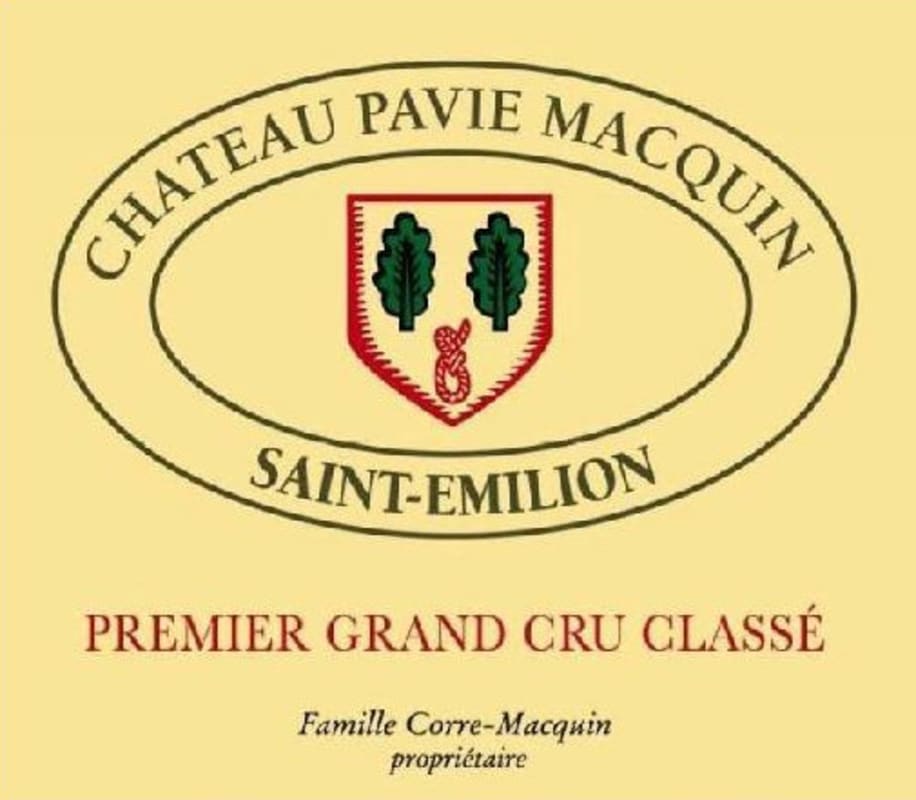


Winemaker Notes
Blend: 78% Merlot, 20% Cabernet Franc, 2% Cabernet Sauvignon
Professional Ratings
-
Jeb Dunnuck
From a cooler, pure limestone terroir just over the hill from Château Pavie, the 2018 Château Pavie Macquin offers an incredible assortment of red and black fruits, cedary spice, white truffle, graphite, and beautiful minerality. Showing the cooler, complex, concentrated style of the vineyard, it's full-bodied and powerful on the palate, with no shortage of extract or tannins. The wine always has a healthy pH and needs bottle age to show at its best. A solid 7-8 years are warranted here, and it will keep for 2-3 decades. The 2018 is 78% Merlot, 20% Cabernet Franc, and 2% Cabernet Sauvignon, representing 90% of the total production. I think this estate has been underrated in the market and it can still be found for reasonable prices. It ages beautifully and I doubt you could have too much in the cellar. Barrel Sample: 97-99
-
Decanter
This is just so good. Not overly big, it has nuance, sapidity and grace, with space between the lines. It's not sacrificing its concentration but it gives you a chance to get onboard and accompany it along the way. I love the quality of the brambled blackberry and loganberry fruit here, and the touch of austerity that gives a welcome note of bitter chocolate to the finish. It has great tannic grip and there's no question that this will age well, but it's also extremely drinkable now. Tasted several times, and each occasion blew me away. My favourite vintage to date from this property.
Barrel Sample: 98 -
Wine Spectator
Packed with very expressive boysenberry and red currant paste aromas and flavors, this is dense and fleshy in feel, but has the energy to easily carry it off. Lots of chalky cut on the long finish. Rock-solid.
Barrel Sample:95-98 -
James Suckling
Violets, blackcurrants, cloves, tobacco, orange zest and dark chocolate on the nose. It’s medium-to full-bodied with firm, silky tannins and fresh acidity. Sleek and refined with elegant floral and spice notes on a long finish. Interesting hint of bitterness at the end. Try from 2025.
-
Robert Parker's Wine Advocate
The 2018 Pavie Macquin is deep garnet-purple colored and a little closed to begin, slowly revealing subtle notions of dark chocolate, candied violets and rose hip tea over a core of plum preserves, blueberry compote and cherry coulis plus wafts of woodsmoke and crushed stones. Full-bodied, the palate has a seriously impressive structure of ripe, firm, velvety tannins and bold freshness carrying off all that rich black fruit, finishing very long and mineral laced.
Barrel Sample: 95-97 -
Wine Enthusiast
The pure black currant fruits of this exemplary wine are matched with bright acidity and ripe, solid tannins. It is impressively rich and will certainly age well.
Barrel Sample:94-96


One of the world’s most classic and popular styles of red wine, Bordeaux-inspired blends have spread from their homeland in France to nearly every corner of the New World. Typically based on either Cabernet Sauvignon or Merlot and supported by Cabernet Franc, Malbec and Petit Verdot, the best of these are densely hued, fragrant, full of fruit and boast a structure that begs for cellar time. Somm Secret—Blends from Bordeaux are generally earthier compared to those from the New World, which tend to be fruit-dominant.

Marked by its historic fortified village—perhaps the prettiest in all of Bordeaux, the St-Émilion appellation, along with its neighboring village of Pomerol, are leaders in quality on the Right Bank of Bordeaux. These Merlot-dominant red wines (complemented by various amounts of Cabernet Franc and/or Cabernet Sauvignon) remain some of the most admired and collected wines of the world.
St-Émilion has the longest history in wine production in Bordeaux—longer than the Left Bank—dating back to an 8th century monk named Saint Émilion who became a hermit in one of the many limestone caves scattered throughout the area.
Today St-Émilion is made up of hundreds of independent farmers dedicated to the same thing: growing Merlot and Cabernet Franc (and tiny amounts of Cabernet Sauvignon). While always roughly the same blend, the wines of St-Émilion vary considerably depending on the soil upon which they are grown—and the soils do vary considerably throughout the region.
The chateaux with the highest classification (Premier Grand Cru Classés) are on gravel-rich soils or steep, clay-limestone hillsides. There are only four given the highest rank, called Premier Grand Cru Classés A (Chateau Cheval Blanc, Ausone, Angélus, Pavie) and 14 are Premier Grand Cru Classés B. Much of the rest of the vineyards in the appellation are on flatter land where the soils are a mix of gravel, sand and alluvial matter.
Great wines from St-Émilion will be deep in color, and might have characteristics of blackberry liqueur, black raspberry, licorice, chocolate, grilled meat, earth or truffles. They will be bold, layered and lush.