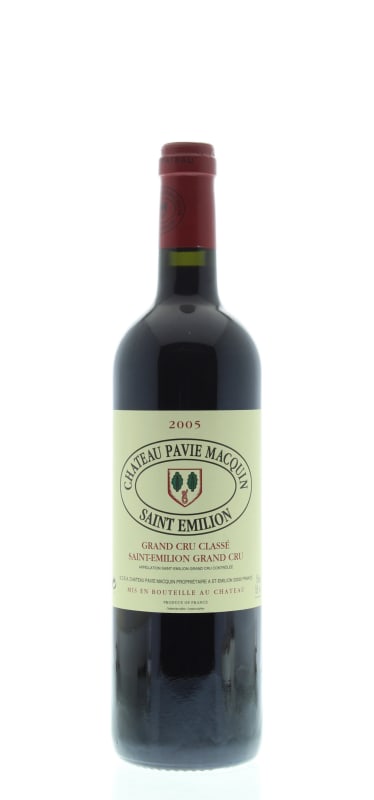


Winemaker Notes
Professional Ratings
-
Jeb Dunnuck
A blend of 70% Merlot, 25% Cabernet Franc, and 5% Cabernet Sauvignon, from a cool limestone terroir on the plateau, the 2005 Château Pavie Macquin is extraordinary juice, and the finest vintage of this cuvee I’ve ever tasted. Sporting a saturated purple color as well as an off the hook bouquet of crème de cassis, blackberries, smoked earth, chocolate, and Asian spices, with a sensational sense of minerality developing with time in the glass. Deep, full-bodied, massively concentrated, and multi-dimensional, it’s just now at the early stages of its drinking plateau and it will probably keep for another 2-3 decades. Count yourself lucky if you have bottles of this in the cellar!
-
Robert Parker's Wine Advocate
Inky bluish/purple in color, Pavie Macquin produced a prodigious effort from St.-Emilion in 2005. Its crushed, chalky rock minerality, massive body, and high tannin make for a wine to forget for another decade. Super-loaded, concentrated and powerful, this wine should turn out great, but patience will be required. The blackberry and cassis fruit are there in abundance, but so is a massive structure. Anticipated maturity: 2020-2035. Rating: 96+
-
Wine Spectator
Terrifically dense, with layers of plum sauce, melted red licorice, raspberry coulis and blackberry pâte de fruit coursing along, but never top-heavy, as alluring floral and incense notes hang in the background. The long, mineral-driven finish keeps everything firmly grounded. Approachable now, but has a ways to go.—Non-blind Pavie Macquin vertical (December 2014). Best from 2019 through 2029.
-
Wine Enthusiast
This chateau deserved its promotion to Premier Grand Cru in 2006. Nicolas Thienpont has made a wonderfully firm, dense wine that piles rich fruit upon tannin upon rich fruit, while still preserving considerable elegance. The after effect is of a solid wine, powerful, long-lasting.
Cellar Selection -
Wine & Spirits
A grand wine, this is about as heady as Pavie-Macquin gets. It feels supple, sophisticated and so fattened with robust black cherry fruit that it's about to burst. But instead the fruit density remains balanced, mouthwatering in its floral tannins that hint at lavender and mint. Complex and profound, yet still easy to enjoy, this wine will give tremendous pleasure for decades to come.


One of the world’s most classic and popular styles of red wine, Bordeaux-inspired blends have spread from their homeland in France to nearly every corner of the New World. Typically based on either Cabernet Sauvignon or Merlot and supported by Cabernet Franc, Malbec and Petit Verdot, the best of these are densely hued, fragrant, full of fruit and boast a structure that begs for cellar time. Somm Secret—Blends from Bordeaux are generally earthier compared to those from the New World, which tend to be fruit-dominant.

Marked by its historic fortified village—perhaps the prettiest in all of Bordeaux, the St-Émilion appellation, along with its neighboring village of Pomerol, are leaders in quality on the Right Bank of Bordeaux. These Merlot-dominant red wines (complemented by various amounts of Cabernet Franc and/or Cabernet Sauvignon) remain some of the most admired and collected wines of the world.
St-Émilion has the longest history in wine production in Bordeaux—longer than the Left Bank—dating back to an 8th century monk named Saint Émilion who became a hermit in one of the many limestone caves scattered throughout the area.
Today St-Émilion is made up of hundreds of independent farmers dedicated to the same thing: growing Merlot and Cabernet Franc (and tiny amounts of Cabernet Sauvignon). While always roughly the same blend, the wines of St-Émilion vary considerably depending on the soil upon which they are grown—and the soils do vary considerably throughout the region.
The chateaux with the highest classification (Premier Grand Cru Classés) are on gravel-rich soils or steep, clay-limestone hillsides. There are only four given the highest rank, called Premier Grand Cru Classés A (Chateau Cheval Blanc, Ausone, Angélus, Pavie) and 14 are Premier Grand Cru Classés B. Much of the rest of the vineyards in the appellation are on flatter land where the soils are a mix of gravel, sand and alluvial matter.
Great wines from St-Émilion will be deep in color, and might have characteristics of blackberry liqueur, black raspberry, licorice, chocolate, grilled meat, earth or truffles. They will be bold, layered and lush.