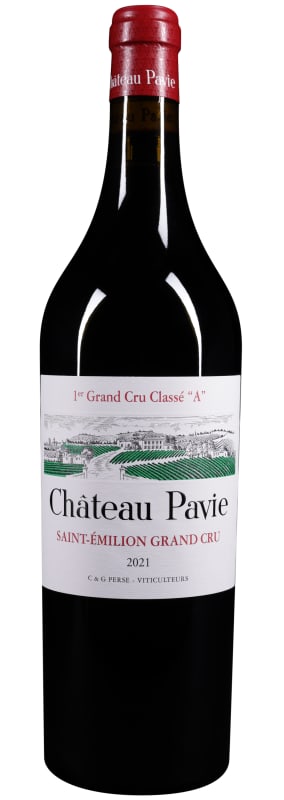


Winemaker Notes
Blend: 52% Merlot, 30% Cabernet Franc, 18% Cabernet Sauvignon
Professional Ratings
-
James Suckling
Very complex with red currants, iodine and iron. Medium-bodied, with a dense yet energetic palate and a long and racy finish showing chalk and gunpowder. Flinty. 52% merlot, 30% cabernet franc and 18% cabernet sauvignon. Tight at the end, suggesting at least four to five years of cellaring. Drink after 2029.
-
Decanter
Extremely dark aromatics on the nose, dark bramble fruits, cedar and liquorice with a really vibrant but dark indigo rim to the wine. Focussed and sharp, high toned in the best way, this really makes you smile when you first taste it, the juicy but almost sweet acidity making the mouth water while salty, but so well defined tannins coat the mouth giving the structure and support. Lovely finesse and movement from start to finish and an excellent weight too - deep and round but straight and pristine. Feels a bit relaxed, quite elegant and not pushed or too tense at this point. A lovely wine to drink, acidity, fruit purity, fine tannins and a sense of balance and good construction. Still a little constricted on the finish, this will need time, but when it hits its drinking window this will be lovely to drink. Fresh and invigorating but keeping the structure and power.
-
Jeb Dunnuck
As to the Grand Vin, the saturated ruby/purple-hued 2021 Château Pavie defies the vintage with its ripe, powerful aromatics of cassis, toasted spice, chalky minerality, graphite, and hints of truffly earth. A rich, medium to full-bodied, concentrated, incredibly textured 2021, it has velvety tannins, no hard edges, and a gorgeous finish. It's a testament to the talent and work of this incredible team and is up with the crème de la crème of the vintage. The 2021 is based on 52% Merlot, 30% Cabernet Franc, and 18% Cabernet Sauvignon, brought up in a mix of new and used barrels, hitting 14.14% alcohol and a pH of 3.67. It’s going to age for 20-25 years if well stored.
-
Vinous
The 2021 Pavie is a potent, brooding wine that is going to need time to be at its best. Floral and spice notes confer freshness on the bouquet. In this tasting, the 2021 feels a bit tight. I doubt that will be an issue in another few years' time. Structurally, the 2021 is a touch lighter than most recent vintages, but the identity is there. The move towards move Cabernet in the blend since 2019 has markedly changed the character of Pavie. The 2021 is on the linear side today. I can't wait to see how it ages. -Antonio Galloni
-
Wine Spectator
Blackberry and black cherry compote flavors bring a restrained juiciness, while floral, singed apple wood and black tea notes fill in liberally. The finish extends nicely, with a long, underlying chalky minerality. An admirable effort for the vintage. Merlot, Cabernet Franc and Cabernet Sauvignon. Best from 2025 through 2040.


One of the world’s most classic and popular styles of red wine, Bordeaux-inspired blends have spread from their homeland in France to nearly every corner of the New World. Typically based on either Cabernet Sauvignon or Merlot and supported by Cabernet Franc, Malbec and Petit Verdot, the best of these are densely hued, fragrant, full of fruit and boast a structure that begs for cellar time. Somm Secret—Blends from Bordeaux are generally earthier compared to those from the New World, which tend to be fruit-dominant.

Marked by its historic fortified village—perhaps the prettiest in all of Bordeaux, the St-Émilion appellation, along with its neighboring village of Pomerol, are leaders in quality on the Right Bank of Bordeaux. These Merlot-dominant red wines (complemented by various amounts of Cabernet Franc and/or Cabernet Sauvignon) remain some of the most admired and collected wines of the world.
St-Émilion has the longest history in wine production in Bordeaux—longer than the Left Bank—dating back to an 8th century monk named Saint Émilion who became a hermit in one of the many limestone caves scattered throughout the area.
Today St-Émilion is made up of hundreds of independent farmers dedicated to the same thing: growing Merlot and Cabernet Franc (and tiny amounts of Cabernet Sauvignon). While always roughly the same blend, the wines of St-Émilion vary considerably depending on the soil upon which they are grown—and the soils do vary considerably throughout the region.
The chateaux with the highest classification (Premier Grand Cru Classés) are on gravel-rich soils or steep, clay-limestone hillsides. There are only four given the highest rank, called Premier Grand Cru Classés A (Chateau Cheval Blanc, Ausone, Angélus, Pavie) and 14 are Premier Grand Cru Classés B. Much of the rest of the vineyards in the appellation are on flatter land where the soils are a mix of gravel, sand and alluvial matter.
Great wines from St-Émilion will be deep in color, and might have characteristics of blackberry liqueur, black raspberry, licorice, chocolate, grilled meat, earth or truffles. They will be bold, layered and lush.