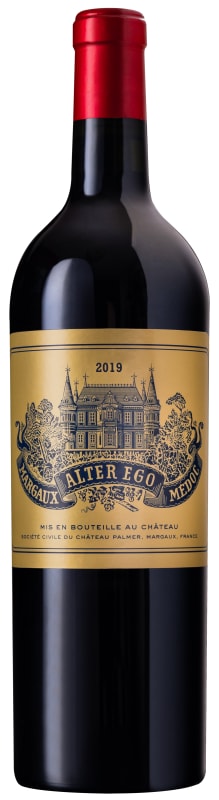


Winemaker Notes
With its dark red robe, the 2019 Alter Ego immediately impresses with its explosive aromatics. Subtle notes of red fruits evoking raspberries and redcurrants blend harmoniously with the floral fragrance of a field in spring. The sensation on the palate, initially refreshing, unfolds into a texture of great softness and length. This is Alter Ego at its best – a wine perfectly true to its identity.
Blend: 51% Merlot, 40% Cabernet Sauvignon, 9% Petit Verdot
Professional Ratings
-
James Suckling
Intense aromas of blackcurrants, cedar and ripe tobacco with hints of violets, following through to a full-bodied palate with extremely refined tannins that are well-integrated into the wine and are long and subtle at the finish. Such precision and harmony with structure. From biodynamically grown grapes.
-
Decanter
Cinnamon spice on the nose, with a patisserie edge to the fruits that gives a rich, creamy impression. As ever with the Palmer stable of wines, you can pick out the individual flavours clearly, with careful and precise delineation of cassis, bilberry, slate and tobacco notes, but overall this is an outstanding Alter Ego that puts the emphasis on pleasure. Tannins are extremely precise but feathery and pliable. An extremely low 37ppm of SO2 at this stage, in keeping with biodynamic principles and a desire to let the fruit speak.
Barrel Sample: 94 -
Jeb Dunnuck
The second wine of Château Palmer, the 2019 Alter Ego De Palmer is rock-solid and reveals a dense purple hue as well as deep, rich, concentrated aromas and flavors of ripe black cherries, blackcurrants, tobacco, graphite, and chocolate. It might be the richest, most concentrated second wine out here, and truthfully, it tastes like a Grand Vin. Medium to full-bodied, layered, and textured, it has ripe tannins, a fleshy, mouth-filling texture, and a great finish. It's beautifully done.
-
Vinous
The 2019 Alter Ego de Palmer is delineated and focused on the nose with blackberry, cedar and graphite scents. More austere yet still complex and one with the most cerebral Margaux aromatics. The palate is medium-bodied with sappy black fruit, quite saline and peppery, firm and insistent grip with quiet assertive tannins on the finish. A Margaux that should be given a long-term lease in your cellar. Tasted blind at the Southwold annual tasting.
-
Robert Parker's Wine Advocate
Aromas of sweet cherries, raspberries, berry fruit liqueur, licorice and spices introduce the 2019 Alter Ego de Palmer, a medium to full-bodied, fleshy and enveloping wine with lively acids, melting tannins and a lavish core of ripe, creamy fruit. It's more immediate than the more muscular, powerful grand vin.
-
Wine Spectator
Caressing, offering plum and cherry sauce flavors, hints of ganache and tobacco, with a sanguine hint on the fresh humus-tinged finish. Merlot, Cabernet Sauvignon and Petit Verdot.


One of the world’s most classic and popular styles of red wine, Bordeaux-inspired blends have spread from their homeland in France to nearly every corner of the New World. Typically based on either Cabernet Sauvignon or Merlot and supported by Cabernet Franc, Malbec and Petit Verdot, the best of these are densely hued, fragrant, full of fruit and boast a structure that begs for cellar time. Somm Secret—Blends from Bordeaux are generally earthier compared to those from the New World, which tend to be fruit-dominant.

Silky, seductive and polished are the words that characterize the best wines from Margaux, the most inland appellation of the Médoc on the Left Bank of Bordeaux.
Margaux’s gravel soils are the thinnest of the Médoc, making them most penetrable by vine roots—some reaching down over 23 feet for water. The best sites are said to be on gentle outcrops, or croupes, where more gravel facilitates good drainage.
The Left Bank of Bordeaux subscribes to an arguably outdated method of classification but it is nonetheless important in regards to history of the area. In 1855 the finest chateaux were deemed on the basis of reputation and trading price—at that time. In 1855, Chateau Margaux achieved first growth status, yet it has been Chateau Palmer (officially third growth from the 1855 classification) that has consistently outperformed others throughout the 20th century.
Chateau Margaux in top vintages is capable of producing red Cabernet Sauvignon based wines described as pure, intense, spell-binding, refined and profound with flavors and aromas of black currant, violets, roses, orange peel, black tea and incense.
Other top producers worthy of noting include Chateau Rauzan-Ségla, Lascombes, Brane-Cantenac, and d’Issan, among others.
The best wines of Margaux combine a deep ruby color with a polished structure, concentration and an unrivaled elegance.