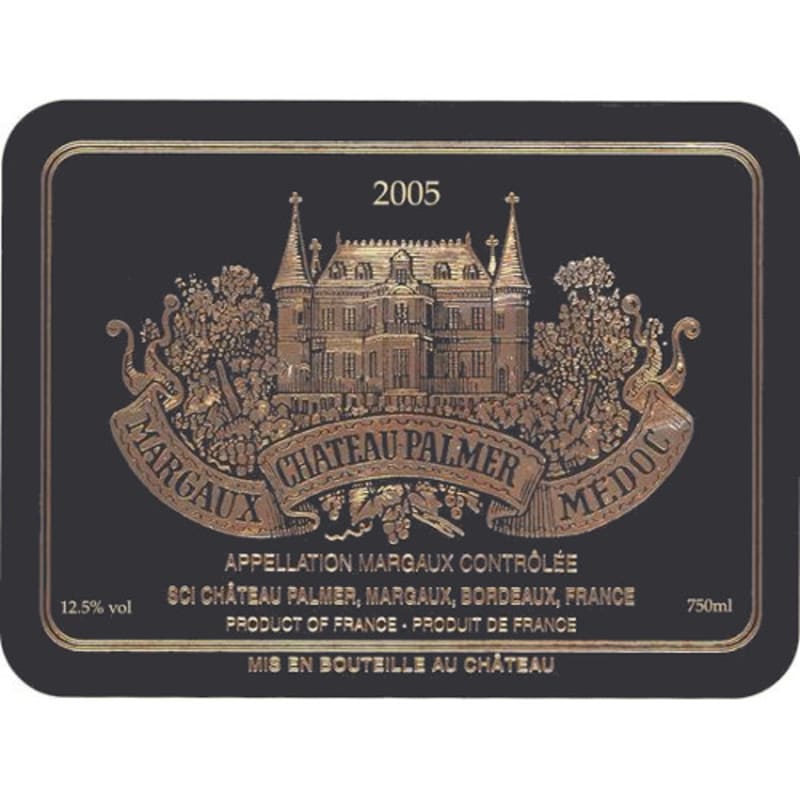

Winemaker Notes
The fruit is so opulent that the richness in the nose is answered by opulence in the mouth, structured by sumptuous tannins allied to sovereign freshness. The wine has imperious presence and is already glistening. Velvety and suave, the length lingers forever.
The vintage is wholly contained in this Palmer that epitomizes Palmer at its best: breed, balance and elegance.
Conceivable peak: 2015-2050.
Professional Ratings
-
Robert Parker's Wine Advocate
This spectacular offering should continue to improve, and may merit an even higher score after additional aging. Stunningly rich and powerful, the dark purple-tinged 2005 Palmer is a blend of 53% Cabernet Sauvignon, 40% Merlot, and 7% Petit Verdot. Aromas of incense, burning embers, black currants, plums, licorice, and flowers are followed by a full-bodied Margaux with more weight and power even than its nearby first-growth rival, Chateau Margaux. The abundant acidity and tannins are beautifully coated by the wine's exceptional fruit extract and overall harmony and richness. It is so concentrated that one is hard pressed to find even a hint of new oak. Anticipated maturity: 2017-2045+
-
Wine Enthusiast
Aromas of black tar, chocolate and berries lead to a wine that is so effortlessly delicious that it’s easy to forget the power the Merlot gives it. The center is round, but dark, filled with sweetness; the outer layers are full of red jelly and toast. There are tannins, but they, too, are sweet.
-
Wine Spectator
Dark in color, with intense aromas of crushed berry, toasty oak and hints of raisin, turning to fresh flowers. Full-bodied, with a big, juicy, velvety texture and a long aftertaste of coffee, coconut and berry. This is powerful and muscular for Palmer. Best after 2012.
-
James Suckling
What a nose of milk chocolate, with raspberries and hints of plums and flowers. A wonderful nose. Full-bodied, with super velvety tannins and a chocolate, nut, and dark fruit character on the palate. The fine tannins and great balance make you want to drink this, but you should wait and let it all out. Pull the cork in 2016.


One of the world’s most classic and popular styles of red wine, Bordeaux-inspired blends have spread from their homeland in France to nearly every corner of the New World. Typically based on either Cabernet Sauvignon or Merlot and supported by Cabernet Franc, Malbec and Petit Verdot, the best of these are densely hued, fragrant, full of fruit and boast a structure that begs for cellar time. Somm Secret—Blends from Bordeaux are generally earthier compared to those from the New World, which tend to be fruit-dominant.

Silky, seductive and polished are the words that characterize the best wines from Margaux, the most inland appellation of the Médoc on the Left Bank of Bordeaux.
Margaux’s gravel soils are the thinnest of the Médoc, making them most penetrable by vine roots—some reaching down over 23 feet for water. The best sites are said to be on gentle outcrops, or croupes, where more gravel facilitates good drainage.
The Left Bank of Bordeaux subscribes to an arguably outdated method of classification but it is nonetheless important in regards to history of the area. In 1855 the finest chateaux were deemed on the basis of reputation and trading price—at that time. In 1855, Chateau Margaux achieved first growth status, yet it has been Chateau Palmer (officially third growth from the 1855 classification) that has consistently outperformed others throughout the 20th century.
Chateau Margaux in top vintages is capable of producing red Cabernet Sauvignon based wines described as pure, intense, spell-binding, refined and profound with flavors and aromas of black currant, violets, roses, orange peel, black tea and incense.
Other top producers worthy of noting include Chateau Rauzan-Ségla, Lascombes, Brane-Cantenac, and d’Issan, among others.
The best wines of Margaux combine a deep ruby color with a polished structure, concentration and an unrivaled elegance.