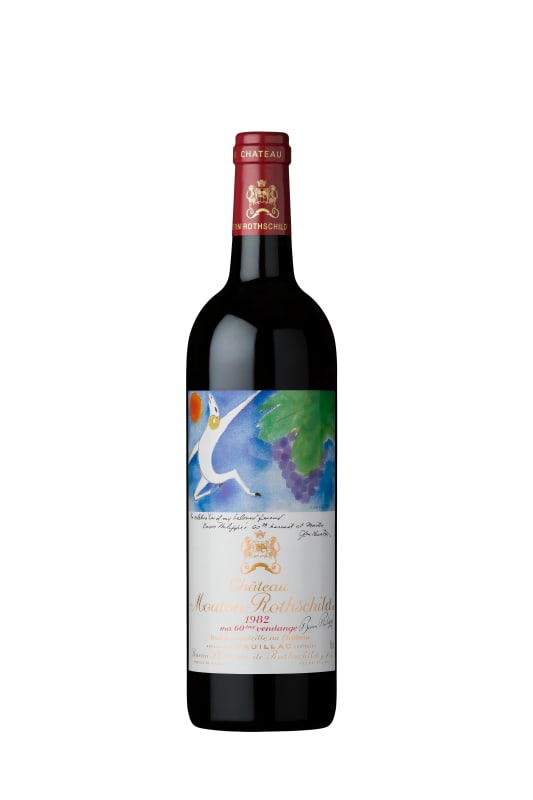


Winemaker Notes
The color is dense and deep with a slightly amber tint, while the nose reveals aromas of gingerbread, mint, very ripe fruit, blackcurrant and bilberry, with notes of cinnamon, toast and mocha. From a firm and silky attack with an elegant tannic structure of velvety, patrician tannins, the wine develops a full, round body with suggestions of licorice and caramel. Fresh, stylish, seductive and charming, with notes of chocolate, this is a powerful wine with attractive length.
Blend: 85% Cabernet Sauvignon, 8% Cabernet Franc, 7% Merlot
Professional Ratings
-
Jeb Dunnuck
A wine that’s singing today, the 1982 Chateau Mouton-Rothschild is one of those wines that needs to be tasted to be believed. It almost has a California Cabernet-like sexiness and opulence paired with pure Bordeaux class. Still solid ruby-colored, with a sensational nose of crème de cassis, lead pencil shaving, sweet tobacco, and even some flowery incense, it hits the palate with full-bodied richness, a multidimensional, layered texture, straight-up awesome levels of sweet fruit, and a blockbuster finish. This is Bordeaux at its most sexy and hedonistic, and it’s just a joy to drink. Given its relatively youthful vibe, I expect it to continue drinking brilliantly for another two decades and even at that point have a gradual decline. There’s no need to delay gratification though, and it’s certainly ready to go.
-
James Suckling
What an amazing red. It's so very youthful with toasted oak, light vanilla, and dark berries such as currants and blueberries. Then it turns to mint. This is so fresh and intensely fruity. It lasts for minutes on your palate with each sip. It is so powerful yet elegant. It will improve for hundreds of years. I would still leave it in my cellar for five or ten years. If you need to drink it, decant it three to four hours in advance.
-
Robert Parker's Wine Advocate
Over the last couple of years, I had inclined to the view that the 1986 vintage was eclipsing the 1982 Mouton Rothschild, but two perfectly conserved bottles this year put paid to that hypothesis. One of the emblematic wines of the vintage, offering up aromas of sweet crème de cassis, cigar wrapper, espresso roast, spices and vine smoke, it's full-bodied, broad and enveloping, with a rich core of fruit; ripe, supple tannins; and a long, expansive finish. Lavish, even flamboyant, and at the same time seriously structured and quintessentially Mouton, it encapsulates the greatness of the vintage.
-
Vinous
Every now and then, you chance upon a 1982 Mouton-Rothschild that blows you away. This is one such example. It has a wonderful, outgoing, precocious bouquet, with blackberry, cedar and a sprig of wild mint that is so exuberant it enraptures the olfactory senses. The palate is fuller and denser than the '82 Pichon-Lalande, with wonderful poise and layers of graphite-tinged black fruit mixed with light aniseed notes. It is unapologetically extravagant and yet it is all delivered with a kind of carefree joie de vivre. Stupendous.
-
Wine Spectator
Glorious aromas. Dark ruby red. Wonderful perfumes of flowers, berry and lilac. Full-bodied, with silky tannins and a long and pretty finish. Balanced. Class in a glass. Just as I remember.
-
Decanter
Rich and deep in colour, this has a stunning intensity on the first nose. On the palate, there is the slight iodine edge of an older Cabernet Sauvignon, set against soft brambly fruits, smoky cedar and black truffles. Soft structure but the architecture of this wine is still very much in play, building in power as it works through your palate, setting your taste buds tingling with the gentlest of tannins. Again this is a classic, superlative example of how Pauillac can age. As it uncurls in the glass, the rich smoke on the nose is just beautifully seductive, but the palate softens just a touch quicker than some of the others in this line-up.


One of the world’s most classic and popular styles of red wine, Bordeaux-inspired blends have spread from their homeland in France to nearly every corner of the New World. Typically based on either Cabernet Sauvignon or Merlot and supported by Cabernet Franc, Malbec and Petit Verdot, the best of these are densely hued, fragrant, full of fruit and boast a structure that begs for cellar time. Somm Secret—Blends from Bordeaux are generally earthier compared to those from the New World, which tend to be fruit-dominant.

The leader on the Left Bank in number of first growth classified producers within its boundaries, Pauillac has more than any of the other appellations, at three of the five. Chateau Lafite Rothschild and Mouton Rothschild border St. Estephe on its northern end and Chateau Latour is at Pauillac’s southern end, bordering St. Julien.
While the first growths are certainly some of the better producers of the Left Bank, today they often compete with some of the “lower ranked” producers (second, third, fourth, fifth growth) in quality and value. The Left Bank of Bordeaux subscribes to an arguably outdated method of classification that goes back to 1855. The finest chateaux in that year were judged on the basis of reputation and trading price; changes in rank since then have been miniscule at best. Today producers such as Chateau Pontet-Canet, Chateau Grand Puy-Lacoste, Chateau Lynch-Bages, among others (all fifth growth) offer some of the most outstanding wines in all of Bordeaux.
Defining characteristics of fine wines from Pauillac (i.e. Cabernet-based Bordeaux Blends) include inky and juicy blackcurrant, cedar or cigar box and plush or chalky tannins.
Layers of gravel in the Pauillac region are key to its wines’ character and quality. The layers offer excellent drainage in the relatively flat topography of the region allowing water to run off into “jalles” or streams, which subsequently flow off into the Gironde.