

Winemaker Notes
Professional Ratings
-
James Suckling
Incredible iodine, oyster, currants, peat and cedar. Yet subtle. Full body, chewy yet polished tannins and great depth and complexity on the finish. I love the spice and blueberry character on the finish. Vibrant. A sexy style of Mouton. Try drinking this in 2022.
-
Jeb Dunnuck
Unquestionably one of the great wines in the vintage, the 2014 Mouton-Rothschild offers more flamboyance, depth, and texture than just about every other release out there. Crème de cassis, violets, lead pencil, and ample creamy oak notes all emerge from this incredibly sexy, concentrated 2014 that has a terrific mid-palate, sweet tannin, and a great, great finish. Not far off the incredible 2015, it can be enjoyed anytime over the coming 3-4 decades, although 3-5 years of bottle age should do it good.
-
Wine Enthusiast
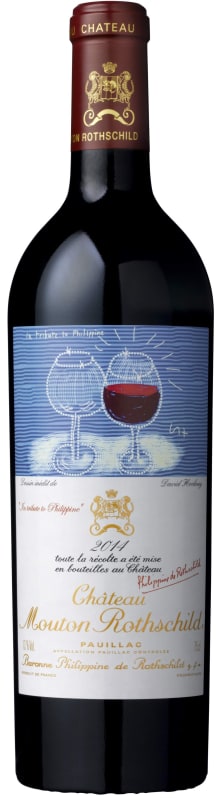
The label of this vintage is designed by David Hockney in memory of Philippine de Rothschild. It is a powerful wine in the rich style of Mouton with strong black-currant fruits from 81% Cabernet Sauvignon. It is dense and dark, ready to age for many years. Drink this impressive wine from 2026. Cellar Selection
-
Wine Spectator
This delivers a large core of pure, unadorned cassis, accented by notes of anise, plum cake, mint and bitter plum coulis. The core has serious heft, supported easily by a riveting iron spine that shows superb length through the finish. A prodigious display of power and cut. Best from 2022 through 2040.
-
Decanter
Explosively floral nose – the usual exotic Mouton fruit underlined by very ripe 16% Merlot. The classic 'iron fist in a velvet glove', with ripe tannins and marvellous structure. Its true qualities will need time to show.
Barrel Sample: 95+ -
Robert Parker's Wine Advocate
The 2014 Mouton-Rothschild was closed at first when I tasted the wine in bottle with winemaker Philippe Dhalluin. But as it transpires, this First Growth is just toying with you. Initially quite understated, it responds to aeration like a young child peeking from around a corner and then running out, waving its hands. It suddenly hits you with gorgeous black cherries, bilberry, cedar and wilted rose petal. The palate is medium-bodied with a silky smooth entry. This is utterly seductive: a wine without a hair out of place. It is not as powerful or as complex as the 2015 Mouton-Rothschild, yet the precision and focus here is beguiling. It will require five to seven years to absorb the 100% new oak, then it will be an utterly delicious and to use a term employed at en primeur, "cerebral" First Growth that is destined to give two or three decades of pleasure.


One of the world’s most classic and popular styles of red wine, Bordeaux-inspired blends have spread from their homeland in France to nearly every corner of the New World. Typically based on either Cabernet Sauvignon or Merlot and supported by Cabernet Franc, Malbec and Petit Verdot, the best of these are densely hued, fragrant, full of fruit and boast a structure that begs for cellar time. Somm Secret—Blends from Bordeaux are generally earthier compared to those from the New World, which tend to be fruit-dominant.

The leader on the Left Bank in number of first growth classified producers within its boundaries, Pauillac has more than any of the other appellations, at three of the five. Chateau Lafite Rothschild and Mouton Rothschild border St. Estephe on its northern end and Chateau Latour is at Pauillac’s southern end, bordering St. Julien.
While the first growths are certainly some of the better producers of the Left Bank, today they often compete with some of the “lower ranked” producers (second, third, fourth, fifth growth) in quality and value. The Left Bank of Bordeaux subscribes to an arguably outdated method of classification that goes back to 1855. The finest chateaux in that year were judged on the basis of reputation and trading price; changes in rank since then have been miniscule at best. Today producers such as Chateau Pontet-Canet, Chateau Grand Puy-Lacoste, Chateau Lynch-Bages, among others (all fifth growth) offer some of the most outstanding wines in all of Bordeaux.
Defining characteristics of fine wines from Pauillac (i.e. Cabernet-based Bordeaux Blends) include inky and juicy blackcurrant, cedar or cigar box and plush or chalky tannins.
Layers of gravel in the Pauillac region are key to its wines’ character and quality. The layers offer excellent drainage in the relatively flat topography of the region allowing water to run off into “jalles” or streams, which subsequently flow off into the Gironde.