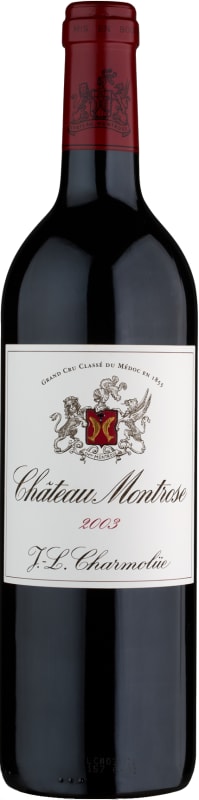


Winemaker Notes
Dense, deep, purple color with a ruby reflection. Very complex nose offering aromas of ripe red berries, currants, mocha, liquorice, and peony. Complex and very fresh palate loaded with black fruit, chocolate (cocoa with silky tannins). Fabulous wine, full-bodied and very structured. Fresh. Beautiful length with neat, velvety tannins. Splendid aromatic complexity.
Blend: 62% Cabernet-Sauvignon, 34% Merlot, 3% Cabernet Franc, 1% Petit Verdot
Professional Ratings
-
Jeb Dunnuck
A prodigious beast of a wine that's now starting to shed just a touch of its considerable baby fat, the 2003 Château Montrose is based on 62% Cabernet Sauvignon, 34% Merlot, 3% Cabernet Franc, and the rest Petit Verdot. It shows the richness of the vintage with its ripe, opulent core of fruit, yet it freshens up noticeably with time in the glass, offering currants, mulberries, smoked tobacco, minty herbs, and licorice. Full-bodied, deep, and powerful on the palate, it still has classic Bordeaux focus and structure.
-
Robert Parker's Wine Advocate
The 2003 Montrose was served blind in Bordeaux on two occasions. Picked between 11 to 26 September, it is a blend of 62% Cabernet Sauvignon, 34% Merlot, 3% Cabernet Franc and 1% Petit Verdot. It remains one of the outstanding wines of a very black and white vintage. Without knowledge of the vintage, I was hesitant to suggest 2003, because though there is clearly fruit intensity locked up inside this Saint Estèphe, it is counterbalanced by the estate's trademark masculinity and austerity. So both on the nose and the palate it reaches this happy medium: pure blackberry, graphite and roasted herbs on the nose, perhaps even more elegant than I have observed on previous bottles. The palate is medium-bodied rather than full bodied with sturdy tannins couched in layers of seamless blackberry and cassis fruit, offset by scents of tobacco and graphite. As usual it has immense length and depth, a Montrose that is really just a few chapters into what is sure to be a longer "book" than many other 2003s.
-
James Suckling
After the 2009, this is the most exciting Montrose ever made, with intense aromas and flavors of plums, blueberries, spices, tobacco and cedar. It’s full-bodied with extremely refined tannins but a dense, delicious palate.
-
Wine Enthusiast
Thought by many tasters to be the wine of the vintage at the time of the 2004 barrel tastings. Has it retained that status? It is certainly a hugely powerful wine, monumental even. It is also finely balanced, with great dark tannins working in partnership with brooding black fruit. The question is whether it is too big, too powerful: only time will tell.
-
Wine Spectator
Dark color. Aromas of blackberry, toasted oak, spice and tobacco. Loads of plum. Medium- to full-bodied, with very integrated and refined tannins. Long. This really builds on the palate. This is better than the 2000 and 1990. Only time will tell if it's better than the 1989.


One of the world’s most classic and popular styles of red wine, Bordeaux-inspired blends have spread from their homeland in France to nearly every corner of the New World. Typically based on either Cabernet Sauvignon or Merlot and supported by Cabernet Franc, Malbec and Petit Verdot, the best of these are densely hued, fragrant, full of fruit and boast a structure that begs for cellar time. Somm Secret—Blends from Bordeaux are generally earthier compared to those from the New World, which tend to be fruit-dominant.

Deeply colored, concentrated, and distinctive, St. Estephe is the go-to for great, age-worthy and reliable Bordeaux reds. Separated from Pauillac merely by a stream, St. Estephe is the farthest northwest of the highest classed villages of the Haut Medoc and is therefore subject to the most intense maritime influence of the Atlantic.
St. Estephe soils are rich in gravel like all of the best sites of the Haut Medoc but here the formation of gravel over clay creates a cooler atmosphere for its vines compared to those in the villages farther downstream. This results in delayed ripening and wines with higher acidity compared to the other villages.
While they can seem a bit austere when young, St. Estephe reds prove to live very long in the cellar. Traitionally dominated by Cabernet Sauvignon, many producers now add a significant proportion of Merlot to the blend, which will soften any sharp edges of the more tannic, Cabernet.
The St. Estephe village contains two second growths, Chateau Montrose and Cos d’Estournel.