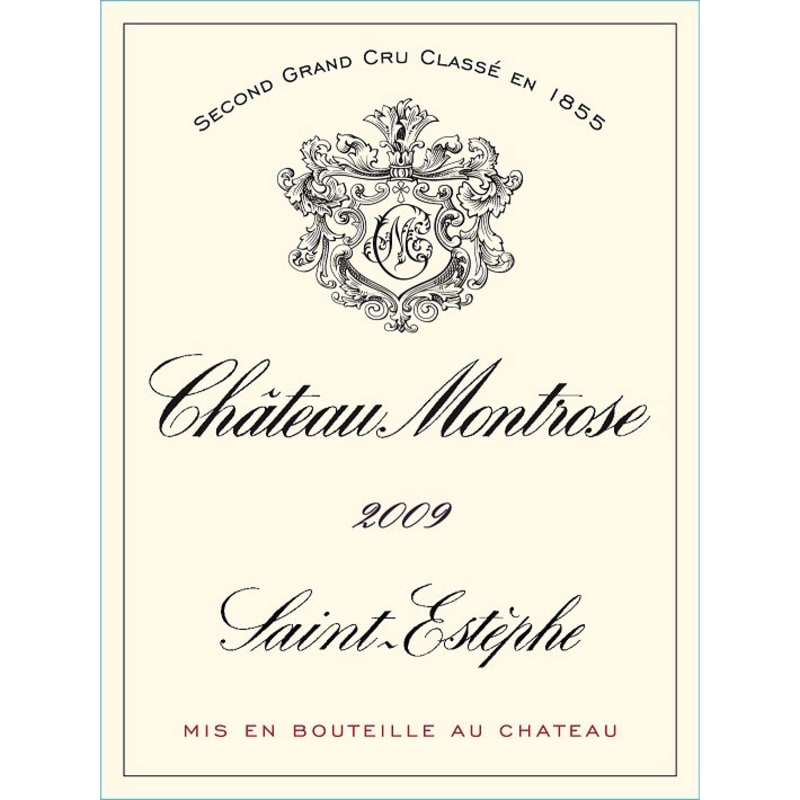

Winemaker Notes
Deep and dense, dark color with dark ruby tints. The nose is complex with morello, core of cherry and blackberry. It delivers notes of citron and spices (saffron). Aromas of redcurrant, cassis, morello, cocoa and liquorice develop on the palate. Supple and long-lasting finish on neat, coated and very precise tannins. Complex, balanced and harmonious wine. The tasting reveals very homogeneous, soft and silky. Incredibly long finish.
Blend: 65% Cabernet Sauvignon, 29% Merlot, 5% Cabernet Franc, 1% Petit Verdot
Professional Ratings
-
Robert Parker's Wine Advocate
A brilliant wine that stands out as one of the high points of the vintage, the 2009 Montrose unwinds in the glass with a rich and incipiently complex bouquet of dark berries, cigar wrapper and loamy soil, framed by a deftly judged touch of new oak. Full-bodied, broad and enveloping, it's a velvety, layered and impressively dynamic wine that's deep and concentrated, exhibiting terrific balance and a long, resonant finish. While it is still five or six years away from showing all its cards, I have drunk this benchmark for contemporary Montrose with immense pleasure three times this year. In style, it's hard to find an obvious comparison (and I have drunk Montrose back to 1895), but I would be inclined to invoke a fresher, more complete and more powerful version of the estate's very successful 2003.
-
James Suckling
For the very ripe vintage this has a herbal and wet earth nose that's very cool. Then on the palate there’s a ton of ripe cassis, polished fine tannins and a tremendous freshness powering the very long dry finish.
-
Decanter
A brilliant Montrose, and a great window into what St Estèphe can deliver. This is fresh and concentrated, with ripe cassis fruits, sweet vanilla bean and black pepper spice notes alongside robust tannins, 1% Petit Verdot completes the blend. Jean-Bernard Delmas was estate director for this wine, and is making the most of the complex soils that are gravel-dominant towards the river, with pockets of sand over clay and limestone where the Merlots tend to be planted. Starting to feel ready to drink, but is going nowhere in a hurry. Drinking Window: 2020 - 2042.
-
Wine Spectator
A bit of a brute, with a very chewy bittersweet ganache, tobacco and roasted fig core splayed open right now by a dagger of roasted apple wood, allspice and cedar. Long and dense through the finish, with a strong singed iron edge.
-
Wine Enthusiast
Enormous tannins, dominant black fruit and a solid, dense structure. The wine, packed with dark fruits, dry tannins, very firm in character. With its huge tannins as well as fruit, this is a wine that really needs many years of aging.
Cellar Selection


One of the world’s most classic and popular styles of red wine, Bordeaux-inspired blends have spread from their homeland in France to nearly every corner of the New World. Typically based on either Cabernet Sauvignon or Merlot and supported by Cabernet Franc, Malbec and Petit Verdot, the best of these are densely hued, fragrant, full of fruit and boast a structure that begs for cellar time. Somm Secret—Blends from Bordeaux are generally earthier compared to those from the New World, which tend to be fruit-dominant.

Deeply colored, concentrated, and distinctive, St. Estephe is the go-to for great, age-worthy and reliable Bordeaux reds. Separated from Pauillac merely by a stream, St. Estephe is the farthest northwest of the highest classed villages of the Haut Medoc and is therefore subject to the most intense maritime influence of the Atlantic.
St. Estephe soils are rich in gravel like all of the best sites of the Haut Medoc but here the formation of gravel over clay creates a cooler atmosphere for its vines compared to those in the villages farther downstream. This results in delayed ripening and wines with higher acidity compared to the other villages.
While they can seem a bit austere when young, St. Estephe reds prove to live very long in the cellar. Traitionally dominated by Cabernet Sauvignon, many producers now add a significant proportion of Merlot to the blend, which will soften any sharp edges of the more tannic, Cabernet.
The St. Estephe village contains two second growths, Chateau Montrose and Cos d’Estournel.