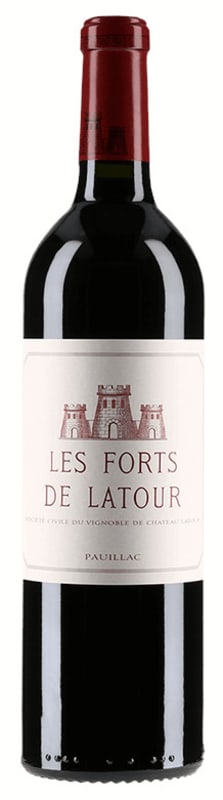


Winemaker Notes
Château Latour, with origins dating back to 1331, is set in the heart of the Médoc, about 50 km northwest of Bordeaux—the birthplace of Bordeaux's legendary vineyards. Les Forts de Latour is sourced from three distinct areas, including part of the Enclos. The wine takes its name from a historic parcel within the Enclos. Since it was first bottled under this name in 1966, relentless dedication to quality has placed it among the finest classified growths of the Médoc. From vineyard to cellar, Les Forts de Latour is crafted with the same meticulous care as the Grand Vin. The only key difference, aside from its origins, is the proportion of new oak barrels used for ageing—between 50% and 60%.
Blend: 69.7% Cabernet Sauvignon, 26.7% Merlot, 3.7% Petit Verdot
Professional Ratings
-
James Suckling
Already nicely open at this stage, with a ripe cedar quality to the cassis fruit. Some discreet notes of tobacco leaves, ash, black licorice and graphite. Lots of dusty tannins surround the palate, giving a dense but caressing sensation. Structured, polished and generous, but extremely well-formed. Really long, concentrated and layered. A blend of 70% cabernet sauvignon, 26.5% merlot and 3.5% petit verdot.
-
Jeb Dunnuck
A blockbuster of a Les Forts, the 2020 Les Forts de Latour is based on 70% Cabernet Sauvignon, 26.5% Merlot, and the rest Petit Verdot and aged 18 months in 60% new French oak. Its deep ruby/plum hue is followed by textbook Latour notes of currants, melted crayon, graphite, and lead pencil shavings. Medium to full-bodied, dense, and concentrated on the palate, it has a powerful, structured mouthfeel, remarkable purity, perfectly ripe tannins, and a great, great finish. It might be the finest Les Forts I've tasted. Hitting 13.1% alcohol, it's approachable today yet has another 30 years of longevity. Drink 2026-2056.
-
Vinous
The 2020 Les Forts de Latour has a fresh, delineated, precise and focused bouquet of graphite-infused black fruit. The oak is neatly integrated. The palate is medium-bodied with sapid black fruit, fine depth and ample grip. This builds momentum toward a structured finish, with a dash of spice lingering on the aftertaste. Excellent. Tasted blind at the annual Southwold tasting.
-
Wine Enthusiast
The wine's black currant fruits are sustained through the structure and the wine's great concentration. With delicious freshness at the same time as the vibrant fruit, this second wine of Latour is very fine and ready to age.
Barrel Sample: 93-95 -
Decanter
Dark fruits on the nose with purple violet floral reflections, milk chocolate and cocoa touches give hints of savoury complexity on the nose. Pumped, alive and round, this is full in the mouth, supple but with high acidity. Round and textured in the mouth with powdery, crushed velvet tannins giving the depth and width. Round, bright, vivacious, plump and juicy. Joyful but still cool and fresh with salty stone elements, blue fruits as well as plums and blackcurrants with cola touches. I really like this, feels really well worked, very complete, lively, energetic, and detailed. 3.7pH
-
Robert Parker's Wine Advocate
The 2020 Les Forts de Latour is composed of 70% Cabernet Sauvignon, 26.5% Merlot and 3.5% Petit Verdot, incorporating a 64-hectoliter tank of Merlot that would normally have been included in the Grand Vin but which didn't fit with this year's blend. Unwinding in the glass with aromas of minty cassis, plums, licorice, pipe tobacco and vanilla pod, it's medium to full-bodied, rich and velvety, with terrific depth at the core and a somewhat more textural, granular profile than the suave 2019.


One of the world’s most classic and popular styles of red wine, Bordeaux-inspired blends have spread from their homeland in France to nearly every corner of the New World. Typically based on either Cabernet Sauvignon or Merlot and supported by Cabernet Franc, Malbec and Petit Verdot, the best of these are densely hued, fragrant, full of fruit and boast a structure that begs for cellar time. Somm Secret—Blends from Bordeaux are generally earthier compared to those from the New World, which tend to be fruit-dominant.

The leader on the Left Bank in number of first growth classified producers within its boundaries, Pauillac has more than any of the other appellations, at three of the five. Chateau Lafite Rothschild and Mouton Rothschild border St. Estephe on its northern end and Chateau Latour is at Pauillac’s southern end, bordering St. Julien.
While the first growths are certainly some of the better producers of the Left Bank, today they often compete with some of the “lower ranked” producers (second, third, fourth, fifth growth) in quality and value. The Left Bank of Bordeaux subscribes to an arguably outdated method of classification that goes back to 1855. The finest chateaux in that year were judged on the basis of reputation and trading price; changes in rank since then have been miniscule at best. Today producers such as Chateau Pontet-Canet, Chateau Grand Puy-Lacoste, Chateau Lynch-Bages, among others (all fifth growth) offer some of the most outstanding wines in all of Bordeaux.
Defining characteristics of fine wines from Pauillac (i.e. Cabernet-based Bordeaux Blends) include inky and juicy blackcurrant, cedar or cigar box and plush or chalky tannins.
Layers of gravel in the Pauillac region are key to its wines’ character and quality. The layers offer excellent drainage in the relatively flat topography of the region allowing water to run off into “jalles” or streams, which subsequently flow off into the Gironde.