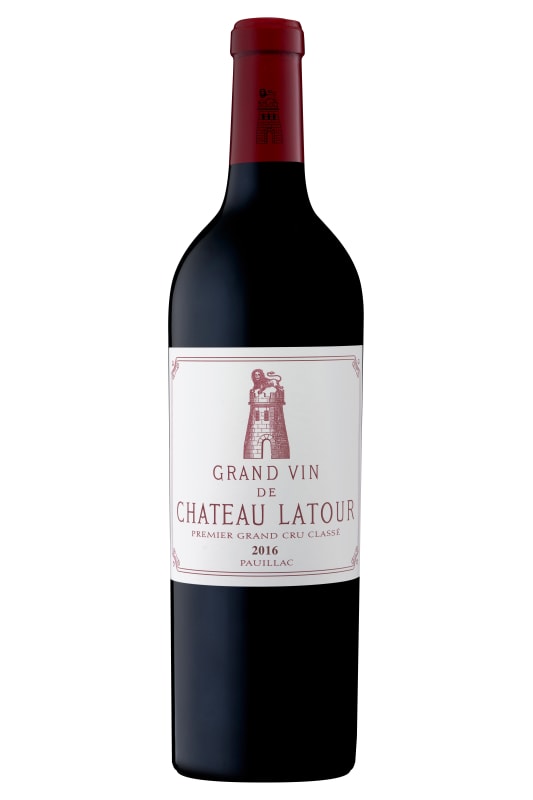


Winemaker Notes
Château Latour’s Grand Vin is made exclusively from "vieilles vignes", an average of 60 years-old, in the Enclos. Gravettes, Sarmentier, Pièce de Château... these are the names of some of the finest plots that express the character of the terroir and forge the wine's identity every year.
The 2016 offers a backbone of focused, taut tannins and a long-lasting, bright finish.
Blend: 92.9% Cabernet Sauvignon, 7.1% Merlot
Professional Ratings
-
Decanter
The 2016 blend is 92.9% Cabernet Sauvignon and 7.1% Merlot, with an IPT of 83. It represents 36% of the overall production. At this stage, you are almost as aware of how much is being held back as how much is being revealed. The power in reserve is thrilling, even more so because although there is a lightness and florality running through the palate, it sacrifices none of the Latour signature. This is more 2005 then 2010 in expression, a beautiful wine with an amazing style that has the length and texture of the great vintages, freshened up by exceptional salinity on the finish. Fine, fine tannins, crushed tobacco and mint leaves, a momentum that is unmissable and more 'Latour' than the 2015 was at this stage. Hélène Génin is the winemaker and Vincent Masson (son of Pierre Masson) is the estate's biodynamic consultant. This vintage is 50% biodynamic for the grand vin (entirely organic), but from 2017 that is being extended to 100%. My guess is that we should expect to wait eight or so years before they put this on the market.
Barrel Sample: 100 -
Jeb Dunnuck
Retasting the 2016 Château Latour next to both the 2010 and 2022 had me feeling like a kid in a candy store. Needing lots of air to show at its best, its dense purple hue is followed by quintessential Latour notes of smoky blackcurrants, scorched earth, graphite, and lead pencil shavings. This carries to a medium to full-bodied Pauillac that has lively acids, a pure, seamless, layered mouthfeel, building yet perfectly ripe tannins, and that rare Latour mix of power, austerity, and elegance that makes this château so compelling. Pulled from just 36% of the total production, the 2016 is 92.9% Cabernet Sauvignon and 7.1% Merlot hitting 13.5 alcohol with an IPT of 83. It's primarily academic at this stage, but it's starting to round the corner and clearly, with its level of fruit and overall balance, offers pleasure. I think it needs another 5-7 years to hit the early stages of its prime drinking window and will have 75-100 years of overall longevity.
-
James Suckling
I am dreaming as I smell this wine, perfectly ripe cabernet sauvignon with currants, tobacco and fresh mint. Orange blossoms too. This amazing nose is so complex. Medium- to full-bodied, this has has perfectly integrated tannins that you don't feel but know are there, elevating the wine to another level. It's very drinkable because of its stellar balance, yet the tannic tension gives it energy and seamless texture. A benchmark Latour that reminds me of the 1982 in many ways.
-
Wine Enthusiast
Reaching for 100 points, this Latour has great structure and power. Almost pure Cabernet Sauvignon this year, it is a grandiose wine, packed with tannins, rich black fruits and a solid core that will allow it to age over so many years. The acidity and crisp black-currant flavor at the end means the fruit can only shine even more as it develops. Superb.
Barrel Sample: 98-100 -
Vinous
The 2016 Latour has a very pure bouquet that soars from the glass, more floral than its peers, with crushed violet petals infusing the mixture of black and blue fruit; hints of blood orange and camphor emerge with time in the glass. The medium-bodied palate displays supple tannins and a fine bead of acidity. Powerful and quite burly, this bottle does not deliver the finesse and breeding that previous bottles have shown, simply because it needs a very long decanting. I have encountered perfect examples of the 2016 Latour, and though I did not meet one today, I will do so again. Tasted blind at the Southwold tasting.
Rating: 98+


One of the world’s most classic and popular styles of red wine, Bordeaux-inspired blends have spread from their homeland in France to nearly every corner of the New World. Typically based on either Cabernet Sauvignon or Merlot and supported by Cabernet Franc, Malbec and Petit Verdot, the best of these are densely hued, fragrant, full of fruit and boast a structure that begs for cellar time. Somm Secret—Blends from Bordeaux are generally earthier compared to those from the New World, which tend to be fruit-dominant.

The leader on the Left Bank in number of first growth classified producers within its boundaries, Pauillac has more than any of the other appellations, at three of the five. Chateau Lafite Rothschild and Mouton Rothschild border St. Estephe on its northern end and Chateau Latour is at Pauillac’s southern end, bordering St. Julien.
While the first growths are certainly some of the better producers of the Left Bank, today they often compete with some of the “lower ranked” producers (second, third, fourth, fifth growth) in quality and value. The Left Bank of Bordeaux subscribes to an arguably outdated method of classification that goes back to 1855. The finest chateaux in that year were judged on the basis of reputation and trading price; changes in rank since then have been miniscule at best. Today producers such as Chateau Pontet-Canet, Chateau Grand Puy-Lacoste, Chateau Lynch-Bages, among others (all fifth growth) offer some of the most outstanding wines in all of Bordeaux.
Defining characteristics of fine wines from Pauillac (i.e. Cabernet-based Bordeaux Blends) include inky and juicy blackcurrant, cedar or cigar box and plush or chalky tannins.
Layers of gravel in the Pauillac region are key to its wines’ character and quality. The layers offer excellent drainage in the relatively flat topography of the region allowing water to run off into “jalles” or streams, which subsequently flow off into the Gironde.