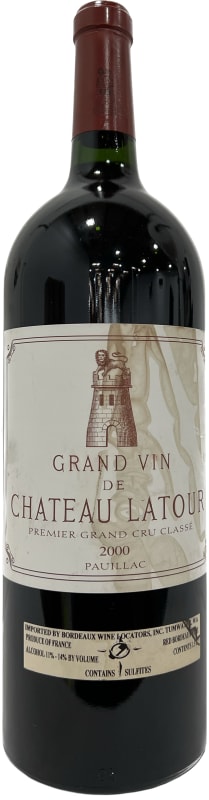


Winemaker Notes
Impressive deep, dark color. The wine has powerful, balanced structure. The dense structures and the unique qualities of the tannins may be superior to those of the '96 and '90 vintage. The balance of the wine combines class, rigor, complexity and great finesse in the fruit.
Professional Ratings
-
James Suckling
Latour has made truly great wines in the past two decades—and this is one of the best. It has fabulous aromas of black truffles, currants, raspberry and dried flowers. Mind-blowing on the palate, it’s an emotional and soulful red.
-
Decanter
Dense and complex, this shows layers of dark fruit with aromas of plum, fig and blackcurrant overlaid with spice, leather and earth. It is not as expressive as the 2001 vintage now, but it is more substantial, almost massive. There was rain at Latour on 19th September, which refreshed the grapes, and the team waited until 22nd September to start with the Merlot. The final blend is 77% Cabernet Sauvignon, 16% Merlot, 4% Cabernet Franc and 3% Petit Verdot. It is just beginning to open now and should age gracefully for another 30 or 40 years.
-
Wine Spectator
The fruit here is still very much in the primary phase, with a decidedly racy feel to the raspberry coulis, cassis and blackberry reduction notes that are streaked with violet, iron and graphite flavors. The superlong finish alternates between a tug of sweet earth and a velvety feel, as the fruit and grip are still melding together, but there's so much vivacity here, there's no concern with waiting it out. The wait may be a while though. Rather stunning that this can separate itself so clearly from the rest of 2000's high-class field.—Blind 2000 Bordeaux retrospective (December 2015). Best from 2020 through 2040. 14,165 cases made.
-
Wine Enthusiast
This is such an expressive wine, with elegance a major factor in its character. It is certainly huge, rich and dense. But there is much more to it. You can peel layers of fruit and tannins away, and still never get to the end of the wine’s complexity. At every stage of its life, it will reveal a new character, but for now it is dominated by powerful tannins and huge, black, fruit.
-
Robert Parker's Wine Advocate
2000 saw a warm, dry July and August with a small amount of rain from mid-September onward. Composed of 77% Cabernet Sauvignon, 16% Merlot, 4% Cabernet Franc and 3% Petit Verdot, the 2000 Latour has a deep garnet color and is showing a good amount of evolution, sporting mature notes of fried exotic spices, hoisin, unsmoked cigars and fruitcake with hints of incense, potpourri, cast iron pan and charcuterie. Medium-bodied, soft, plush and savory in the mouth, it has a long, mineral-tinged finish. 14,000 cases were made this year, representing 48% of production.


One of the world’s most classic and popular styles of red wine, Bordeaux-inspired blends have spread from their homeland in France to nearly every corner of the New World. Typically based on either Cabernet Sauvignon or Merlot and supported by Cabernet Franc, Malbec and Petit Verdot, the best of these are densely hued, fragrant, full of fruit and boast a structure that begs for cellar time. Somm Secret—Blends from Bordeaux are generally earthier compared to those from the New World, which tend to be fruit-dominant.

The leader on the Left Bank in number of first growth classified producers within its boundaries, Pauillac has more than any of the other appellations, at three of the five. Chateau Lafite Rothschild and Mouton Rothschild border St. Estephe on its northern end and Chateau Latour is at Pauillac’s southern end, bordering St. Julien.
While the first growths are certainly some of the better producers of the Left Bank, today they often compete with some of the “lower ranked” producers (second, third, fourth, fifth growth) in quality and value. The Left Bank of Bordeaux subscribes to an arguably outdated method of classification that goes back to 1855. The finest chateaux in that year were judged on the basis of reputation and trading price; changes in rank since then have been miniscule at best. Today producers such as Chateau Pontet-Canet, Chateau Grand Puy-Lacoste, Chateau Lynch-Bages, among others (all fifth growth) offer some of the most outstanding wines in all of Bordeaux.
Defining characteristics of fine wines from Pauillac (i.e. Cabernet-based Bordeaux Blends) include inky and juicy blackcurrant, cedar or cigar box and plush or chalky tannins.
Layers of gravel in the Pauillac region are key to its wines’ character and quality. The layers offer excellent drainage in the relatively flat topography of the region allowing water to run off into “jalles” or streams, which subsequently flow off into the Gironde.