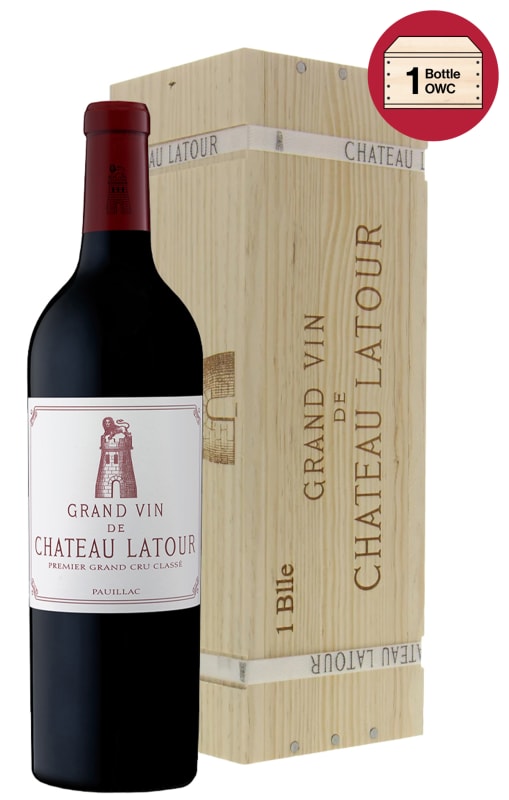


Winemaker Notes
Ex-Chateau Release March 2024 with Proof Tag for Authentication
Château Latour 2017 has a magnificent aromatic spectrum of black cherry and blackcurrant combined with fresher notes of chalk, tobacco and olive. Precise, structured tannins on a dense, deep palate make this a powerful wine with energy and balance that convey refinement and freshness.
Blend: 92.1 % Cabernet-Sauvignon, 7.8 % Merlot, 0.1 % Petit Verdot
Professional Ratings
-
James Suckling
Ripe and very powerful aromas of black licorice, currants and violets. Full-bodied, dense and flavorful with lots of very new, flashy wood. Sexy and gorgeous. Round and polished tannins. Superb wine for the vintage. Try after 2028.
-
Decanter
It's fairly unusual in 2017 to find the bright blue-violet reflections around the rim of the wine that you find in years like 2010 and 2016, but it is here in abundance. Still extremely young, knitted, closed up, holding tight to its cassis and bilberry fruits at this point. This was the first year when they were in full organics, although not certified until 2019. It's a big-framed Latour and you can see that it is going to need a good long while before softening its Pauillac tannins; at least a decade on this showing. Lovely rich deep flavours here with great dollops of black spice. It feels majestic and full of Latour signature of menthol, liquorice, slate and earth. One of the best 2017s tasted. 18 months ageing, building up to 100% new oak.
-
Robert Parker's Wine Advocate
The 2017 Latour is a blend of 92.1% Cabernet Sauvignon, 7.8% Merlot and 0.1% Petit Verdot with 13.3% alcohol and an IPT of 66. Deep garnet-purple in color, it starts off a little broody before exploding from the glass with powerful scents of ripe blackcurrants, blackberry pie and preserved black cherries plus touches of cedar chest, fenugreek, cumin seed and charcoal with emerging wafts of violets, dark chocolate, star anise and fertile loam. Medium-bodied, this may be one of the most elegant, great Latours ever, revealing layer upon layer of fresh, crunchy black fruits with a vast array of exotic spice and floral nuances, framed by super ripe, super fine-grained tannins, finishing very long with mineral sparks coming through. This is so nuanced and perfumed that I imagine, in 50 years, this wine could be mistaken for a great red Burgundy.
-
Wine Spectator
A pure, sleek, seamless beauty, featuring a crystal-clear core of cassis, cherry and damson plum fruit racing along, glistening with lilac, iron and wet pebble notes. Shows terrific spine and clarity, with well-buried grip running throughout. Cabernet Sauvignon, Merlot and Petit Verdot. Best from 2025 through 2040.
-
Vinous
The 2017 Latour lives in the realm of the totally sublime. Vertical and deep, with soaring intensity, Latour is simply magnificent in 2017. I especially like the energy and aromatic depth of the 2017, but all the elements are just impeccably balanced throughout. Constantly changing in the glass, the 2017 is mesmerizing Latour that will thrill those lucky enough to own it.
-
Jeb Dunnuck
Based on 92.1% Cabernet Sauvignon, 7.8 % Merlot, and a splash of Petite Verdot, the 2017 Chateau Latour spent 16 months in new barrels and hit 13.3% natural alcohol with a pH 3.7 and an IPT of 66. It's a classic, ageworthy Latour offering a deep purple/ruby hue, textbook Latour graphite, lead pencil, minerality, and cassis-driven aromatics, building tannins, and a beautiful sense of power married to elegance. Flawlessly balanced, medium to full-bodied, and with the class that this estate is known for, hide bottles for 7-8 years and enjoy over the following 3-4 decades.
Rating: 96+ -
Wine Enthusiast
This wine's tannins are hugely rich and concentrated. They give what is also a fruity wine power, density and shape. Don't forget the fruits though, because they will be a powerhouse of richness as they mature. Drink this wine from 2024.


One of the world’s most classic and popular styles of red wine, Bordeaux-inspired blends have spread from their homeland in France to nearly every corner of the New World. Typically based on either Cabernet Sauvignon or Merlot and supported by Cabernet Franc, Malbec and Petit Verdot, the best of these are densely hued, fragrant, full of fruit and boast a structure that begs for cellar time. Somm Secret—Blends from Bordeaux are generally earthier compared to those from the New World, which tend to be fruit-dominant.

The leader on the Left Bank in number of first growth classified producers within its boundaries, Pauillac has more than any of the other appellations, at three of the five. Chateau Lafite Rothschild and Mouton Rothschild border St. Estephe on its northern end and Chateau Latour is at Pauillac’s southern end, bordering St. Julien.
While the first growths are certainly some of the better producers of the Left Bank, today they often compete with some of the “lower ranked” producers (second, third, fourth, fifth growth) in quality and value. The Left Bank of Bordeaux subscribes to an arguably outdated method of classification that goes back to 1855. The finest chateaux in that year were judged on the basis of reputation and trading price; changes in rank since then have been miniscule at best. Today producers such as Chateau Pontet-Canet, Chateau Grand Puy-Lacoste, Chateau Lynch-Bages, among others (all fifth growth) offer some of the most outstanding wines in all of Bordeaux.
Defining characteristics of fine wines from Pauillac (i.e. Cabernet-based Bordeaux Blends) include inky and juicy blackcurrant, cedar or cigar box and plush or chalky tannins.
Layers of gravel in the Pauillac region are key to its wines’ character and quality. The layers offer excellent drainage in the relatively flat topography of the region allowing water to run off into “jalles” or streams, which subsequently flow off into the Gironde.