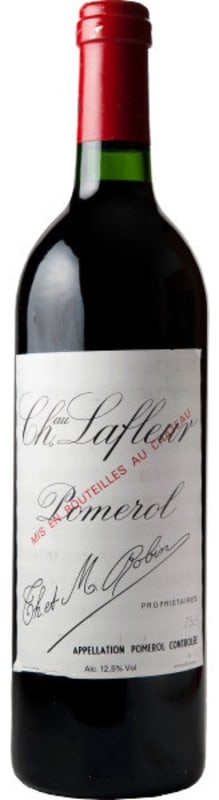


Winemaker Notes
Professional Ratings
-
Decanter
The paradox of Bordeaux is that some of the greatest vintages are almost unapproachable until they are 20 years old or more. 2010 almost certainly qualifies to be in that bracket, and no one would say this is ready to drink yet (head to Les Pensées for a good few years yet). But at 10 years it practically runs you over with its brilliance the second you get anywhere near it. This is intense with lashings of tannins yet finely wrought and elegant. Power without weight, loaded with graphite, olives, sage, rosemary and violets. This really shows how expansive Lafleur can be, and yet without the slightest trace of heaviness, this is suspended over the glass. So much nuance, texture and layers here - an utterly amazing wine from a year that had a cool early season then turned hot right through until harvest, but always with fresh nights. A standout that makes the most of its high Cabernet Franc content. Drinking Window 2021 - 2055
-
James Suckling
This red shows such beautiful and ripe aromas of blackberries, orange peel, hazelnuts, and tropical fruits. It's full-bodied, with superb texture of polished tannins that are velvety. The length last for minutes. It's muscular yet elegant. It flexes it muscle yet pulls them back. What gorgeous tone to this young red. Try in 2020.
-
Jeb Dunnuck
Killer aromatics of ripe currants, spring flowers, sappy tobacco, and underbrush, as well as white truffle, all shine in the 2010 Château Lafleur, a sensationally seamless, layered, complex 2010. It stays tight and focused on the palate, with terrific density and length. I love its tannins, it's flawlessly balanced, and it has just started to develop incredible complexity and nuance.
-
Robert Parker's Wine Advocate
Made of 62% Cabernet Franc and 38% Merlot, the deep garnet colored 2010 Lafleur features cedar chest and kirsch notes to begin, unfurling to offer baked plums, boysenberries, sandalwood and licorice scents plus a waft of pencil lead. Full-bodied, the palate is very taut and muscular, with slowly maturing red and black fruits and a solid frame of firm, ripe, grainy tannins, finishing long and mineral laced.
-
Vinous
The 2010 Lafleur is simply magnificent. It just oozes class and complexity on the nose with intense blackberry, graphite and light tertiary scents, yet there is a sense of brightness and clarity that surpasses the 2009. The palate has an unerring symmetry that roots your feet to the post. With sensational mineralité , this fans out effortlessly towards a sapid finish that urges you back for more. Yes, for sure, it requires more bottle age, but what a fabulous Lafleur.
-
Wine Spectator
Packed, with a charcoal frame and hints of alder and mesquite offering an impressive, aromatic profile, while flavors of crushed plum, warm linzer torte and blackberry preserves form the massive core. Dense, chewy and velvety, this features a riveting iron note and enticing tobacco accents that help to expand and lengthen the finish. Best from 2020 through 2040.


One of the world’s most classic and popular styles of red wine, Bordeaux-inspired blends have spread from their homeland in France to nearly every corner of the New World. Typically based on either Cabernet Sauvignon or Merlot and supported by Cabernet Franc, Malbec and Petit Verdot, the best of these are densely hued, fragrant, full of fruit and boast a structure that begs for cellar time. Somm Secret—Blends from Bordeaux are generally earthier compared to those from the New World, which tend to be fruit-dominant.

A source of exceptionally sensual and glamorous red wines, Pomerol is actually a rather small appellation in an unassuming countryside. It sits on a plateau immediately northeast of the city of Libourne on the right bank of the Dordogne River. Pomerol and St-Émilion are the stars of what is referred to as Right Bank Bordeaux: Merlot-dominant red blends completed by various amounts of Cabernet Franc or Cabernet Sauvignon. While Pomerol has no official classification system, its best wines are some of the world’s most sought after.
Historically Pomerol attached itself to the larger and more picturesque neighboring region of St-Émilion until the late 1800s when discerning French consumers began to recognize the quality and distinction of Pomerol on its own. Its popularity spread to northern Europe in the early 1900s.
After some notable vintages of the 1940s, the Pomerol producer, Petrus, began to achieve great international attention and brought widespread recognition to the appellation. Its subsequent distribution by the successful Libourne merchant, Jean-Pierre Mouiex, magnified Pomerol's fame after the Second World War.
Perfect for Merlot, the soils of Pomerol—clay on top of well-drained subsoil—help to create wines capable of displaying an unprecedented concentration of color and flavor.
The best Pomerol wines will be intensely hued, with qualities of fresh wild berries, dried fig or concentrated black plum preserves. Aromas may be of forest floor, sifted cocoa powder, anise, exotic spice or toasted sugar and will have a silky, smooth but intense texture.