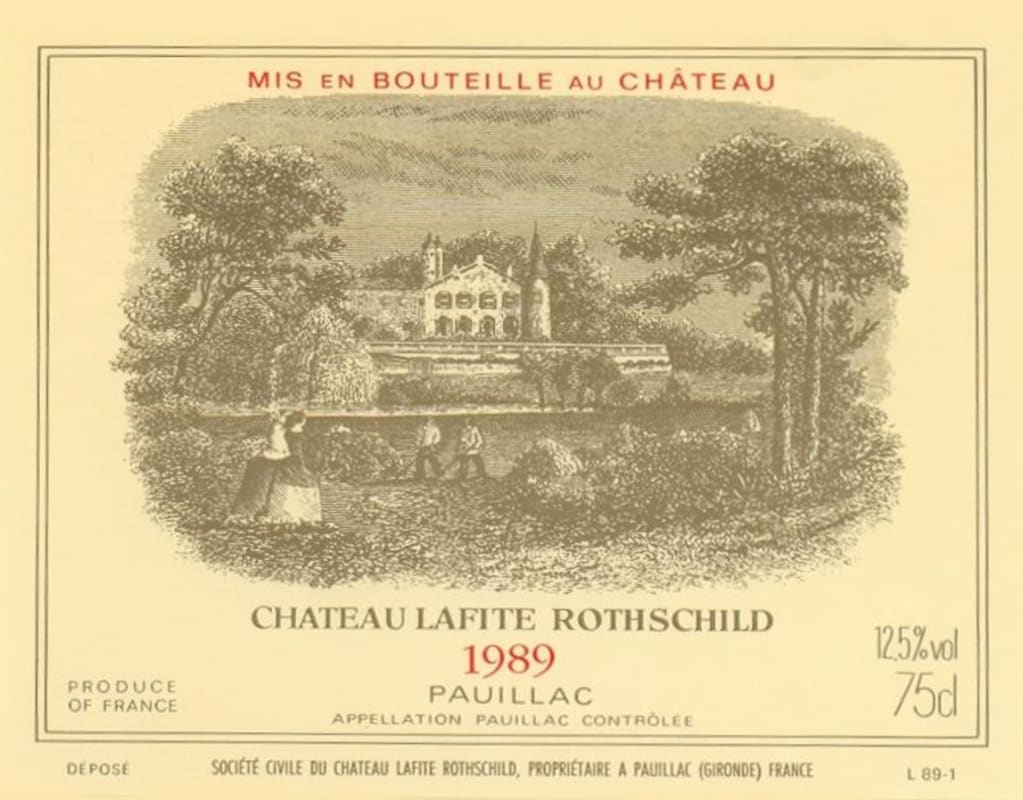

Winemaker Notes
Bordeaux had not seen such an early vintage since 1893. By the end of August, the grapes were already ripened and wonderfully sweet. We know that one can not call a vintage really great when it has been harvested too early, but this one was appreciated because it appeared to be of a good vintage. Médoc produced colourful wines, which possess excellent richness without being too heavy. Seductive, fleshy and can be compared to the 1982 wines.
Professional Ratings
-
James Suckling
Château Lafite-Rothschild Pauillac 1989: I have never been a huge fan of this Lafite but it seems to be coming into its own now. It's a wine with a character of cloves and berries with hints plums. It shows loads of potpourri. Roses too. Full and so balanced. Tight and youthful. The winemaker at Lafite says that when he wants to show someone a perfect example of Pauillac this is the Lafite he pours. Maybe he is right?
-
Wine Spectator
Subtle, yet rich and decadent, offering meat, sweet berry and fresh leather on the nose. Full and very soft, with velvety tannins and a long, fruity finish. This has so much ripe fruit. Reserved and firm, this is turning to a very fine and shy Lafite. This is fresh and structured, but still holding back. I wouldn't wait, though.
-
Robert Parker's Wine Advocate
As I suspected, the 1989 and 1990 vintages of Lafite-Rothschild have gone dormant. Both wines were among the more closed, backward examples in my blind tasting. The 1989 Lafite is also outstanding, but closed, with the tannin more elevated, and the wine so stubbornly reticent as to make evaluation almost impossible. Lafite's 1989 was far more easy to taste and understand several years ago. It appears to have gone completely to sleep. This medium ruby-colored, medium-bodied wine reveals new oak in the nose, and a spicy finish. It is a quintessentially elegant, restrained, understated style of Lafite.


One of the world’s most classic and popular styles of red wine, Bordeaux-inspired blends have spread from their homeland in France to nearly every corner of the New World. Typically based on either Cabernet Sauvignon or Merlot and supported by Cabernet Franc, Malbec and Petit Verdot, the best of these are densely hued, fragrant, full of fruit and boast a structure that begs for cellar time. Somm Secret—Blends from Bordeaux are generally earthier compared to those from the New World, which tend to be fruit-dominant.

The leader on the Left Bank in number of first growth classified producers within its boundaries, Pauillac has more than any of the other appellations, at three of the five. Chateau Lafite Rothschild and Mouton Rothschild border St. Estephe on its northern end and Chateau Latour is at Pauillac’s southern end, bordering St. Julien.
While the first growths are certainly some of the better producers of the Left Bank, today they often compete with some of the “lower ranked” producers (second, third, fourth, fifth growth) in quality and value. The Left Bank of Bordeaux subscribes to an arguably outdated method of classification that goes back to 1855. The finest chateaux in that year were judged on the basis of reputation and trading price; changes in rank since then have been miniscule at best. Today producers such as Chateau Pontet-Canet, Chateau Grand Puy-Lacoste, Chateau Lynch-Bages, among others (all fifth growth) offer some of the most outstanding wines in all of Bordeaux.
Defining characteristics of fine wines from Pauillac (i.e. Cabernet-based Bordeaux Blends) include inky and juicy blackcurrant, cedar or cigar box and plush or chalky tannins.
Layers of gravel in the Pauillac region are key to its wines’ character and quality. The layers offer excellent drainage in the relatively flat topography of the region allowing water to run off into “jalles” or streams, which subsequently flow off into the Gironde.