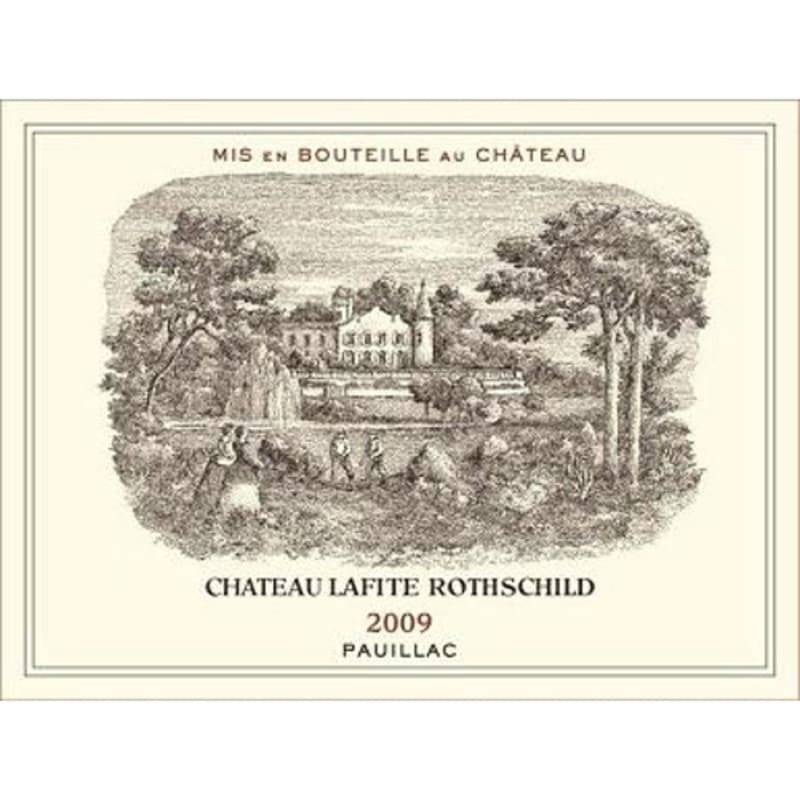

Winemaker Notes
A deep bouquet of dark fruit and licorice. The palate is full-bodied and already expressive, but then becomes tighter, expressing power and exuberance. The youth of this Lafite does not hide its energy, but the distinctive elegance and complexity are already there.
Blend: 82.5% Cabernet Sauvignon 17% Merlot 0.5% Petit Verdot
Professional Ratings
-
James Suckling
The second you put your nose in the glass, you know that it is 100 points. The combination of sweet tobacco, fresh flowers, currants and sultanas on the nose leaves me breathless. Turns to cocoa powder and freshness. The palate re-enforces the show, with phenomenally polished tannins. Fabulous class. Could be a remake of the phenomenal 1959. Try in 2022.
-
Robert Parker's Wine Advocate
The main reason the 2009 Lafite Rothschild did not receive a perfect score is because the wine has closed down slightly, but it is unquestionably another profound Lafite, their greatest wine since the amazing 2003. Among the most powerful Lafites ever made (it came in at 13.59% alcohol), the final blend was 82.5% Cabernet Sauvignon, 7% Merlot and the rest Petit Verdot. The selection was incredibly severe with only 45% of the crop being utilized. A tight, but potentially gorgeous nose of graphite, black currants, licorice and camphor is followed by a full-bodied wine revealing the classic elegance, purity and delineated style of Lafite. It is phenomenally concentrated with softer tannins than the 2005, the 2003's voluptuous, broad, juicy personality, and low acidity. There are several vintages that I thought were a replay of their colossal 1959, most notably 1982 and 2003, but 2009 is also one to keep an eye on. It is still extremely youthful and seems slightly more backward than I would have guessed based on the barrel tastings, but it needs 10-15 years of bottle age, and should last for 50+.
Rating: 99+ -
Wilfred Wong of Wine.com
One of the greatest red wines I have tasted in its youth. Rich and long, plenty and fine; this is a really long wine with lots of grip and a powerful style that I don't often see in Lafite. Yet there is plenty of elegance here. A really complete wine with lots of future and rewards to come. (98-100) (Best Served 2029-2040)
-
Decanter
It displays, as Lafite always does, more of a laid back elegance than Latour, and the difference between the two once again highlights the huge differences in terroir between north and south Pauillac, with the deep gravels here giving finesse, composure, almost nonchalance. It tames with a whisper, bringing you to submission by gently, purposefully and ever so slowly layering one thing on top of another. It has gorgeously pure and precise fruit on the nose, while the palate displays a multitude of flavours, from charcoal to cassis to crushed stone, and yet no one thing dominates. There are a ton of tannins, but they are individually fine, and it's only in retrospect that you realise how many of them there are. The tone of Lafite is speaking over the vintage, and it's going to run and run.
-
Wine Spectator
This is stunning for its ability to take massively endowed fig, currant paste and crushed plum fruit flavors and harness them with ultrasuave freshly roasted espresso, black tea and ganache notes. A seductive style, long and velvety, with the dense core of black fruit and smoldering iron just waiting and waiting. Best from 2020 through 2040.
-
Wine Enthusiast
A powerful expression of Cabernet Sauvignon, solid in structure. The wine is rich and concentrated, very textured. Great spice goes with just enough fresh acidity, in this big wine.
Barrel Sample: 95-97 Points


One of the world’s most classic and popular styles of red wine, Bordeaux-inspired blends have spread from their homeland in France to nearly every corner of the New World. Typically based on either Cabernet Sauvignon or Merlot and supported by Cabernet Franc, Malbec and Petit Verdot, the best of these are densely hued, fragrant, full of fruit and boast a structure that begs for cellar time. Somm Secret—Blends from Bordeaux are generally earthier compared to those from the New World, which tend to be fruit-dominant.

The leader on the Left Bank in number of first growth classified producers within its boundaries, Pauillac has more than any of the other appellations, at three of the five. Chateau Lafite Rothschild and Mouton Rothschild border St. Estephe on its northern end and Chateau Latour is at Pauillac’s southern end, bordering St. Julien.
While the first growths are certainly some of the better producers of the Left Bank, today they often compete with some of the “lower ranked” producers (second, third, fourth, fifth growth) in quality and value. The Left Bank of Bordeaux subscribes to an arguably outdated method of classification that goes back to 1855. The finest chateaux in that year were judged on the basis of reputation and trading price; changes in rank since then have been miniscule at best. Today producers such as Chateau Pontet-Canet, Chateau Grand Puy-Lacoste, Chateau Lynch-Bages, among others (all fifth growth) offer some of the most outstanding wines in all of Bordeaux.
Defining characteristics of fine wines from Pauillac (i.e. Cabernet-based Bordeaux Blends) include inky and juicy blackcurrant, cedar or cigar box and plush or chalky tannins.
Layers of gravel in the Pauillac region are key to its wines’ character and quality. The layers offer excellent drainage in the relatively flat topography of the region allowing water to run off into “jalles” or streams, which subsequently flow off into the Gironde.