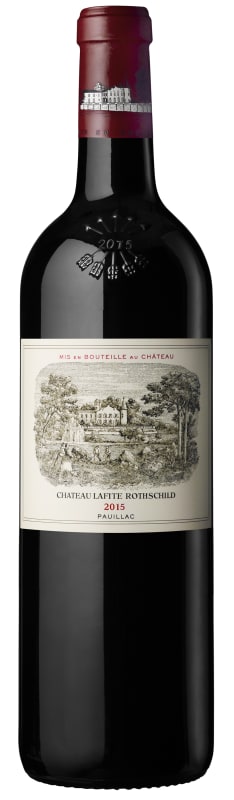


Winemaker Notes
The intensity on the palate rises steadily... gently coming to rest on a plateau that is already very high. Not at all aggressive, it continues with great length, and in perfect harmony. This is a Lafite that is currently revealing very little of its potential; to experience it in its full glory will require waiting... for some years.
Blend: 91% Cabernet Sauvignon, 9% Merlot
Professional Ratings
-
Wine Enthusiast
This is a great vintage from Lafite. The profile is rich in feel, with a seriously firm tannic structure. Solid, complex and with great authority, this Cabernet Sauvignon-dominant wine, is impressively dense in dark-fruit tones. It will age for many years. Drink from 2027, although that would almost be too soon.
Cellar Selection -
James Suckling
Firm and powerful with blackberries, blueberries, currants and wet earth. Full-bodied, yet tight and angular with very pretty fruit and brightness. Really racy and super and set for a long, long life. Better after 2025.
-
Decanter
Although Lafite is often the most elegant of the first growths, it sometimes takes the longest to come round. There is a touch of spice and volatility here. Wonderfully rich yet super-fine in its structure. Effortless integration of tannin, but this wine will take time to be at its best. Great length, with a lingering perfume on the finish. Exceptional.
-
Jeb Dunnuck
The grand vin 2015 Lafite-Rothschild checks in as 91% Cabernet Sauvignon and the rest Merlot that was brought all in 100% new oak. Director Eric Kohler (who replaced Charles Chevallier in 2015) told me the vintage suffered a touch of dilution but wasn’t a complicated year. The 2015 is an aristocratic, classy example from this estate that offers textbook lead pencil shavings, tobacco, smoked herbs, and graphite as well as a beautiful core of currant and cassis fruit. It’s the most refined and subtle of the first growths, has medium to full-bodied richness, building tannin, and undeniable class and charm. Give bottles 4-5 years of bottle age and enjoy over the following 2-3 decades.
-
Robert Parker's Wine Advocate
The deep garnet-purple shaded 2015 Lafite Rothschild is blended of 91% Cabernet Sauvignon and 9% Merlot and was matured for 20 months in new oak barrels from Tonnellerie des Domaines (their own cooperage). It is still sporting a lot of cedar at this nascent stage with a vibrant core of black raspberries, red currants and crushed plums plus touches of cigar boxes, violets and underbrush with a waft of tilled loam. Medium-bodied and elegantly styled with wonderful freshness and depth, it is compellingly earthy/minerally in the mouth with a frame of seductively silky yet very firm tannins and culminating in a very long, racy and pure finish. Boasting spectacular finesse and packed with nuances, clearly, given some of the challenges here in 2015, this is a masterpiece of diligence in the vineyards, careful selection and very clever crafting—bravo!
Rating: 96+ -
Wine Spectator
Velvet- and silk-textured red currant, raspberry and black cherry compote notes glide through, supported by a perfectly embedded graphite spine, while enticing violet, black tea and alder accents add range through the finish. Very refined and sneakily long. Best from 2025 through 2045.


One of the world’s most classic and popular styles of red wine, Bordeaux-inspired blends have spread from their homeland in France to nearly every corner of the New World. Typically based on either Cabernet Sauvignon or Merlot and supported by Cabernet Franc, Malbec and Petit Verdot, the best of these are densely hued, fragrant, full of fruit and boast a structure that begs for cellar time. Somm Secret—Blends from Bordeaux are generally earthier compared to those from the New World, which tend to be fruit-dominant.

The leader on the Left Bank in number of first growth classified producers within its boundaries, Pauillac has more than any of the other appellations, at three of the five. Chateau Lafite Rothschild and Mouton Rothschild border St. Estephe on its northern end and Chateau Latour is at Pauillac’s southern end, bordering St. Julien.
While the first growths are certainly some of the better producers of the Left Bank, today they often compete with some of the “lower ranked” producers (second, third, fourth, fifth growth) in quality and value. The Left Bank of Bordeaux subscribes to an arguably outdated method of classification that goes back to 1855. The finest chateaux in that year were judged on the basis of reputation and trading price; changes in rank since then have been miniscule at best. Today producers such as Chateau Pontet-Canet, Chateau Grand Puy-Lacoste, Chateau Lynch-Bages, among others (all fifth growth) offer some of the most outstanding wines in all of Bordeaux.
Defining characteristics of fine wines from Pauillac (i.e. Cabernet-based Bordeaux Blends) include inky and juicy blackcurrant, cedar or cigar box and plush or chalky tannins.
Layers of gravel in the Pauillac region are key to its wines’ character and quality. The layers offer excellent drainage in the relatively flat topography of the region allowing water to run off into “jalles” or streams, which subsequently flow off into the Gironde.