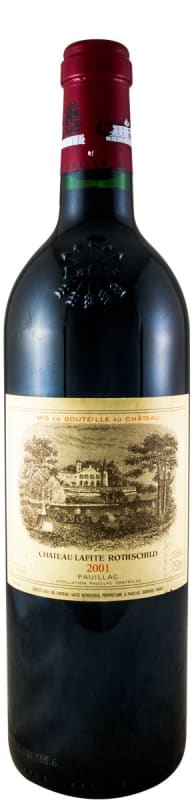


Winemaker Notes
Lafite has a soul, a beautiful, generous, kindly soul. Lafite turns bare earth into heaven. Lafite is harmony, a harmony between man and nature, because without our magnificent winegrowers, nothing would be accomplished.
Professional Ratings
-
Robert Parker's Wine Advocate
Tasted at "The Sampler's" icon tasting in London. The 2001 Lafite Rothschild has a quintessential bouquet for Lafite: very pure, almost understated at first. It then begins to open with briary, blackberry leaf, cedar and freshly rolled tobacco with subtle floral notes emerging after three of four minutes in the glass. The palate is medium-bodied with fine tannins and it certainly shows more vitality than the 1985 served alongside. Slightly grainy tannins, more feminine than previous bottles with dark plum, blackberry, citrus fruit, a touch of dried apricot and a very precise finish. Superb. Tasted December 2011.
-
Wine Spectator
Stick your nose in this and it says something—"I am special." Deep and generous aromas of blackberries, fresh tobacco and minerals. It's full-bodied, with big velvety tannins and a superlong finish. Like a fine cashmere sweater. Best after 2010. 22,000 cases made.


One of the world’s most classic and popular styles of red wine, Bordeaux-inspired blends have spread from their homeland in France to nearly every corner of the New World. Typically based on either Cabernet Sauvignon or Merlot and supported by Cabernet Franc, Malbec and Petit Verdot, the best of these are densely hued, fragrant, full of fruit and boast a structure that begs for cellar time. Somm Secret—Blends from Bordeaux are generally earthier compared to those from the New World, which tend to be fruit-dominant.

The leader on the Left Bank in number of first growth classified producers within its boundaries, Pauillac has more than any of the other appellations, at three of the five. Chateau Lafite Rothschild and Mouton Rothschild border St. Estephe on its northern end and Chateau Latour is at Pauillac’s southern end, bordering St. Julien.
While the first growths are certainly some of the better producers of the Left Bank, today they often compete with some of the “lower ranked” producers (second, third, fourth, fifth growth) in quality and value. The Left Bank of Bordeaux subscribes to an arguably outdated method of classification that goes back to 1855. The finest chateaux in that year were judged on the basis of reputation and trading price; changes in rank since then have been miniscule at best. Today producers such as Chateau Pontet-Canet, Chateau Grand Puy-Lacoste, Chateau Lynch-Bages, among others (all fifth growth) offer some of the most outstanding wines in all of Bordeaux.
Defining characteristics of fine wines from Pauillac (i.e. Cabernet-based Bordeaux Blends) include inky and juicy blackcurrant, cedar or cigar box and plush or chalky tannins.
Layers of gravel in the Pauillac region are key to its wines’ character and quality. The layers offer excellent drainage in the relatively flat topography of the region allowing water to run off into “jalles” or streams, which subsequently flow off into the Gironde.