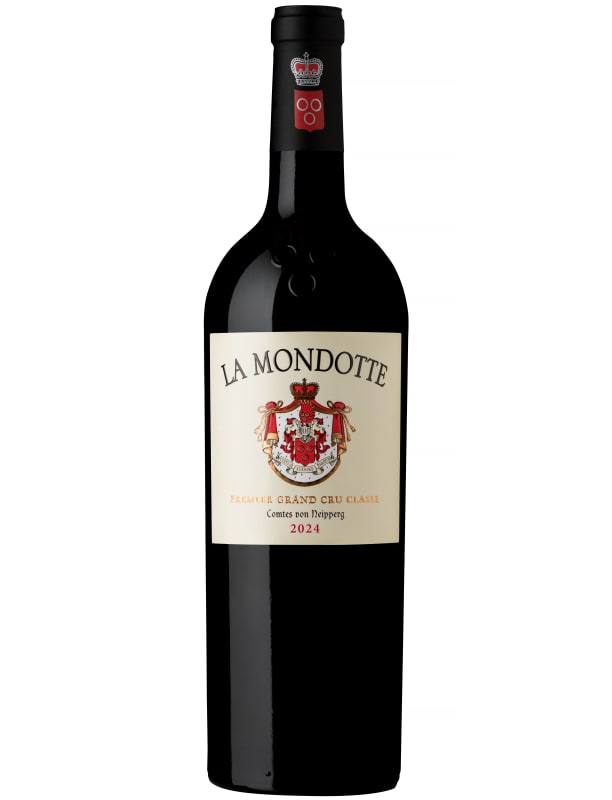


Winemaker Notes
This wine does not include the blanket 10% tariff imposed in April 2025. When the wines are shippable in fall of 2027, customers will have the option to pay any tariff in place at the time or to keep their wines stored in a temperature-controlled facility free of charge in France.
Professional Ratings
-
James Suckling
This has a crunchy, al dente character, showing sliced cherries, oranges and hints of iodine. Medium-bodied with a lovely drive and length. Compacted and serious. Nicely knit-together already. From organically grown grapes.
Barrel Sample: 95-96 -
Jeb Dunnuck
Deep ruby/purple hued, the 2024 La Mondotte offers up impressive aromatics of cassis and black raspberries intermixed with scorched earth, graphite, and sappy, floral nuances. It's medium-bodied, has a pure, layered, elegant mouthfeel, ripe tannins, juicy acidity, and outstanding length.
Barrel Sample: 92-94 -
Decanter
Beautifully lifted raspberry and strawberry fruit on the nose, expressive, open and alive. Clarity and purity. Linear and straight, this has tension at the fore driving the cool and fresh blue fruit and liquorice from start to finish. I love the fun, joyous aspect to the fruit - it’s clean, detailed and so finessed. Some citrus-edged acidity showing the super low 3.35pH. Ageing 30% new oak barrels.
Barrel Sample: 93 -
Robert Parker's Wine Advocate
With a gentle oaky, spicy profile, the 2024 La Mondotte reveals aromas of dark berries, pepper and licorice mingled with mulberry notes. Medium-bodied, chewy and structured, it's layered with elegant tannins and a lively mid-palate that segues into an oaky, firm finish.
Barrel Sample: 91-93


One of the world’s most classic and popular styles of red wine, Bordeaux-inspired blends have spread from their homeland in France to nearly every corner of the New World. Typically based on either Cabernet Sauvignon or Merlot and supported by Cabernet Franc, Malbec and Petit Verdot, the best of these are densely hued, fragrant, full of fruit and boast a structure that begs for cellar time. Somm Secret—Blends from Bordeaux are generally earthier compared to those from the New World, which tend to be fruit-dominant.

Marked by its historic fortified village—perhaps the prettiest in all of Bordeaux, the St-Émilion appellation, along with its neighboring village of Pomerol, are leaders in quality on the Right Bank of Bordeaux. These Merlot-dominant red wines (complemented by various amounts of Cabernet Franc and/or Cabernet Sauvignon) remain some of the most admired and collected wines of the world.
St-Émilion has the longest history in wine production in Bordeaux—longer than the Left Bank—dating back to an 8th century monk named Saint Émilion who became a hermit in one of the many limestone caves scattered throughout the area.
Today St-Émilion is made up of hundreds of independent farmers dedicated to the same thing: growing Merlot and Cabernet Franc (and tiny amounts of Cabernet Sauvignon). While always roughly the same blend, the wines of St-Émilion vary considerably depending on the soil upon which they are grown—and the soils do vary considerably throughout the region.
The chateaux with the highest classification (Premier Grand Cru Classés) are on gravel-rich soils or steep, clay-limestone hillsides. There are only four given the highest rank, called Premier Grand Cru Classés A (Chateau Cheval Blanc, Ausone, Angélus, Pavie) and 14 are Premier Grand Cru Classés B. Much of the rest of the vineyards in the appellation are on flatter land where the soils are a mix of gravel, sand and alluvial matter.
Great wines from St-Émilion will be deep in color, and might have characteristics of blackberry liqueur, black raspberry, licorice, chocolate, grilled meat, earth or truffles. They will be bold, layered and lush.