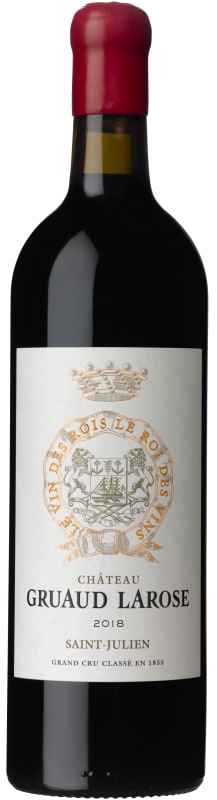


Winemaker Notes
Blend: 67% Cabernet Sauvignon, 24% Merlot, 9% Cabernet Franc
Professional Ratings
-
Jeb Dunnuck
Based on 67% Cabernet Sauvignon, 24% Merlot, and the rest Cabernet Franc, the 2018 Château Gruaud Larose sports a dense purple hue as well as a stunning nose of pure crème de cassis, cedar pencil shavings, blackcurrants, smoked tobacco, and a liquid rock-like sense of minerality. This dense, almost broodingly backward, concentrated Saint-Julien has flawless balance, a remarkable sense of purity, masses of tannins, and one hell of a great finish. Seemingly almost from a more austere year (say 2000 or 2010), it's not going to hit maturity for at least a decade and should cruise in cold cellars for 20-30 years. It's a brilliant wine!
-
James Suckling
Aromas of currants, blackberries, dried flowers, dark chocolate and tobacco leaves. Citrus zest, too. It’s full-bodied with firm, ultra fine tannins. Complex and layered with a juicy core of ripe fruit. Silky and delicious. Very creamy and fine-tannined. Better from 2025.
-
Wine Enthusiast
A densely textured and rich wine, this has power and concentration. Smoky tannins show strongly as well as juicy black-currant fruits that are still young. The wine, with its structure, is just starting on a journey to aging. Drink from 2027.
-
Decanter
Here the tannins are pretty hefty, matched by deep brambly black cherry notes. Good-quality with slate, cigar, chocolate, earth and black pepper spice through the mid-palate. Not as elegant at this stage as some St-Julien in the vintage but this has a long life ahead and is full of promise. Drinking Window 2026 - 2040
-
Robert Parker's Wine Advocate
Composed of 67% Cabernet Sauvignon, 24% Merlot and 9% Cabernet Franc, the 2018 Gruaud Larose has a medium to deep garnet-purple color. It comes barreling out of the glass with powerful scents of blackberry preserves, baked plums and crème de cassis plus hints of fruitcake, Indian spices and tobacco leaf. The medium to full-bodied palate offers bags of baked berries flavors and a chewy texture with just enough freshness, finishing spicy. Judging by the slightly rustic tannin's and suggestions of dried berry characters, I'm guessing the heat and drought had an impact this year. This said, the wine is very well crafted and delicious right now, although a good 3-4 years in bottle should soften the tannin's and bring out further nuances.


One of the world’s most classic and popular styles of red wine, Bordeaux-inspired blends have spread from their homeland in France to nearly every corner of the New World. Typically based on either Cabernet Sauvignon or Merlot and supported by Cabernet Franc, Malbec and Petit Verdot, the best of these are densely hued, fragrant, full of fruit and boast a structure that begs for cellar time. Somm Secret—Blends from Bordeaux are generally earthier compared to those from the New World, which tend to be fruit-dominant.

An icon of balance and tradition, St. Julien boasts the highest proportion of classed growths in the Médoc. What it lacks in any first growths, it makes up in the rest: five amazing second growth chateaux, two superb third growths and four well-reputed fourth growths. While the actual class rankings set in 1855 (first, second, and so on the fifth) today do not necessarily indicate a score of quality, the classification system is important to understand in the context of Bordeaux history. Today rivalry among the classed chateaux only serves to elevate the appellation overall.
One of its best historically, the estate of Leoville, was the largest in the Médoc in the 18th century, before it was divided into the three second growths known today as Chateau Léoville-Las-Cases, Léoville-Poyferré and Léoville-Barton. Located in the north section, these are stone’s throw from Chateau Latour in Pauillac and share much in common with that well-esteemed estate.
The relatively homogeneous gravelly and rocky top soil on top of clay-limestone subsoil is broken only by a narrow strip of bank on either side of the “jalle,” or stream, that bisects the zone and flows into the Gironde.
St. Julien wines are for those wanting subtlety, balance and consistency in their Bordeaux. Rewarding and persistent, the best among these Bordeaux Blends are full of blueberry, blackberry, cassis, plum, tobacco and licorice. They are intense and complex and finish with fine, velvety tannins.