
Winemaker Notes
Classic complement to grilled red meats, roast or braised beef, and lamb prepared in any style. With age, it is a fine partner for ripe cheeses.
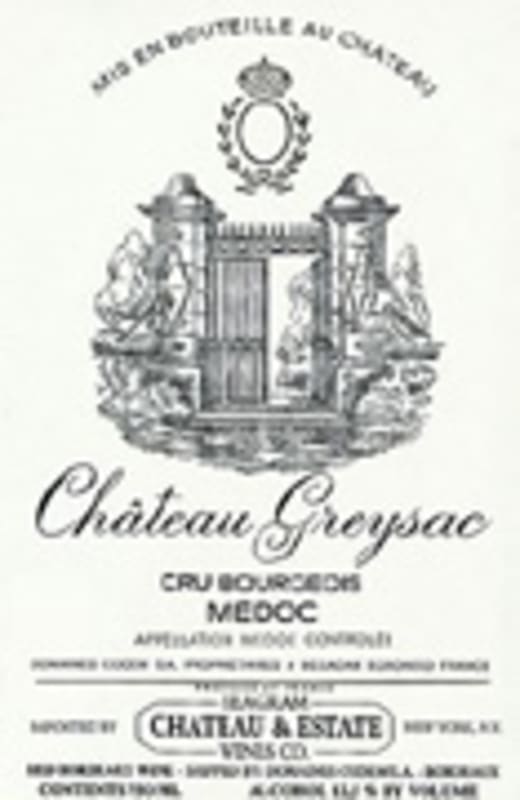
Located outside the village of Bégadan in the northern Médoc, 2 miles west of the Gironde. 160 acres of typical Medoc soil of light gravel lie. For centuries, vines were given the soil with the best drainage, and so it was at Greysac, where Cabernet was planted in the late 1700's and the lovely small château was built. For many years the property of the late Baron François de Gunzburg and Gianni Agnelli, Greysac is still owned by members of the Agnelli family.


Château Greysac is a beautiful mansion built during the 18th century that inspires French elegance and finesse. Some of its most famous owners have included Georges Héreil, the engineer who created the Caravelle plane, and the Italian Agnelli family, owners of Ferrari and Fiat, before Jean Guyon fell in love with it in 2012 and decided to bring it to its prime.
Located on the edge of the Gironde, its soil is composed of rolled pebble quaternary soil and a clay-limestone subsoil. Understanding and observation of the terroir is the key to success at this Château.
Located on the edge of the Gironde, its soil is composed of rolled pebble quaternary soil and a clay-limestone subsoil. Understanding and observation of the terroir is the key to success at this Château. Today, the chateau’s characteristic style is one of great aromatic finesse, combined with precise, sumptuous fruit flavors that develop in elegance and complexity over time.

One of the world’s most classic and popular styles of red wine, Bordeaux-inspired blends have spread from their homeland in France to nearly every corner of the New World. Typically based on either Cabernet Sauvignon or Merlot and supported by Cabernet Franc, Malbec and Petit Verdot, the best of these are densely hued, fragrant, full of fruit and boast a structure that begs for cellar time. Somm Secret—Blends from Bordeaux are generally earthier compared to those from the New World, which tend to be fruit-dominant.

One of the most—if not the most—famous red wine regions of the world, the Medoc reaches from the city of Bordeaux northwest along the left bank of the Gironde River almost all the way to the Atlantic. Its vineyards climb along a band of flatlands, sandwiched between the coastal river marshes and the pine forests in the west. The entire region can only claim to be three to eight miles wide (at its widest), but it is about 50 miles long.
While the Medoc encompasses the Haut Medoc, and thus most of the classed-growth villages (Margaux, Moulis, Listrac, St-Julien, Pauillac and St. Estephe) it is really only those wines produced in the Bas-Medoc that use the Medoc appellation name. The ones farther down the river, and on marginally higher ground, are eligible to claim the Haut Medoc appellation, or their village or cru status.
While the region can’t boast a particularly dramatic landscape, impressive chateaux disperse themselves among the magically well-drained gravel soils that define the area. This optimal soil draining capacity is completely necessary and ideal in the Medoc's damp, maritime climate. These gravels also serve well to store heat in cooler years.