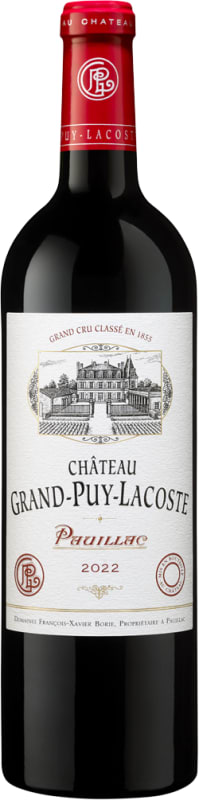


Winemaker Notes
Blend: 79% Cabernet Sauvignon, 21% Merlot
Professional Ratings
-
Vinous
The 2022 Grand Puy Lacoste was picked from 7 to 23 September and contains more Merlot due to the high quality of the fruit, matured in 75% new oak. There is 14.2% alcohol. Therefore, this lends this GPL a little more precocity and sensuality compared to other vintages, not cut from the same "classical" cloth as, say, the 2019 or 2020. Underlying this velvety veneer are enticing traits of freshly-rolled tobacco and undergrowth. The palate is medium-bodied with finely-sculpted tannins. Silky smooth in texture, so much so that it belies that backbone underneath. There is a peacock's tail of mineral-rich, quite peppery black fruit on the finish, completing a Pauillac endowed with huge potential.–Neal Martin
Barrel Sample: 96-98 -
James Suckling
Licorice with tapenade, cassis, roasted spices and a touch of bergamot and pencil shavings. Full-bodied and structured, this has filigreed tannins in a very dusty, almost powdery form. Really youthful and long. Juicy and compact with spot-on balance. 79% cabernet sauvignon, 21% merlot.
-
Decanter
Gorgeous vibrant purple colour in the glass, deep and darkly scented, black bramble fruits, flowers, cinnamon, dark chocolate and liquorice. Firm and forward, this is generous but sleek, so you get power and concentration but also juicy liveliness, great tension and energy. I really do like the ease of this, it's not trying too hard but delivered with poise, punch and purity. An excellent wine that really over delivers - so well presented, detailed, finessed and refined but still with the strength coming at the end in the wave of liquorice, dark chocolate and wet stone terroir markers. A brilliant wine with potential to deliver such excellent drinking pleasure. I love it. 3.57pH. A yield of 38hl/ha. 60% grand vin, 40% second wine. Eric Boissenot consultant. Harvest 7-23 September. Yield of 38hl/ha. Ageing in French oak, 75% new.
Barrel Sample: 96 -
Wine Spectator
This version shows the floral side of the vintage, with a vibrant mix of iris, violet and rose petal notes leading the way, backed by a core of pure and racy red and black currant preserves. There's a well-integrated singed cedar note running along its flanks and a long beam of iron driving the finish. Textbook. Cabernet Sauvignon and Merlot.
-
Robert Parker's Wine Advocate
The 2022 Grand-Puy-Lacoste has turned out nicely in bottle, unwinding in the glass with aromas of cassis and plums mingled with notions of rose petal, tobacco leaf and pencil shavings. Medium to full-bodied, bright and velvety, with a layered core of fruit and powdery structuring tannins, it's beautifully balanced.


One of the world’s most classic and popular styles of red wine, Bordeaux-inspired blends have spread from their homeland in France to nearly every corner of the New World. Typically based on either Cabernet Sauvignon or Merlot and supported by Cabernet Franc, Malbec and Petit Verdot, the best of these are densely hued, fragrant, full of fruit and boast a structure that begs for cellar time. Somm Secret—Blends from Bordeaux are generally earthier compared to those from the New World, which tend to be fruit-dominant.

The leader on the Left Bank in number of first growth classified producers within its boundaries, Pauillac has more than any of the other appellations, at three of the five. Chateau Lafite Rothschild and Mouton Rothschild border St. Estephe on its northern end and Chateau Latour is at Pauillac’s southern end, bordering St. Julien.
While the first growths are certainly some of the better producers of the Left Bank, today they often compete with some of the “lower ranked” producers (second, third, fourth, fifth growth) in quality and value. The Left Bank of Bordeaux subscribes to an arguably outdated method of classification that goes back to 1855. The finest chateaux in that year were judged on the basis of reputation and trading price; changes in rank since then have been miniscule at best. Today producers such as Chateau Pontet-Canet, Chateau Grand Puy-Lacoste, Chateau Lynch-Bages, among others (all fifth growth) offer some of the most outstanding wines in all of Bordeaux.
Defining characteristics of fine wines from Pauillac (i.e. Cabernet-based Bordeaux Blends) include inky and juicy blackcurrant, cedar or cigar box and plush or chalky tannins.
Layers of gravel in the Pauillac region are key to its wines’ character and quality. The layers offer excellent drainage in the relatively flat topography of the region allowing water to run off into “jalles” or streams, which subsequently flow off into the Gironde.