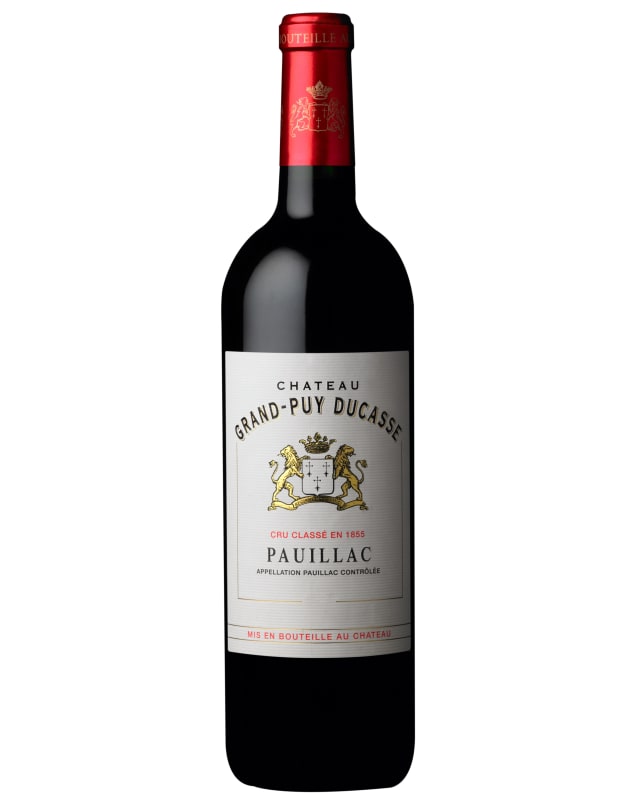


Winemaker Notes
Blend: 53% Cabernet Sauvignon, 47% Merlot
Professional Ratings
-
Wine Enthusiast
From one of the lesser-known Pauillac crus classés, this wine shows plenty of fine structure as well as ripe black currant fruits from the Cabernet Sauvignon in the blend. It is also the succulent fruitiness that shines, lending to a good future.
Barrel Sample: 94-96 -
James Suckling
Blackcurrants and walnuts with sweet berry and cherry undertones. Full-bodied with chewy tannins and a long, flavorful finish. Linear and intense tannins run the length of the wine with intensity and persistence.
-
Vinous
The 2019 Grand Puy Ducasse is a stunning wine. In 2019, the Grand Vin is statuesque and towering in its beauty, with tons of fruit intensity but none of the harder edges that have characterized some previous vintages. The 2019 has found a way to capture an intense, flamboyant expression of fruit without being too much, as some vintages have been. The result is an absolutely stunning Grand Puy Ducasse that is also the best in recent memory. Raspberry jam, blood orange, mint, pomegranate and spice all build into the beautifully layered finish. Tasted two times.
Barrel Sample:93-95 -
Jeb Dunnuck
A beautiful effort that does everything right, the 2019 Château Grand-Puy Ducasse offers a rich, medium to full-bodied, concentrated style that shows the inherent elegance, as well as richness, of the vintage. Darker currants, toasted spice, cedar pencil, and tobacco notes all define the bouquet, and it's quintessentially Pauillac with its aromatics as well as structure. It already offers pleasure, particularly with a decant (I followed this bottle for multiple days), but it will certainly benefit from 5-7 years in the cellar and is going to shine for at least two decades.
-
Wine Spectator
Well-packed, showing black currant and blackberry fruit flavors, which are marked by bramble and savory accents and carried by fresh acidity through a finish that's scored by humus, tobacco and iron. A textbook, austere, driven and age-worthy Pauillac. Cabernet Sauvignon and Merlot. Best from 2024.
-
Decanter
Lovely deep purple color gives this an attractive Pauillac strength both visually and on the firm cassis-led attack. This is attractive, with well-worked but plentiful tannins and touches of austerity in the way you hope for in a young Pauillac. This is well balanced with firm cassis fruits and has a chewiness to the tannins that becomes more apparent on the finish. Spice and fresh mint leaf add interest and typicity. Tasted twice three weeks apart.
Barrel Sample:92 -
Robert Parker's Wine Advocate
The 2019 Grand-Puy-Ducasse exhibits aromas of raspberries, currants and fruit liqueur mingled with subtle hints of loamy soil and pencil shavings. Medium to full-bodied, fleshy and demonstrative, with an ample core of fruit, ripe tannins and lively acids and a finish subtly marked by alcoholic warmth, this is more elegant than its muscular, powerful 2018 predecessor; but it's held back by that touch of alcoholic heat. The new ambition that's animating this historically lackluster estate, however, is more than evident, and there are surely great things to come from this address. Best after 2025.


One of the world’s most classic and popular styles of red wine, Bordeaux-inspired blends have spread from their homeland in France to nearly every corner of the New World. Typically based on either Cabernet Sauvignon or Merlot and supported by Cabernet Franc, Malbec and Petit Verdot, the best of these are densely hued, fragrant, full of fruit and boast a structure that begs for cellar time. Somm Secret—Blends from Bordeaux are generally earthier compared to those from the New World, which tend to be fruit-dominant.

The leader on the Left Bank in number of first growth classified producers within its boundaries, Pauillac has more than any of the other appellations, at three of the five. Chateau Lafite Rothschild and Mouton Rothschild border St. Estephe on its northern end and Chateau Latour is at Pauillac’s southern end, bordering St. Julien.
While the first growths are certainly some of the better producers of the Left Bank, today they often compete with some of the “lower ranked” producers (second, third, fourth, fifth growth) in quality and value. The Left Bank of Bordeaux subscribes to an arguably outdated method of classification that goes back to 1855. The finest chateaux in that year were judged on the basis of reputation and trading price; changes in rank since then have been miniscule at best. Today producers such as Chateau Pontet-Canet, Chateau Grand Puy-Lacoste, Chateau Lynch-Bages, among others (all fifth growth) offer some of the most outstanding wines in all of Bordeaux.
Defining characteristics of fine wines from Pauillac (i.e. Cabernet-based Bordeaux Blends) include inky and juicy blackcurrant, cedar or cigar box and plush or chalky tannins.
Layers of gravel in the Pauillac region are key to its wines’ character and quality. The layers offer excellent drainage in the relatively flat topography of the region allowing water to run off into “jalles” or streams, which subsequently flow off into the Gironde.