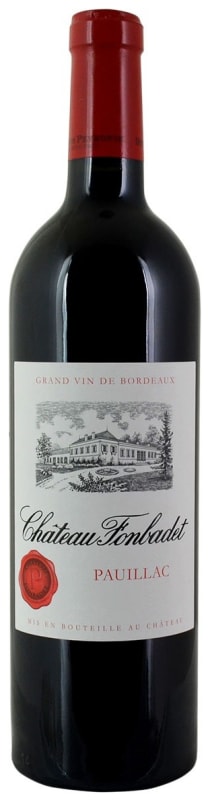


Winemaker Notes
Professional Ratings
-
Wine Enthusiast
This 50-acre, family-owned property is surrounded by some of the most famous names in Pauillac. The wine shares some of the same fine Cabernet Sauvignon flavors, ripe with intense black-currant fruitiness that partners with dusty tannins and acidity. It’s a wine for aging. Do not expect to drink before 2025.
-
Jeb Dunnuck
Château Fonbadet has turned out an incredibly successful 2016, a blend of 70% Cabernet Sauvignon and 30% Merlot raised in 50% new oak. It has outstanding notes of tobacco leaf, graphite, and some earthy black and blue fruit as well as medium to full-bodied richness and depth on the palate. While I never feel this cuvée hits the highs of its neighbors, the estate certainly seems to have all the right materials, with high density vineyards consisting of 60-year-old vines planted in the classic gravelly soils of the appellation. Yields are miniscule, everything is hand harvested (in 2016 harvest occurred between the 3rd and 25th of October), vinification occurs all in concrete, the wine sees malolactic in barrel, and they use judicious yet high-class oak. I suspect this is an estate to keep on your radar.
-
James Suckling
This is very Pauillac with blackcurrant, lead-pencil and blueberry aromas and flavors. Full body, round and chewy tannins and a flavorful finish. A blend of 60 per cent cabernet sauvignon, 15 per cent cabernet franc, 20 per cent merlot and five per cent petit verdot and malbec. Needs two or three years to soften. Try from 2023.
-
Decanter
A great wine, with well judged extraction that is tight without being rustic. It takes you right up to the edge and could perhaps have let in a little more juice on the finish, but I love the complexity on the nose, the cassis and menthol on the finish and the brushing of Petit Verdot spice. This is a recent change to a Michel Rolland consultation, overseen by Julien Viaud for the past two years. 33% new oak following vinification in cement, from a blend of 70% Cabernet Sauvignon, 25% Merlot and 5% Petit Verdot. Drinking Window 2025 - 2038
-
Robert Parker's Wine Advocate
Aged in 50% new French oak barrels and blended of 70% Cabernet Sauvignon and 30% Merlot, the medium to deep garnet-purple colored 2016 Fonbadet offers up expressive notions of warm plums, blackberries and kirsch plus unsmoked cigars and spice cake scents with a waft of dusty soil. Medium-bodied and laden with juicy black fruits plus loads of spicy accents, it has a finely grained, approachable texture and great length.


One of the world’s most classic and popular styles of red wine, Bordeaux-inspired blends have spread from their homeland in France to nearly every corner of the New World. Typically based on either Cabernet Sauvignon or Merlot and supported by Cabernet Franc, Malbec and Petit Verdot, the best of these are densely hued, fragrant, full of fruit and boast a structure that begs for cellar time. Somm Secret—Blends from Bordeaux are generally earthier compared to those from the New World, which tend to be fruit-dominant.

The leader on the Left Bank in number of first growth classified producers within its boundaries, Pauillac has more than any of the other appellations, at three of the five. Chateau Lafite Rothschild and Mouton Rothschild border St. Estephe on its northern end and Chateau Latour is at Pauillac’s southern end, bordering St. Julien.
While the first growths are certainly some of the better producers of the Left Bank, today they often compete with some of the “lower ranked” producers (second, third, fourth, fifth growth) in quality and value. The Left Bank of Bordeaux subscribes to an arguably outdated method of classification that goes back to 1855. The finest chateaux in that year were judged on the basis of reputation and trading price; changes in rank since then have been miniscule at best. Today producers such as Chateau Pontet-Canet, Chateau Grand Puy-Lacoste, Chateau Lynch-Bages, among others (all fifth growth) offer some of the most outstanding wines in all of Bordeaux.
Defining characteristics of fine wines from Pauillac (i.e. Cabernet-based Bordeaux Blends) include inky and juicy blackcurrant, cedar or cigar box and plush or chalky tannins.
Layers of gravel in the Pauillac region are key to its wines’ character and quality. The layers offer excellent drainage in the relatively flat topography of the region allowing water to run off into “jalles” or streams, which subsequently flow off into the Gironde.