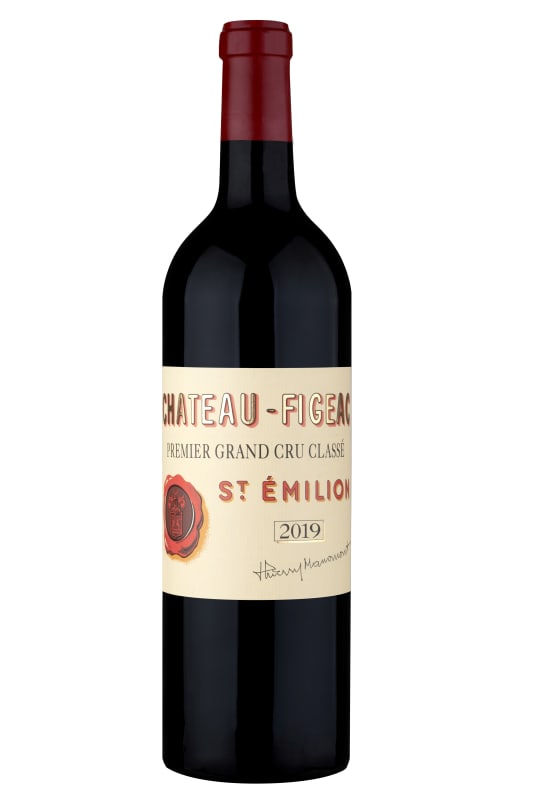


Winemaker Notes
The color of the 2019 with its deep, brilliant, amaranthine red hue and bright purple glints testifies to the beautiful ripeness of this vintage. The nose is intensely aromatic, pure and reveals great finesse. Our Cabernets find their full expression through notes of flowers and fruit, such as blueberries and Mara Des Bois strawberries. Delicious and dense on the entry to the palate, the wine develops harmoniously on the mid-palate with the gentle, enveloping texture of the Merlot. Showing exceptional length of favor, the wine maintains a balance that follows right through to the finish, in which the fine, mineral texture of the Cabernets is elevated by the freshness of the fruit flavor. 2019 will go down in the history of Château-Figeac as one of its benchmark vintages.
Blend: 36% Cabernet Franc, 34% Cabernet Sauvignon, 30% Merlot
Professional Ratings
-
Jeb Dunnuck
The 2019 Château Figeac checks in as 36% Cabernet Franc, 34% Cabernet Sauvignon, and 30% Merlot, and it's another brilliant wine from Frédéric Faye. This deep purple-hued effort offers a beautiful Pauillac-like bouquet of ripe black cherries, cassis, damp earth, leafy herbs, chocolate, and smoked tobacco. It has classic Figeac herbal, earthy goodness (no doubt due to its high percentage of Cabernet) and is medium to full-bodied on the palate, has perfect tannins and flawless balance, all making for a brilliant Saint-Emilion that brings richness and power paired with finesse and elegance. Give bottles 4-5 years, count yourself lucky, and enjoy over the following 30+. Best after 2026.
-
James Suckling
This is a really beautiful red with crushed-berry, plum, bark, mushroom and earth character. It’s full and creamy-textured with lots of tannins, but they are integrated and polished and flow across the palate. So much depth and intensity, yet there’s underlying grace and class.
-
Wine Enthusiast
This is another magnificent vintage from this estate. It has density, elevated tannins and the purest black currant fruits. The Cabernet Sauvignon that always gives structure to the wine from this estate is there in abundance. The tannins are rich and dry, a combination that will ensure long-term aging.
Barrel Sample: 96-98 -
Decanter
A higher amount of Cabernet Franc than usual in the blend, really get the Cabernet impact on the nose and on the attack, could easily say Left Bank with the liquorice root, menthol and leafy character. A rich creaminess comes in through the mid palate, with sappy raspberry fruits alongside salinity and minerality. The exuberance of a warm summer is there but it is well hidden under the precision of the tannic structure overall. An extremely impressive and signature Figeac. Juicy on the finish and oh so careful in its tannic delivery.
Barrel Sample: 97 -
Robert Parker's Wine Advocate
The 2019 Figeac has turned out brilliantly. Wafting from the glass with aromas of blackberries, cassis, warm spices, violets and pencil shavings, framed by a deft touch of nicely integrated new oak, it's full-bodied, deep and concentrated, with terrific depth at the core, powdery structuring tannins and lively acids, concluding with a long, precise finish. Rich but vibrant, this 2019 reflects the new precision that Frédéric Faye has brought to Figeac; but while it's richer and more polished than the wines of yesteryear, the estate's identity hasn't been lost. Best after 2029.
-
Wine Spectator
Large-scaled, capturing all the rich and flamboyant cassis, steeped plum and blackberry reduction notes that are hallmarks of the vintage, along with a broad swath of loam and warm gravel underneath as tobacco and alder accents fill in wherever possible. Muscular and toothy along the edges but rock-solid in build, with enough fruit to round into form eventually. Cabernet Franc, Cabernet Sauvignon and Merlot. Best from 2024.


One of the world’s most classic and popular styles of red wine, Bordeaux-inspired blends have spread from their homeland in France to nearly every corner of the New World. Typically based on either Cabernet Sauvignon or Merlot and supported by Cabernet Franc, Malbec and Petit Verdot, the best of these are densely hued, fragrant, full of fruit and boast a structure that begs for cellar time. Somm Secret—Blends from Bordeaux are generally earthier compared to those from the New World, which tend to be fruit-dominant.

Marked by its historic fortified village—perhaps the prettiest in all of Bordeaux, the St-Émilion appellation, along with its neighboring village of Pomerol, are leaders in quality on the Right Bank of Bordeaux. These Merlot-dominant red wines (complemented by various amounts of Cabernet Franc and/or Cabernet Sauvignon) remain some of the most admired and collected wines of the world.
St-Émilion has the longest history in wine production in Bordeaux—longer than the Left Bank—dating back to an 8th century monk named Saint Émilion who became a hermit in one of the many limestone caves scattered throughout the area.
Today St-Émilion is made up of hundreds of independent farmers dedicated to the same thing: growing Merlot and Cabernet Franc (and tiny amounts of Cabernet Sauvignon). While always roughly the same blend, the wines of St-Émilion vary considerably depending on the soil upon which they are grown—and the soils do vary considerably throughout the region.
The chateaux with the highest classification (Premier Grand Cru Classés) are on gravel-rich soils or steep, clay-limestone hillsides. There are only four given the highest rank, called Premier Grand Cru Classés A (Chateau Cheval Blanc, Ausone, Angélus, Pavie) and 14 are Premier Grand Cru Classés B. Much of the rest of the vineyards in the appellation are on flatter land where the soils are a mix of gravel, sand and alluvial matter.
Great wines from St-Émilion will be deep in color, and might have characteristics of blackberry liqueur, black raspberry, licorice, chocolate, grilled meat, earth or truffles. They will be bold, layered and lush.